15-minute window · 3 observations · Measured Sep 30, 2026, 10:55 AM UTC · Provider: go_recent_snapshot_v2
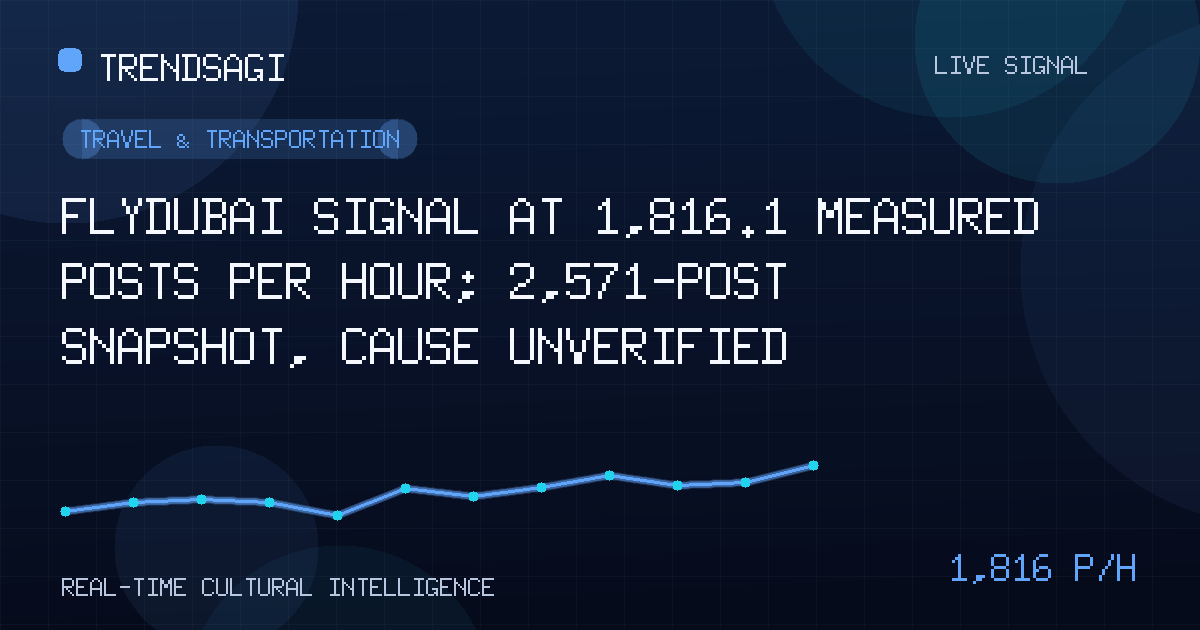
Flydubai signal at 1,816.1 measured posts per hour; 2,571-post snapshot, cause unverified
Flydubai's latest snapshot has 2,571 posts and a measured 1,816.1 posts/hour; the briefing separates observed activity from an unverified cause.
Automated briefing. Generated from stored signal measurements and source-backed research; it is not manually reviewed. Read the methodology and limitations.
Metrics in this briefing are a snapshot associated with its publication date and may not reflect current conditions.
What changed
The stored signal shows a concentrated increase in Flydubai-related posting, but it does not establish a public trigger. The latest snapshot contains 2,571 posts. That warrants prompt investigation, not a factual claim about an operational event, announcement, or controversy.
The measured change was 1,816.1 posts per hour at the recorded observation time, across an exact 900-second window using 3 stored observations. This is a measured snapshot rate, not a live or current rate, forecast, reach figure, engagement total, or unique-person count. No verified public source has been tied to the increase, so the reason for the movement remains unclear.
| Observation time | 2026-09-30T10:55:59Z |
|---|---|
| Measured snapshot rate | 1,816.1 posts per hour |
| Latest snapshot volume | 2,571 posts |
Why this topic may be moving
The available category is Travel & Transportation, but the signal has no verified event summary. A short burst of posts can have several ordinary drivers, and each requires different evidence:
- Operational news: Delays, cancellations, aircraft availability, or service changes would need a timestamped operational notice or confirmed reporting.
- Commercial news: A promotion, partnership, route announcement, or fleet update would need a published announcement with a matching time.
- Regulatory or airport news: A policy, slot, terminal, or infrastructure event would need confirmation from the relevant public authority or operator.
- Customer reaction: A social post, video, or complaint may spread rapidly, but being repeated is not proof that the underlying claim is true.
- Label ambiguity: Mentions may combine the airline with unrelated uses of the same name, so the topic label alone does not confirm subject matter.
These are verification paths, not explanations asserted by the signal. A spike may also be amplified by many near-identical posts, a small number of highly active accounts, or a broad mix of independent reactions. Without post-level evidence, those patterns cannot be distinguished. Volume measures activity in the captured collection; it does not reveal motive, sentiment, or factual accuracy.
The defensible finding is narrow: Flydubai-related posting accelerated inside this stored measurement window. The evidence does not yet support a claim about operational disruption, a new route, a promotion, or any other specific event.
Why it matters
The signal matters first as a verification queue. A fast increase can help communications and media teams find the underlying claim quickly, while the absence of source-level evidence makes acting on the topic label alone risky.
- Airline, airport, and travel teams can use the spike to check whether a service disruption, schedule change, or announcement is prompting discussion.
- Publishers and analysts can compare the conversation with confirmed reporting instead of treating mention volume as evidence that an event occurred.
- Travelers should use verified operational information when making plans; a high post count is not confirmation of a booking, schedule, or service issue.
- Commercial teams should avoid inferring demand, reputation, or campaign performance from an unlabeled post total.
For all these readers, the useful question is not merely whether Flydubai is being discussed, but whether the discussion converges on one verifiable event.
What the signal can and cannot establish
The signal supports a narrow operational conclusion: the captured series registered a positive measured change during the stated window, and the latest snapshot held 2,571 posts.
It can:
- Prioritize investigation and provide a repeatable benchmark for later snapshots.
- Show that the increase was present in the captured collection, not that it occurred across all public conversation.
It cannot:
- Identify the cause, determine whether the mood is positive or negative, or establish reach.
- Count unique people, map the discussion by geography or language, or confirm which platform generated the posts.
- Distinguish independent discussion from copied or coordinated repetition, or show effects on bookings, demand, or operations.
It also cannot establish statistical significance because no baseline, distribution, or uncertainty measure is supplied.
What to watch next
The next checks should move from quantity to corroboration.
- Validate the trigger. Review public statements and reporting around the observation time. A credible match should explicitly concern Flydubai and fit the timing; a general aviation story does not explain the spike.
- Audit the posts. Inspect a representative slice from the beginning, middle, and end of the window. Separate original posts from copies, then code the event claimed, named source, account type, geography, and language. This shows whether the conversation is diverse or repetitive.
- Test concentration. Check whether a small set of accounts, a repeated phrase, or a single embedded media item accounts for much of the apparent activity. Repetition can inflate a post count without adding independent confirmation.
- Check persistence. Compare subsequent stored observations using the same 900-second window and collection method. A reversal may indicate a brief reaction; continued activity would justify a fuller event review. Neither result supplies a cause by itself.
- Seek corroboration appropriate to the hypothesis. A schedule claim needs published schedule evidence; a disruption claim needs operational confirmation; a promotion claim needs offer terms. Marketing chatter alone is not enough.
- Set reporting language conservatively. Use unverified while public evidence and post content remain unmatched. Escalate a specific explanation only when the source, timing, and conversation all align.
Methodology and limitations
The observation time marks when the stored signal was recorded, not necessarily when the underlying event began. The 1,816.1 posts-per-hour figure is the measured snapshot rate over an exact 900-second window based on 3 stored observations. The 2,571 figure is the latest snapshot volume, not a rate.
The record does not provide platform scope, collection boundaries, geographic or language coverage, baseline, post-level sample, duplication handling, sentiment, or account data. It therefore supports change detection within this series, not estimates of market impact or causation. Future comparisons should preserve the same definitions and explicitly separate observed activity from verified context.
Track This Topic for New Signals
Set alerts for future velocity or sentiment changes around this topic.
Explore Tracking PlansAbout TrendsAGI research
TrendsAGI's automated research pipeline publishes dated signal snapshots, methodology notes, and practical workflows for teams evaluating cultural momentum. Read how signals are scoped, scored, and limited in our research methodology.


