899-second window · 3 observations · Measured Oct 26, 2026, 2:59 AM UTC · Provider: go_recent_snapshot_v2
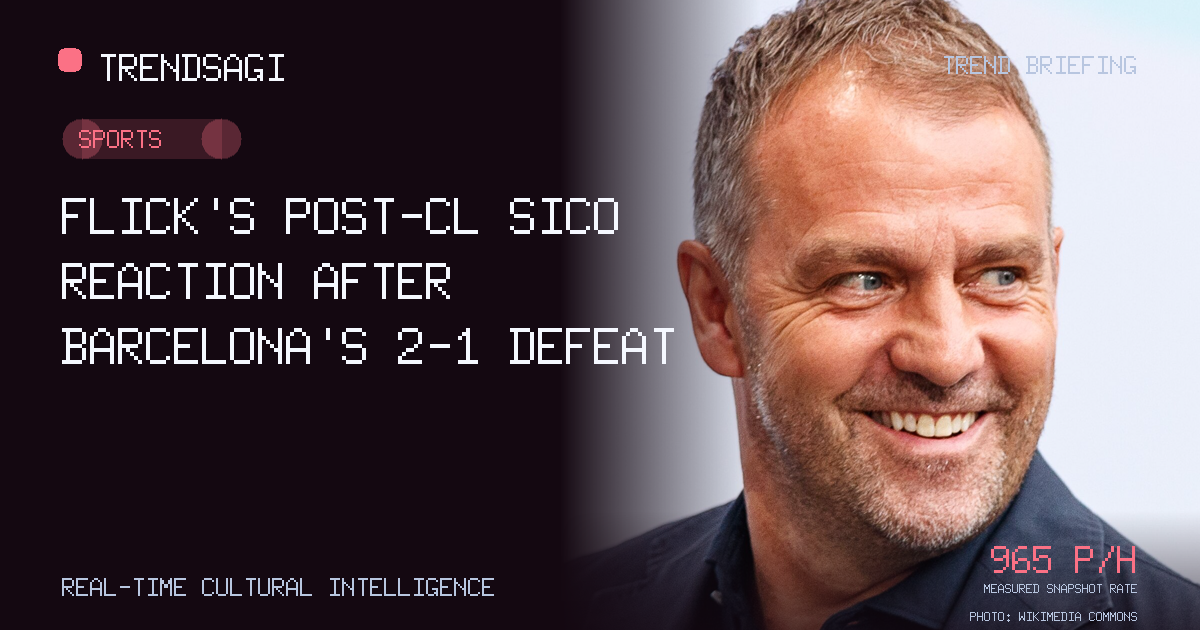
Flick's Post-Clásico Reaction After Barcelona's 2-1 Defeat
Flick's post-Clásico reaction after Barcelona's 2-1 loss to Real Madrid, explained: the quotes, the referee question, and a measured 964.9 posts/hour spike.
Automated briefing. Generated from stored signal measurements and source-backed research; it is not manually reviewed. Read the methodology and limitations.
Metrics in this briefing are a snapshot associated with its publication date and may not reflect current conditions.
What changed
Hansi Flick, Barcelona's coach, reacted sharply after his side's 2-1 Clásico defeat to Real Madrid, and that post-match reaction is the freshest verified development behind the surge in discussion around his name. Coverage from 7MSport.com described Flick opening fire after the "Clasico shock," while Diario AS reported him pushing back at referee questions with the line that he did not want any headlines. Pre-match coverage of the Flick versus Mourinho head-to-head had been building all week, per FC Barcelona, so the spike sits at the intersection of a heavily trailed fixture and an unusually blunt post-match press conference.
On the measurement side: the stored observation at 2026-10-26T02:59:45Z records a snapshot volume of 571 posts and a measured snapshot rate of 964.9 posts per hour, derived from 3 stored observations across an exact 899-second window. That is a measured rate for that window only — not a live figure, forecast, reach, or count of unique people. It tells you conversation accelerated around the Clásico; it does not by itself tell you which remark or decision drove it.
| Observation time (UTC) | Measured snapshot rate | Snapshot volume |
|---|---|---|
| 2026-10-26T02:59:45Z | 964.9 posts/hour (899-second window, 3 observations) | 571 posts |
Why this topic may be moving
The verified reason is narrow and worth stating plainly: the label maps to Flick, whose post-match outburst followed a 2-1 league defeat to Real Madrid reported on 26 October 2026, and the timing coincides with the measured spike. FC Barcelona's own pre-match framing had set this up as the second head-to-head between Flick and Mourinho, giving the fixture a week of buildup. Goal.com reported contrasting reactions from the two managers afterwards.
What the results do not establish is a single definitive trigger. The exact cause of the acceleration is unconfirmed, and it remains unclear whether social discussion centred on Flick's quotes, the scoreline, or refereeing decisions. Anyone presenting one of those as the proven cause is going beyond the evidence.
A timeline view: calm before, friction after
The most useful way to read this story is as a shift in tone rather than a single flashpoint.
- During the week: pre-match material framed the game around the Flick–Mourinho matchup, with Flick publicly complimentary of his counterpart.
- After the whistle: a 2-1 defeat, then a press conference that Diario AS characterised as Flick declining to engage with referee framing — "Tired of the referees? I don't want any headlines."
- Reaction layer: Goal.com contrasted Flick's demeanour with Mourinho's, which is where much of the commentary energy appears to have concentrated.
Note the tension the ranking pages leave unresolved: if Flick had been referee-neutral before the match, what changed afterwards? The verified reporting shows a sharper tone but does not, in the excerpts available, settle whether he was criticising officiating, shielding his players, or simply managing the news cycle.
The measurable signal is real — conversation about Flick roughly doubled down into a fast-moving post-match window — but a rate measures attention, not causation. Read the quotes first, then treat the volume as confirmation that fans were responding, not as an explanation of why.
Why it matters
Three groups should care. Barcelona supporters want to know whether the outburst signals genuine pressure on Flick or a one-night release after a painful result. Journalists and analysts covering La Liga need a consolidated version of the quote set, because most ranking pages offer isolated lines without the pre-match context that makes them legible. And anyone tracking sports narrative velocity gets a clean example of how a single press conference can outrun the match itself.
For Barcelona's season, the honest answer is limited: the defeat is verified, the reaction is verified, and the table consequences are not. Any claim about league position after the loss sits outside what the sources confirm.
What to watch next
- Flick's next press conference: whether the referee-adjacent tone persists or is walked back.
- Player-facing comments: public backing or silence from the squad is the clearest read on dressing-room temperature.
- Selection and tactics in the following fixture: the strongest evidence of whether the Clásico loss changes his approach.
- Volume decay: does the measured rate fall back toward baseline within a day or two, as reaction spikes typically do, or hold?
- Mourinho side of the story: the contrast framing is doing a lot of narrative work; watch whether it develops.
Frequently asked questions
What exactly did Flick say after the 2-1 Clásico defeat?
The verified excerpt available is his response to referee questioning, reported by Diario AS as: "Tired of the referees? I don't want any headlines." 7MSport.com framed the wider press conference as Flick opening fire after the defeat. The full wording and complete context of his remarks are not confirmed in the material available.
Why was Flick angry at journalists, and what did 'Do you only watch the matches?!' refer to?
The sources confirm a combative post-match tone but do not verify that specific line or its referent, so it should be treated as unconfirmed rather than repeated as fact. What is documented is his refusal to engage with referee-focused questioning.
Was Flick criticising the referees or defending his players?
Unresolved. His reported line declines to make referee headlines, which reads as deflection rather than attack, but the excerpts do not show an explicit defence of his players either. The pre-match and post-match positions are not reconciled in the ranking coverage.
How did Flick's pre-match praise of Mourinho compare to Mourinho's response?
FC Barcelona framed the fixture around the second Flick–Mourinho head-to-head, and Goal.com reported contrasting reactions from the two after the match. The specific content of the pre-match praise and Mourinho's reply is not detailed in the verified excerpts.
What does this defeat mean for Barcelona's La Liga standing and Flick's position?
The 2-1 loss is verified; its table consequences and any effect on Flick's job security are not. Treat speculation about his position as commentary, not established fact.
How did Flick's tactics and team selection contribute to the loss?
Not verified in the available sources. Tactical analysis is one of the clearest gaps in the current coverage and a reasonable place for deeper reporting to add value.
Methodology and limitations
The rate figure comes from 3 stored observations spanning 899 seconds, ending at the stated observation time. It is a snapshot rate for that window, not a live measurement, and it should not be read as reach or engagement. The topic label is broad, so some volume may reflect general discussion rather than this specific press conference. Because the results do not isolate a trigger, the causal link between the quotes and the acceleration remains a reasonable inference rather than a confirmed finding. Quote-level detail is drawn only from the named publishers, and anything beyond their excerpts is flagged as unconfirmed.
Sources
- Flick opens fire after Clasico shock (7MSport.com) — news.7msport.com
- Clásico brings second head-to-head between Flick and Mourinho (FC Barcelona) — fcbarcelona.com
- Flick: 'Tired of the referees? I don't want any headlines' (Diario AS) — en.as.com
- Contrasting reactions from Flick and Mourinho (Goal.com)
Image: Hansi Flick by Steffen Prößdorf, CC BY-SA 4.0, via Wikimedia Commons. The thumbnail adapts this photo with a title overlay and is shared under the same licence.
Track This Topic for New Signals
Set alerts for future velocity or sentiment changes around this topic.
Explore Tracking PlansAbout TrendsAGI research
TrendsAGI's automated research pipeline publishes dated signal snapshots, methodology notes, and practical workflows for teams evaluating cultural momentum. Read how signals are scoped, scored, and limited in our research methodology.