885-second window · 3 observations · Measured Oct 5, 2026, 1:26 PM UTC · Provider: go_recent_snapshot_v2
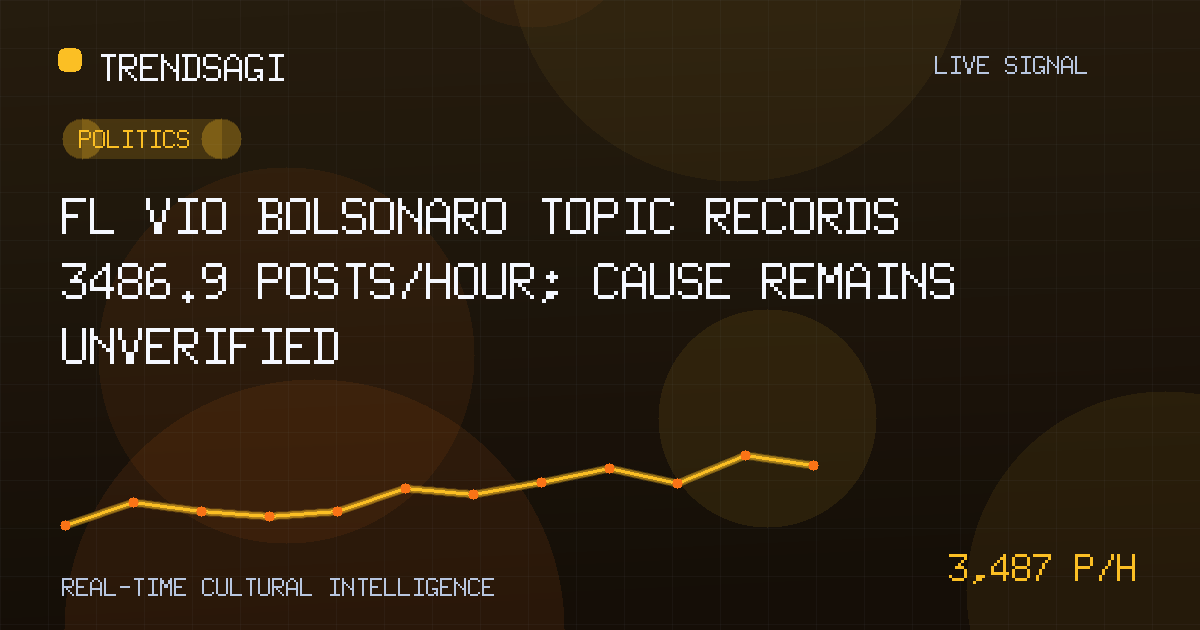
Flávio Bolsonaro topic records 3486.9 posts/hour; cause remains unverified
The Flávio Bolsonaro signal shows 3486.9 posts/hour in an 885-second window; the cause and significance still need verification.
Automated briefing. Generated from stored signal measurements and source-backed research; it is not manually reviewed. Read the methodology and limitations.
Metrics in this briefing are a snapshot associated with its publication date and may not reflect current conditions.
What changed
The topic labeled “Flávio Bolsonaro” was associated with a measured snapshot rate of 3486.9 posts/hour, but the cause of the movement is not verified. The available record contains no confirmed public event, statement, or news development that can safely be identified as the catalyst. The defensible conclusion concerns observed posting activity, not why it happened.
The rate was measured at 2026-10-05T13:26:50Z over an exact 885-second window using 3 stored observations. The latest snapshot contains 3428 posts. The posts/hour value is a measured snapshot rate, not a live or current rate, forecast, reach figure, engagement count, or unique-person count. The 3428 figure is a separate snapshot volume and should not be described as an hourly rate.
| Metric | Recorded value | Scope |
|---|---|---|
| Observation time | 2026-10-05T13:26:50Z | Latest stored observation |
| Measured posts/hour | 3486.9 posts/hour | Exact 885-second window using 3 stored observations |
| Snapshot volume | 3428 posts | Latest snapshot only |
Why this topic may be moving
The record is categorized as Politics, but that classification describes the monitoring context rather than the trigger. No explanatory description accompanies the signal, and no public catalyst has been verified. Several explanations therefore remain open:
- Reaction to a political development: Posts may be responding to a newly reported statement, controversy, interview, or other event, but the available evidence does not identify one.
- Renewed circulation of older material: A previously published clip, quotation, or claim may have returned to circulation without a corresponding new event.
- Amplification through repetition: Reposts, quotes, replies, or reactions may be increasing the measured volume without representing an equivalent number of distinct participants.
- Changes in collection: A shift in observation cadence, query handling, label assignment, or included sources could affect the recorded rate.
- Label drift: Some matching posts may concern a broader conversation, another use of the same name, or material that is only indirectly related to the intended topic.
Until a catalyst is verified, a newsroom or monitoring team should report that the topic showed elevated measured posting activity and that its cause remains unclear. It should not attribute the movement to an unconfirmed event.
This signal establishes measured activity under a topic label; it does not establish what prompted the activity, who participated, or whether the volume represents broad public attention.
Why it matters
Journalists, political communications teams, researchers, public-interest organizations, and platform trust-and-safety teams may need to investigate the signal because a high posts/hour measurement can change monitoring priorities. It can serve as an alert for further review even when the cause is unknown.
The figure cannot by itself establish a election-related effect, public consensus, media influence, or organic popularity. It also does not reveal sentiment, approval, opposition, or the share of posts that are original rather than duplicated. Volume may justify checking for a newsworthy development, but it is not evidence that such a development occurred.
Care is especially important because the measured rate and snapshot volume describe different things. The 3486.9 posts/hour value is a normalized snapshot measurement derived from changes across the stated window. The 3428 posts value is the count in the latest stored snapshot. They should not be combined, treated as interchangeable, or presented as counts of independent people.
What to watch next
The most useful follow-up work would test persistence, relevance, and causation without overstating any of them:
- Persistence: Compare the next observation collected with the same cadence and method. Determine whether the measured rate remains near 3486.9 posts/hour, declines, or changes sharply rather than assuming the latest window represents a sustained trend.
- Earliest-post timing: Reconstruct when relevant posts began and whether they cluster around a specific public event. A clear onset tied to a dated event would be stronger evidence of a catalyst than a diffuse rise.
- Originality and duplication: Classify a representative sample as original posts, quotations, replies, reposts, or media attachments. Remove duplicate content when estimating distinct expression rather than counting repeated publication.
- Public verification: Use targeted Google Search queries combining the exact topic label, the observation date, and candidate event terms. Do not name a cause unless the results provide dated public reporting or a first-party statement that can be verified.
- Source concentration: Check whether activity is broadly distributed or dominated by a concentrated set of accounts. Concentration would indicate amplification, but would not by itself determine whether the activity is coordinated.
- Label relevance: Inspect whether sampled posts explicitly concern Flávio Bolsonaro rather than relying on the topic label alone. A stable, relevant sample would support the label’s descriptive value.
- Comparable history: Add observations from earlier periods collected under the same rules. Without that baseline, the present rate cannot establish whether the activity is unusually high for this topic.
Methodology and limitations
The strongest available finding is the measured 3486.9 posts/hour snapshot rate for the exact 885-second window based on 3 stored observations. That short window provides limited context by itself. The record supplies no historical baseline, platform breakdown, geography, language distribution, account-level activity, engagement data, sentiment, or verification that the posts concern the intended public figure.
Accordingly, the signal does not support labels such as “viral,” “breaking,” “grassroots,” or “bot-driven.” Those conclusions would require evidence about duration, distribution, account behavior, and content provenance. The category identifies the signal as political discussion, while the unexplained movement remains a question for further verification.
A subsequent update should preserve the exact observation time, measurement window, observation count, topic label, and collection method. Any verified public catalyst should be added only when contemporaneous evidence connects it to the timing of the measured activity.
Track This Topic for New Signals
Set alerts for future velocity or sentiment changes around this topic.
Explore Tracking PlansAbout TrendsAGI research
TrendsAGI's automated research pipeline publishes dated signal snapshots, methodology notes, and practical workflows for teams evaluating cultural momentum. Read how signals are scoped, scored, and limited in our research methodology.