1646-second window · 3 observations · Measured Oct 1, 2026, 11:54 AM UTC · Provider: go_recent_snapshot_v2
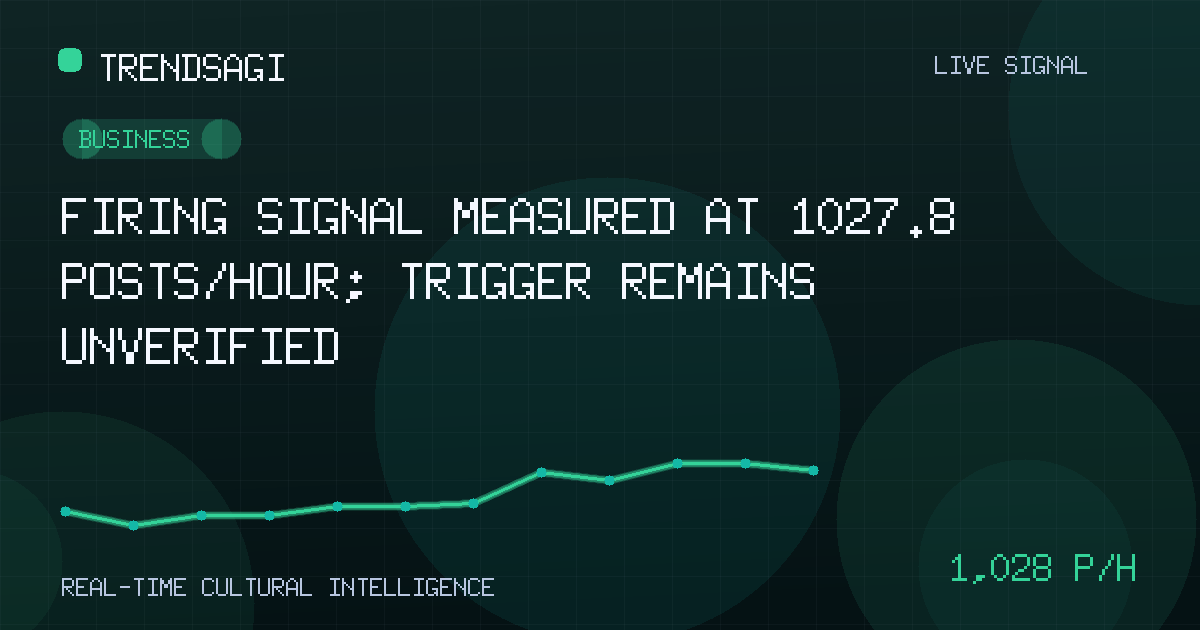
Firing signal measured at 1027.8 posts/hour; trigger remains unverified
The Firing signal measured 1027.8 posts/hour with 1358 posts in the latest snapshot; this briefing separates fact from an unverified cause.
Automated briefing. Generated from stored signal measurements and source-backed research; it is not manually reviewed. Read the methodology and limitations.
Metrics in this briefing are a snapshot associated with its publication date and may not reflect current conditions.
What changed
The stored Business signal labeled “Firing” is moving, but its cause is not established. No verified public context in the available record connects the activity to a particular employer, industry event, policy change, legal development, or announcement.
At the latest observation, 2026-10-01T11:54:13Z, the snapshot contained 1358 posts. Across an exact 1646-second window using three stored observations, the measured change rate was 1027.8 posts/hour. The figure is a measured snapshot rate, not a live or current rate, forecast, reach, engagement, or unique-person count. With no historical baseline in the supplied record, the data does not show how unusual that pace is relative to the topic’s own norm.
| Observation time | Exact measurement window | Stored observations | Measured snapshot rate | Latest snapshot volume |
|---|---|---|---|---|
| 2026-10-01T11:54:13Z | 1646 seconds | 3 | 1027.8 posts/hour | 1358 posts |
Why this topic may be moving
The record establishes that posts were captured under this label; it does not establish what happened in the world. “Firing” is semantically broad, and the Business category does not identify an organization, sector, location, or event type. Unrelated conversations can consequently be grouped under the same trend label.
Possible explanations require evidence rather than assumption:
- Event reaction: A specific announcement, report, ruling, personnel decision, or controversy could have produced a concentrated response. This is only a candidate explanation until the underlying source is verified.
- Recurring attention: Scheduled coverage or a previously active subject could generate new posts without a new triggering event.
- Label collision or platform artifact: The label may combine different meanings or entities. Duplicate, automated, or reposted content can also inflate apparent activity; none of these mechanisms is demonstrated here.
These explanations are hypotheses, not findings. A defensible attribution requires a verified originating item, compatible timing, and sampled posts that consistently refer to the same subject.
A measured rate documents the pace of change in the captured stream; it does not identify the event, audience, or cause behind that change.
The observation count is another limitation. Three stored observations support the stated rate calculation, but they do not reveal the shape of activity inside the window: whether posts arrived in one burst, accumulated gradually, or coincided with a collection boundary. The measurement therefore establishes pace without characterizing the full trajectory.
Why it matters
This signal is best treated as a triage alert. It says the monitored stream warrants inspection, not that a real-world firing event has been confirmed.
- Employers and communications teams should check whether posts name their organization before changing public or workforce messaging. A measured-rate alert can prioritize review, but an irrelevant or mixed label could prompt a misleading response.
- Business and media watchers should separate topic intensity from event identity. Conclusions about a company, sector, or policy require source-level verification rather than inference from the word “firing.”
- Researchers and dashboard users should keep metric definitions separate. Snapshot volume is not a rate, and neither measure establishes unique authors, sentiment, reach, or causation.
For workforce teams, the distinction affects action. A verified, organization-specific event may call for fact checking and internal coordination; a diffuse label should remain in a monitoring queue. Treating both as the same signal can waste attention or create an unsupported response.
The practical value is prioritization: use the rate to decide what to inspect, then use verified examples to decide what, if anything, can be reported.
What to watch next
Useful follow-up should test the alert rather than merely repeat it.
- Consistency: Collect later observations under the same category and label, keeping observation time, window, measured rate, and snapshot volume in separate fields. Persistence would strengthen a trend interpretation; a sharp reversal would weaken it.
- Semantic sample: Review a representative slice of posts and code the referent of “firing,” named entities, geography, and whether each post reports, reacts to, disputes, or discusses the subject.
- Concentration: Check timestamps, sources, and repeated wording. A tight cluster around a single item differs from steady activity spread across unrelated subjects.
- Trigger verification: Look for an original public item that precedes or aligns with the cluster, then seek corroboration. Temporal alignment is useful evidence but does not by itself prove causation.
- Data quality: Check for duplicate text, repost chains, automated behavior, and abrupt collection changes before interpreting the rate as organic attention.
- Taxonomy consistency: Compare the broad label with adjacent, more specific terms if the monitoring system supports them. A shift toward identifiable entities would be more informative than continued volume alone, provided collection methods remain consistent.
Escalate only when sampled posts converge on a single verified subject and an originating source can be documented. If the measured rate remains elevated but meanings stay diffuse, retain the signal as broad monitoring rather than a company-specific or policy-specific conclusion.
Methodology and limitations
The rate was measured over the exact 1646-second window from three stored observations, with the latest observation recorded at 2026-10-01T11:54:13Z. The 1358 figure describes that snapshot only. It is not the total number of posts over the window and is not interchangeable with the 1027.8 posts/hour measure.
- No sample of post text or source domains is supplied, so representativeness cannot be assessed.
- No historical baseline is supplied, so the statistical significance of the pace cannot be established.
- No verified external source is supplied, so the triggering event remains unclear.
- No account-level data is available, so unique authors, geography, and coordinated activity cannot be determined.
The defensible conclusion is narrow: the stored label registered 1027.8 posts/hour and a 1358-post snapshot at the stated time, while the cause and real-world significance remain unconfirmed.
Track This Topic for New Signals
Set alerts for future velocity or sentiment changes around this topic.
Explore Tracking PlansAbout TrendsAGI research
TrendsAGI's automated research pipeline publishes dated signal snapshots, methodology notes, and practical workflows for teams evaluating cultural momentum. Read how signals are scoped, scored, and limited in our research methodology.


