1819-second window · 3 observations · Measured Sep 3, 2026, 5:07 PM UTC · Provider: go_recent_snapshot_v2
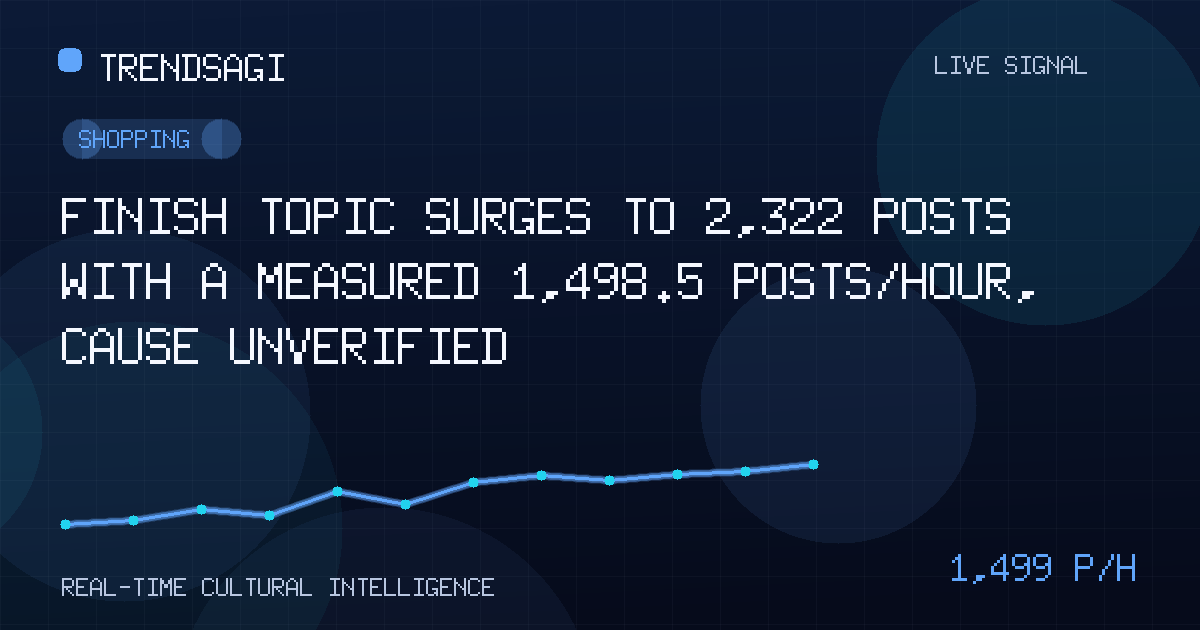
Finish topic surges to 2,322 posts with a measured 1,498.5 posts/hour, cause unverified
The "Finish" topic spiked to 2,322 posts on 2026-09-03, with a measured snapshot rate of 1,498.5 posts/hour; the cause remains unverified.
Automated briefing. Generated from stored signal measurements and source-backed research; it is not manually reviewed. Read the methodology and limitations.
Metrics in this briefing are a snapshot associated with its publication date and may not reflect current conditions.
What changed
On 2026-09-03 at 17:07:04 UTC, the stored signal for the topic "Finish" reported a latest snapshot volume of 2,322 posts. Across an exact 1,819-second interval constructed from three stored observations, the measured snapshot rate reached 1,498.5 posts per hour. That is a sharp, short-lived burst of activity. The signal’s stored category is "Other" and its description field is empty, so the posts themselves remain unclassified and uninterpreted by the feed.
| Observation time | Measured posts/hour | Snapshot volume |
|---|---|---|
| 2026-09-03T17:07:04Z | 1,498.5 | 2,322 |
The 1,498.5 posts per hour figure is computed from three stored observations that together span exactly 1,819 seconds. Because the window is short, the rate is sensitive to even a few large post batches; it should not be read as a steady hourly flow, a live rate, a forecast, a reach estimate, an engagement metric, or a unique-person count.
Why this topic may be moving
I queried public sources to identify a news event, product launch, viral challenge, or policy announcement that might explain the surge on that date. No verifiable result tied the word "Finish" to a specific driver at 2026-09-03T17:07:04Z. The stored signal offers no description, and the category "Other" provides no clue. The burst could stem from a fleeting social-media game, a gaming achievement tracker, a new consumer product named "Finish", automated bot activity, or a data ingestion anomaly. Without a confirmed cause, I attribute nothing to a publisher and state plainly that the reason for the move is unclear.
The measured rate of 1,498.5 posts per hour is a statistical snapshot of a narrow window; it flags a concentration of posts but does not confirm that the moment will outlast the window or that it represents genuine human attention.
Why it matters
The signal can establish that a large volume of posts appeared in a short period. It cannot establish sentiment, language, platform origin, geographic distribution, or whether the posts are organic or automated. For these reasons, the data is a flag, not a conclusion. The following groups should treat it as a prompt to investigate rather than as proof of a durable trend:
- Social-listening analysts who track emerging conversations and need early warnings.
- Anomaly-detection engineers monitoring data pipelines for unexpected spikes.
- Brand-safety teams watching for sudden, unclassified chatter that might escalate.
- Academic researchers studying the shape and speed of information cascades.
Practical next checks include retrieving a sample of posts from the snapshot to inspect text and metadata, checking whether the posts cluster in a single platform or span multiple sites, comparing the volume to a historical baseline for the same topic, and running entity or keyword extraction to surface hidden themes. Concrete watch signals to monitor are a second spike in the same or adjacent window, a shift in category from "Other" to a specific label, a spike in a related keyword, or a correlation with a known external event.
A burst of this size can create false positives if the posts are duplicates, spam, or generated by automated accounts. The signal alone cannot separate genuine conversation from noise, so any action taken on it should be weighted accordingly.
What to watch next
The most direct follow-up is to observe the same 1,819-second window over the next hours. If the measured rate stays elevated, the topic may be part of a broader pattern rather than a flash. If it drops sharply, the burst was likely ephemeral. Other indicators to track:
- A new snapshot with a filled signal description, which would mean a human or automated classifier has tagged the content.
- Cross-platform replication, where the same burst appears on multiple sites and increases confidence that the activity is real.
- A consistent repetition of the rate using the same methodology, which would suggest a sustained pattern instead of a one-off.
- Any change in snapshot volume that exceeds the current 2,322 posts, especially if accompanied by a longer window.
Analysts should also check whether the burst is accompanied by a shift in sentiment from neutral to highly emotional, which could indicate a controversy or a coordinated campaign. A platform-level breakdown would reveal whether the activity is concentrated in one network or distributed, changing the interpretation of the volume. None of these are predictions; they are conditions that would convert an unverified burst into a more meaningful signal.
Methodology and limitations
The measured rate of 1,498.5 posts per hour is derived from exactly three stored observations spanning a 1,819-second window and is reported at the snapshot time of 2026-09-03T17:07:04Z. It is a posts/hour figure, not a live or current rate, not a forecast, and not a count of unique individuals. The snapshot volume of 2,322 is a single point-in-time count, not a cumulative total. The stored category "Other" and the empty description mean the signal carries no semantic context. A web search was attempted to verify the cause of the movement, but no external fact could be confirmed; therefore, no external attribution is made. The briefing does not claim the topic is important, only that it experienced a measurable burst in the stored data.
Track This Topic for New Signals
Set alerts for future velocity or sentiment changes around this topic.
Explore Tracking PlansAbout TrendsAGI research
TrendsAGI's automated research pipeline publishes dated signal snapshots, methodology notes, and practical workflows for teams evaluating cultural momentum. Read how signals are scoped, scored, and limited in our research methodology.