3619-second window · 3 observations · Measured Sep 27, 2026, 2:10 PM UTC · Provider: go_recent_snapshot_v2
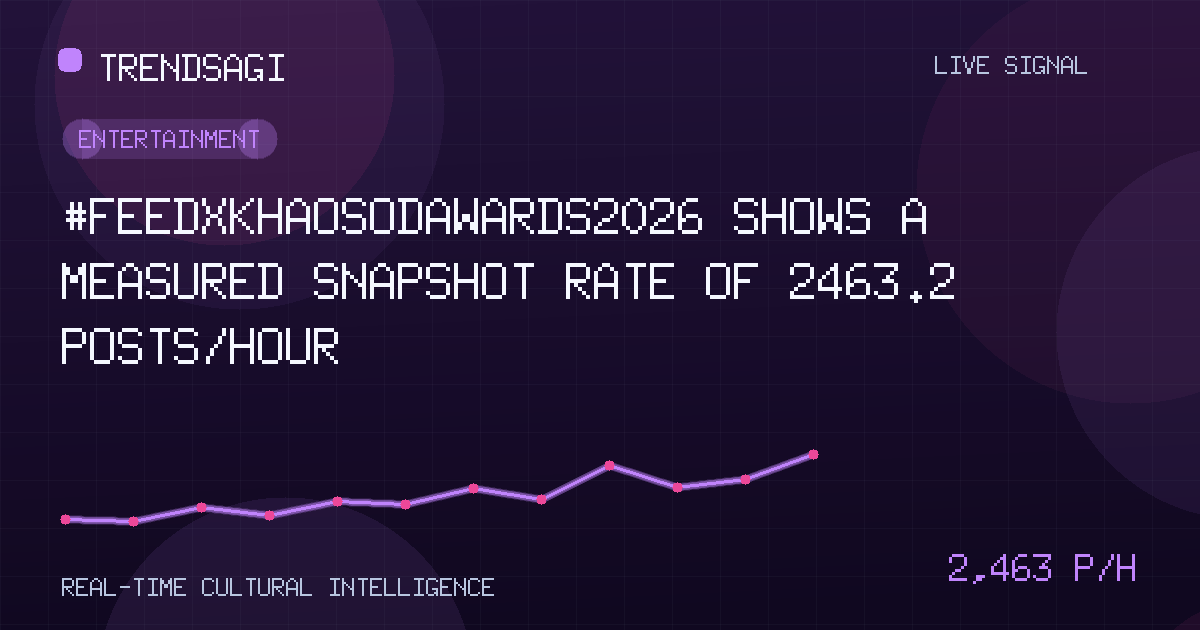
#FEEDxKHAOSODAwards2026 shows a measured snapshot rate of 2463.2 posts/hour
The hashtag logged 2463.2 posts/hour over an exact 3619-second window, with 5142 posts; review the limits and next checks.
Automated briefing. Generated from stored signal measurements and source-backed research; it is not manually reviewed. Read the methodology and limitations.
Metrics in this briefing are a snapshot associated with its publication date and may not reflect current conditions.
What changed
At the latest stored observation, the hashtag #FEEDxKHAOSODAwards2026 registered a measured snapshot rate of 2463.2 posts/hour. The rate was measured over an exact 3619-second window using 3 stored observations, while the latest snapshot contained 5142 posts. No independently verified public context was available to establish why the activity increased.
For editors, the defensible conclusion is that the topic produced a concentrated posting pulse around the observation time—not that an awards announcement, result, controversy, or audience milestone has been confirmed. Treat 2463.2 posts/hour as the pace recorded in the stored window, and 5142 posts as the snapshot volume. Neither is reach, engagement, a unique-person count, a live or current rate, or a forecast.
| Observation time | Measured snapshot rate | Snapshot volume |
|---|---|---|
| 2026-09-27T14:10:31Z | 2463.2 posts/hour | 5142 posts |
Why this topic may be moving
The missing context is causal, not descriptive. The label appears awards-related, but it does not identify an organizer, ceremony, nominees, winners, publication, or campaign. It would be unsafe to turn the year in the hashtag into a claim that a 2026 event occurred.
Possible explanations should remain hypotheses until a source establishes the trigger:
- Verified announcement or result: An official release, winner list, ceremony update, or schedule could concentrate posts. No such item has been verified for this signal.
- Promotional or participant activation: A campaign, participating account, fan community, or media roundup could generate repeated use of the tag. The volume alone does not show who initiated it.
- Controversy or error: Reaction to a result, voting process, outage, or complaint can also create a fast cluster. The available signal contains no verified detail identifying any of these circumstances.
- Repetition or automation: Multiple posts can reuse the same wording or links, and automated or coordinated activity can inflate a post count without representing a broad human audience. That is a risk to test, not a finding.
- Search or recommendation exposure: A post may have been accelerated by an external article or platform discovery event, but no verified source has been tied to the timing.
The strongest supported statement is that observed posting tempo reached 2463.2 posts/hour; the event, actor, or motive behind that rate has not been established.
These possibilities are not equally useful editorially. The first verification step is temporal: locate a public item published before or during the 3619-second window and connect it to the first observed rise. If no such item can be verified, the cause should remain explicitly unclear rather than being reverse-engineered from the hashtag.
Why it matters
For media and entertainment desks, the signal is a timely verification lead, not a publishable explanation. It can direct reporters toward the event or account that generated the discussion while there is still time to check primary material.
- Editors: Confirm whether the activity follows an announcement, a result, a voting phase, a performance, or an organizational controversy. A roundup or audience report should not imply that any one of those events happened until it is sourced.
- Platform and community teams: Inspect account concentration, repetition, and traffic quality before describing the activity as organic or broad. A large post count may be useful for moderation even when it is a poor proxy for unique interest.
- Marketing and brand teams: Treat the tag as a monitoring priority, not a sales or demand signal. Determine whether the participants are customers, enthusiasts, media, or automated accounts before drawing a commercial conclusion.
For general readers, the distinction prevents a measurement from becoming a narrative. A tag can concentrate attention because something happened, because many accounts are repeating one item, or because the topic itself is being promoted. Until account-level and source-level checks are available, the safest characterization is increased posting activity around an awards-themed hashtag, with the cause unverified.
What to watch next
A useful follow-up should answer these questions in sequence:
- Find the first verifiable trigger. Look for a timestamped publication from an identified organizer, participating account, or credible publisher. Compare its time with the exact 3619-second measurement window; the available observation time alone is not enough to show whether it caused the activity.
- Test persistence. Calculate successive measured snapshot rates after 2026-09-27T14:10:31Z using the same hashtag-matching and collection rules. One measured window shows intensity, not whether the pattern lasted or returned.
- Check who is posting. If account-level data becomes available, separate official sources, participants, media, and other accounts. Compare post totals with unique-account counts and the share of previously active accounts.
- Check content quality. Sample original posts, quote-posts, duplicates, shared links, and near-identical wording. A cluster dominated by repetition or automated behavior would require a different explanation from diverse original discussion.
- Track the narrative. Code sampled posts for announcement, nomination, voting, ceremony, result, reaction, criticism, or error. A repeated term becomes a useful watch signal only when it appears across credible or independently sampled posts.
- Look for concentration. If available, break the activity down by platform, geography, language, and account type. Concentration can guide verification, but it cannot by itself establish organic reach, coordinated action, or motive.
Methodology and limitations
The figures come from a stored social-posting snapshot observed at 2026-09-27T14:10:31Z. The 2463.2 posts/hour figure is a measured snapshot rate over an exact 3619-second window using 3 stored observations. The 5142 figure is the latest snapshot volume. They are reported separately, and neither is converted into the other.
The available figures do not provide the individual observation values, a prior baseline, collection coverage, account counts, sentiment, or engagement. As a result, the signal cannot show the shape or duration of the increase, whether posts were unique or authentic, how many people were involved, or what caused the movement. It also cannot establish whether the same rate will continue.
No publisher fact met that verification standard here, so the reason for the movement remains unclear. Before assigning a cause, match a timestamped first-party statement or credible report to the measurement window, confirm that the source is relevant to the exact hashtag, and check for an account-quality pattern. Until those checks are complete, report the measured activity and explicitly label the trigger as unverified.
Track This Topic for New Signals
Set alerts for future velocity or sentiment changes around this topic.
Explore Tracking PlansAbout TrendsAGI research
TrendsAGI's automated research pipeline publishes dated signal snapshots, methodology notes, and practical workflows for teams evaluating cultural momentum. Read how signals are scoped, scored, and limited in our research methodology.


