15-minute window · 3 observations · Measured Sep 4, 2026, 5:47 AM UTC · Provider: go_recent_snapshot_v2
Farage Conversation Volume Surges: Measured Spike in UK Political Discourse
A measured snapshot rate of 1624.6 posts per hour and a total of 712 posts indicate a sharp increase in Farage-related political conversation, though the
Automated briefing. Generated from stored signal measurements and source-backed research; it is not manually reviewed. Read the methodology and limitations.
Metrics in this briefing are a snapshot associated with its publication date and may not reflect current conditions.
What changed
Conversation surrounding the UK political figure Farage has experienced a significant quantitative increase in the latest observation period. The recorded metric indicates a sharp upward deviation from baseline discussion levels, capturing the attention of a substantial volume of digital discourse. This surge represents a notable shift in the political media landscape, demanding closer analytical scrutiny to understand the underlying dynamics at play.
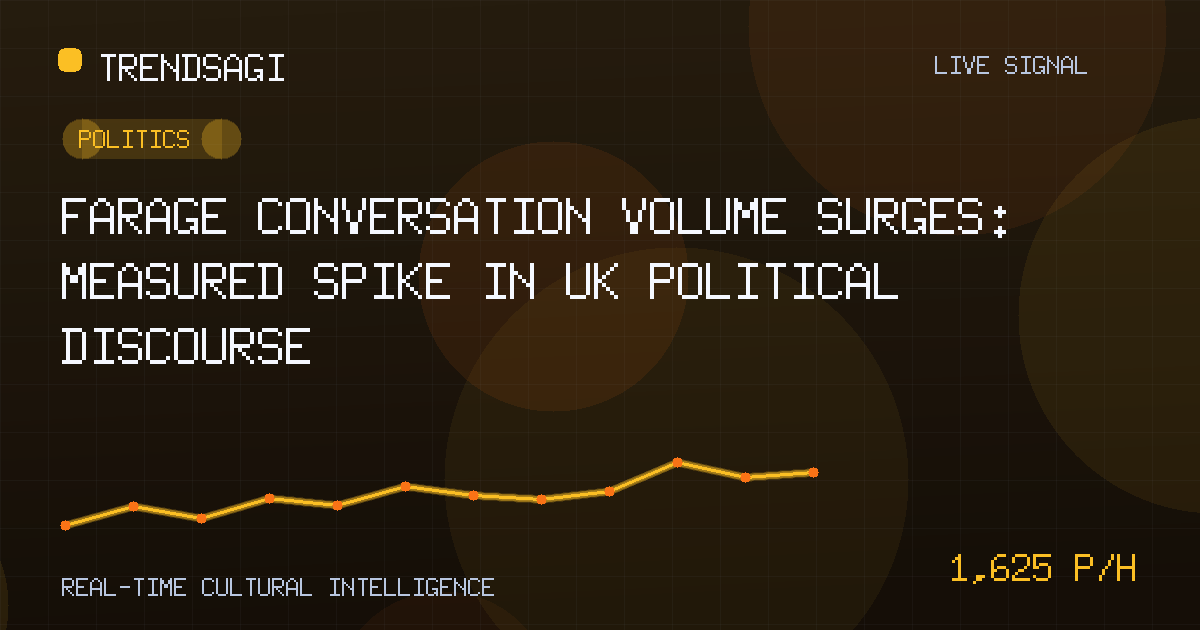
The measured snapshot rate reached 1624.6 posts per hour over an exact 900-second window, derived from three stored observations at the time of capture. This specific measurement translates to a total snapshot volume of 712 posts, providing a concrete baseline for the scale of the conversation spike. It is critical to note that this figure represents a measured snapshot rate, not a live current rate, forecast, reach, engagement metric, or unique-person count.
| Observation Time | Measured Posts/Hour | Snapshot Volume |
|---|---|---|
| 2026-09-04T05:47:49Z | 1624.6 | 712 |
Why this topic may be moving
Determining the precise catalyst for this surge requires external verification, and the stored signal description provides no explicit reason for the movement. When attempting to verify why the topic is moving, the absence of a confirmed, attributable publisher statement means the exact trigger remains unverified. Political conversations of this magnitude often coincide with legislative developments, public appearances, or media broadcasts, but asserting a specific cause without verified attribution would introduce speculative error into the analysis.
In the realm of political metrics, volume spikes frequently correlate with moments of heightened partisan tension or significant policy announcements. However, because the stored data lacks a descriptive narrative, the analytical focus must remain on the observable behavior of the volume itself rather than the unverified content driving it. The surge suggests that whatever has captured public attention is generating rapid, sustained engagement across the observed platforms.
Why it matters
Shifts in political conversation volume are vital indicators of public attention and potential electoral or policy momentum. When a figure like Farage experiences a measured snapshot rate exceeding 1600 posts per hour, it signals that the political discourse is actively pivoting toward the issues or statements associated with this individual. For political analysts, journalists, and campaign strategists, recognizing these volume shifts is essential for understanding the current informational landscape.
High-volume conversations often precede or accompany shifts in public opinion, making them critical data points for assessing political viability and media influence. The concentration of discourse can amplify specific narratives, forcing other political actors to respond or adapt their strategies accordingly. Understanding the scale of this attention helps stakeholders calibrate their own messaging and resource allocation in a rapidly evolving political environment.
The data confirms a quantitative shift in conversation volume, but it does not confirm the qualitative nature of that shift or the specific external catalyst driving the attention.
What to watch next
Practical next checks require monitoring whether this measured snapshot rate sustains itself over subsequent observation windows or if it represents a transient spike. Analysts should track the continuation of the 1624.6 posts per hour benchmark to determine if the conversation is stabilizing at a new, higher baseline or decaying back to historical averages. Furthermore, cross-referencing this volume data with verified news publisher outputs will be necessary to attribute the cause accurately.
Concrete watch signals include the emergence of verified policy announcements, scheduled public appearances, or official responses from political opponents that could explain the sustained interest. Observing the sentiment distribution within the 712 posts will also provide insight into whether the conversation is broadly supportive, critically oppositional, or mixed. These qualitative layers are essential for translating raw volume metrics into actionable political intelligence.
- Monitor subsequent snapshot volumes to identify if the measured snapshot rate stabilizes or decays.
- Watch for verified publisher reports that attribute the surge to a specific political event or statement.
- Track sentiment shifts within the conversation to gauge the qualitative tone of the engagement.
- Observe if other political figures issue responses, indicating that the volume has shifted the broader legislative or media dialogue.
Methodology and limitations
The figures presented in this briefing are derived from stored observations captured at a specific moment in time. The measured snapshot rate of 1624.6 posts per hour was calculated using three stored observations over an exact 900-second window. This methodology provides a reliable mathematical average of the volume during that precise interval, offering a standardized metric for comparison against other temporal snapshots. However, the limitations of this approach are significant and must be clearly understood by the reader.
Because the metric is a measured snapshot rate, it does not account for the total reach of the conversation, the number of unique individuals participating, or the depth of engagement each post generates. A high volume of posts could result from a small number of highly active accounts rather than a broad base of unique participants. Additionally, the snapshot volume of 712 posts represents only the captured data at the observation time, not a cumulative historical total.
The absence of a stored signal description means that the internal categorization of this data as "Politics" relies entirely on the metadata tagging rather than a verified thematic analysis of the post content. External verification attempts did not yield a confirmed, attributable publisher statement explaining this specific surge, so the precise catalyst remains unverified. Consequently, this briefing establishes the fact of the volume increase but cannot definitively establish the reasons behind it without further verified context.
Track This Topic for New Signals
Set alerts for future velocity or sentiment changes around this topic.
Explore Tracking PlansAbout TrendsAGI research
TrendsAGI's automated research pipeline publishes dated signal snapshots, methodology notes, and practical workflows for teams evaluating cultural momentum. Read how signals are scoped, scored, and limited in our research methodology.


