30-minute window · 3 observations · Measured Sep 19, 2026, 5:56 AM UTC · Provider: go_recent_snapshot_v2
Narrative Velocity Analysis: "Fake News" Signal Activity on September 19, 2026
Analyzes a measured snapshot rate of 287.9 posts/hour for "Fake News" on Sept 19, 2026, exploring narrative velocity and potential information volatility.
Automated briefing. Generated from stored signal measurements and source-backed research; it is not manually reviewed. Read the methodology and limitations.
Metrics in this briefing are a snapshot associated with its publication date and may not reflect current conditions.
What changed
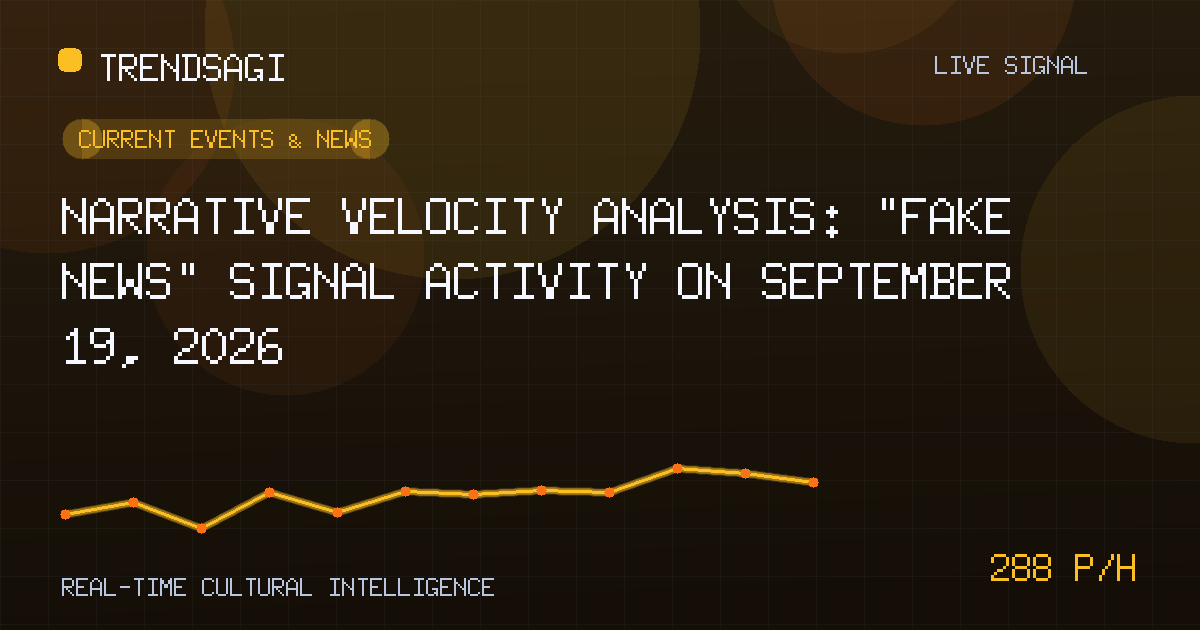
The "Fake News" signal experienced a notable surge in activity during the early hours of September 19, 2026. A measured snapshot rate of 287.9 posts/hour was recorded, reflecting a concentrated period of discussion within the "Current Events & News" category. This velocity indicates a reactive environment where participants are actively contesting or disseminating claims regarding information validity, potentially signaling a response to a recent news event or a coordinated discourse effort.
The latest snapshot observed at 2026-09-19T05:56:35Z captured a total volume of 935 posts. While the signal demonstrates a high measured change rate, the specific external catalyst—such as a specific viral story, political statement, or platform controversy—remains unverified via available public context at the time of this report. The absence of a single, dominant headline suggests the volume may be driven by a fragmented set of local incidents or a generalized debate across multiple social clusters rather than a singular global breaking news event.
| Observation Time | Measured Snapshot Rate | Snapshot Volume |
|---|---|---|
| 2026-09-19 05:56:35Z | 287.9 posts/hour | 935 posts |
Why this topic may be moving
As of this research update, the primary driver for the "Fake News" spike is unverified. When a broad, meta-topic like this reaches a measured snapshot rate of nearly 290 posts per hour without a clear, verified headline from major publishers, it typically points toward one of three scenarios. First, it may represent a "reclamation" period where various interest groups use the term to discredit opposing narratives following a minor but polarizing event. Second, it could indicate a sudden awareness of a new generative AI tool or deepfake capability that has not yet been formally reported by mainstream media but is circulating in niche tech circles. Third, it may reflect a period of high sensitivity following an election or a major policy announcement where the term is used as a generic rhetorical weapon.
It is important to note that the term "Fake News" is often used both as a legitimate critique of misinformation and as a political pejorative. In the context of this 1800-second window, the volume of 935 posts suggests that the conversation is reaching beyond specialized fact-checking communities and into the broader public square. Without a confirmed anchor event, the signal suggests a "sentiment-first" movement where the emotion of the discourse is outpacing the factual documentation of the cause.
Why it matters
For communications professionals, journalists, and risk analysts, a sudden increase in the velocity of the "Fake News" narrative is a warning sign of high atmospheric volatility. When the measured snapshot rate rises, it often precedes a decline in public trust or an increase in institutional friction. If the cause is unclear, the risk is higher because the narrative is unanchored, allowing it to be filled by various actors with competing agendas.
The challenge of the modern information environment is not just the presence of falsehoods, but the systemic erosion of the shared reality required for civil discourse. When the accusation of 'fake news' becomes more frequent than the analysis of the news itself, the signal-to-noise ratio in public policy becomes dangerously low.
This signal suggests that the "Current Events & News" category is currently undergoing a stress test. For brand safety and corporate communications, this means that even benign announcements may be caught in the crossfire of generalized skepticism. When the public is primed to look for deception, they are more likely to find it—even where it does not exist. High-volume snapshots like this often lead to increased pressure on social platforms to modify moderation policies or on governments to introduce stricter digital safety legislation.
What to watch next
Because the current trigger is unverified, analysts should monitor the following specific watch signals over the next 24 to 48 hours:
- Keyword Clustering: Watch for the emergence of specific proper nouns (politicians, companies, or locations) alongside the "Fake News" signal. If a specific name begins to co-occur in more than 15% of the sampled posts, that is likely the underlying catalyst.
- Media Verification: Monitor major wire services for reports on significant deepfake incidents or coordinated bot network takedowns. Often, a spike in discourse precedes the official announcement of a platform intervention.
- Sentiment Polarity: Observe whether the discourse is primarily defensive (users defending themselves against accusations) or offensive (users accusing institutions of lying). A shift toward offensive rhetoric typically indicates a more durable and potentially disruptive trend.
- Source Credibility: Check if the posts driving the 287.9 posts/hour rate are originating from verified accounts or if they are largely from anonymous or new profiles, which could indicate a synthetic or inorganic push.
Methodology and limitations
This report is based on a specific measured change rate of 287.9 posts/hour, calculated over an exact 1800-second window using three stored observations. This is a snapshot in time and does not represent a live, continuous feed or a cumulative daily total. The volume of 935 posts represents the sample size captured during this specific observation period on September 19, 2026.
The limitations of this signal are significant. First, the term "Fake News" is highly polysemous; it is used in diverse ways across different cultural and linguistic contexts. Second, the snapshot rate is a measure of velocity, not reach. We can establish that the topic is moving quickly within a specific window, but we cannot establish how many unique individuals are seeing these posts or the total audience impact. Finally, because the signal description was empty and public context remains unverified, this briefing focuses on the structural nature of the signal rather than the specific content of the claims being made. This is an analysis of discourse behavior, not a verification of the truth of any underlying claims.
Track This Topic for New Signals
Set alerts for future velocity or sentiment changes around this topic.
Explore Tracking PlansAbout TrendsAGI research
TrendsAGI's automated research pipeline publishes dated signal snapshots, methodology notes, and practical workflows for teams evaluating cultural momentum. Read how signals are scoped, scored, and limited in our research methodology.