45-minute window · 3 observations · Measured Oct 3, 2026, 6:51 PM UTC · Provider: go_recent_snapshot_v2
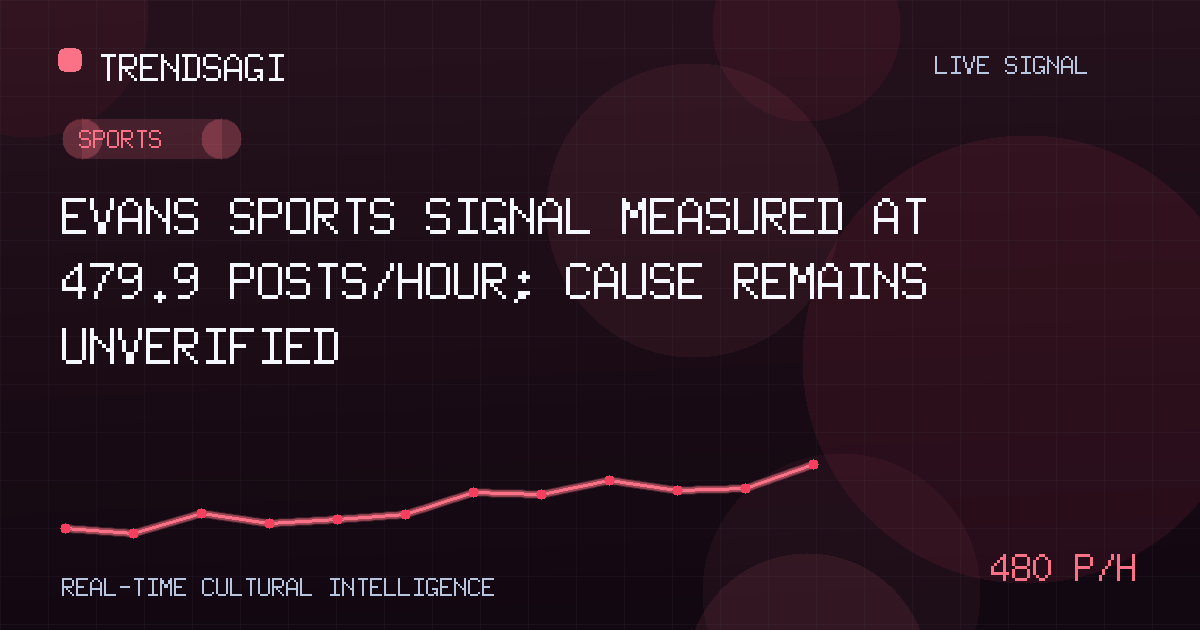
Evans sports signal measured at 479.9 posts/hour; cause remains unverified
Evans shows a measured snapshot rate of 479.9 posts/hour; the cause is unverified, with evidence limits and practical next checks.
Automated briefing. Generated from stored signal measurements and source-backed research; it is not manually reviewed. Read the methodology and limitations.
Metrics in this briefing are a snapshot associated with its publication date and may not reflect current conditions.
What changed
The direct answer is that the stored “Evans” sports signal registered a measured snapshot rate of 479.9 posts/hour, but the available evidence does not identify which person, team, event or issue the posts concern. No verified public context establishes why the topic moved.
The measured rate covers an exact 2700-second window using 3 stored observations and is reported at 2026-10-03T18:51:47Z. The latest snapshot contains 600 posts; that figure is a snapshot volume, not a rate, reach, engagement total, or unique-person count.
| Observation time | 2026-10-03T18:51:47Z |
|---|---|
| Measured posts/hour | 479.9 posts/hour |
| Snapshot volume | 600 posts |
Why this topic may be moving
The cause is unclear. “Sports” classifies the material, but “Evans” does not resolve it to a full name, team, league, event, or source account. Posts carrying that label could therefore refer to more than one underlying story.
Several mechanisms could produce the measured activity, but none can be confirmed from the available signal:
- Label collision: Different people or accounts sharing the same label may contribute to one pool, making unrelated discussions appear unified.
- Event response: A result, roster development, injury update, announcement, or controversy could prompt discussion. No specific event is verified here.
- Amplification: Quotes, reposts, repeated headlines, or duplicate captures may increase the post count without proportionately adding distinct reactions.
Choosing among these explanations before inspecting the posts would create false precision.
What the signal can—and cannot—establish
The signal establishes label-level posting throughput during a defined historical window and provides a clear point for follow-up.
- Observed activity: The label accumulated posts rapidly enough for the stored method to measure 479.9 posts/hour over the supplied window.
- Defined sample: The latest snapshot volume of 600 posts provides a concrete pool that can be inspected for entities, events, and repeated content.
- Verification priority: The rate indicates that resolving the label is more urgent than treating the metric as a confirmed news event.
It does not establish a live or current rate, a forecast, reach, engagement, sentiment, authenticity, or unique participation. It also does not show that the rate exceeds a previous baseline or that every post concerns one story.
A measured post rate can justify closer verification; it cannot verify the identity behind a label, the event behind the posts, or the significance of the discussion.
Who should care
The signal matters most to people who could otherwise turn a volume metric into an unsupported event claim.
- Sports editors: Resolve the subject before using “Evans” in a headline, matchup, developing-story label, or live coverage topic.
- Audience and social-listening analysts: Use the signal to prioritize inspection, but do not present it as a current trend forecast or a measure of public reach.
- Brand and reputation teams: Confirm the relevant person or organization and classify the discussion before drawing reputational conclusions.
- Researchers: Preserve the topic definition and collection method so the rate is not compared with unrelated names or differently sampled windows.
What to watch next
The immediate task is entity resolution, followed by checks that can distinguish a genuine event signal from label collision or amplification.
- Inspect the 600-post snapshot. Look for full names, teams, leagues, event terminology, locations, and consistently linked source accounts. Record which identity dominates and whether meaningful posts point to multiple subjects.
- Find the onset. Sort the available posts by timestamp and identify the earliest substantive items. Compare those posts with later clusters to see whether the activity began around a specific development or accumulated gradually.
- Test for repetition. Where the data permits, separate original posts from quotes, reposts, repeated headlines, and duplicate captures. Repetition can inflate volume without representing an equally broad response.
- Compare equivalent windows. Check adjacent and earlier periods collected with the same method. Without that baseline, the stored rate cannot be described as accelerating, record-setting, or unusually high.
- Verify public context after resolving the name. Use Google Search to locate relevant reporting, then confirm any causal claim on the original publisher or official page. Attribute only developments that can be verified.
Signals that would change the assessment
- Concentration around one named, time-stamped event would support an event-driven explanation.
- Clear references to multiple unrelated identities would indicate that the short label is combining separate discussions.
- Repeated wording with little new information would raise amplification questions, although repetition alone would not prove coordination.
- Continued measured activity in subsequent comparable windows would support persistence; a rapid decline would suggest the rate was concentrated in this snapshot.
- Verified reporting or an official announcement aligned with the apparent onset would strengthen a causal explanation. Unsourced posts would not.
Methodology and limitations
The reported 479.9 posts/hour figure is a measured snapshot rate based on 3 stored observations across an exact 2700-second window at the stated observation time. It is not a live or current rate, a forecast, or a proxy for audience size. The separate 600-post figure is the latest snapshot volume and should not be combined arithmetically with the rate.
The record provides no prior rate, source distribution, geography, platform mix, sentiment breakdown, author uniqueness, or entity-level event metadata. Posts may be original, quoted, reposted, duplicated, or automated, but the supplied signal does not establish their composition. Because no verified external development is tied to “Evans” at this timestamp, the defensible conclusion is elevated posting activity around an unresolved label—not a confirmed event, reaction, or broader trend.
Track This Topic for New Signals
Set alerts for future velocity or sentiment changes around this topic.
Explore Tracking PlansAbout TrendsAGI research
TrendsAGI's automated research pipeline publishes dated signal snapshots, methodology notes, and practical workflows for teams evaluating cultural momentum. Read how signals are scoped, scored, and limited in our research methodology.