906-second window · 3 observations · Measured Sep 16, 2026, 7:10 PM UTC · Provider: go_recent_snapshot_v2
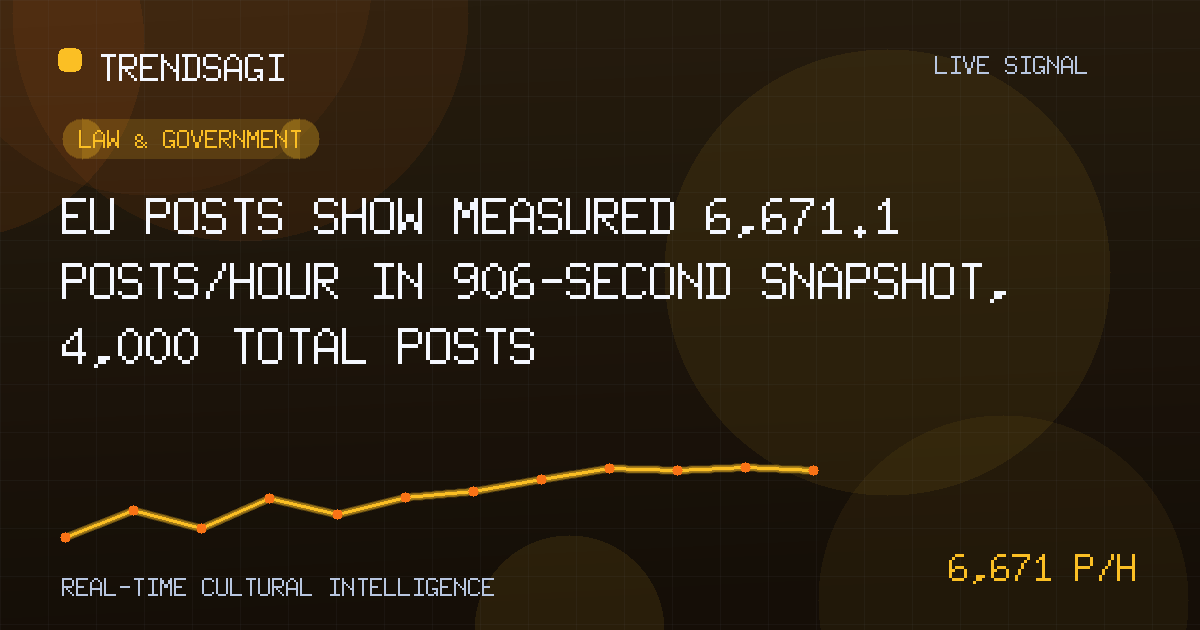
EU posts show measured 6,671.1 posts/hour in 906-second snapshot, 4,000 total posts
A 906-second observation measured 6,671.1 posts/hour for the EU label with 4,000 posts; useful for tracking EU-related news spikes.
Automated briefing. Generated from stored signal measurements and source-backed research; it is not manually reviewed. Read the methodology and limitations.
Metrics in this briefing are a snapshot associated with its publication date and may not reflect current conditions.
What changed
The tracked “The EU” topic showed a measured snapshot rate of 6,671.1 posts/hour over a 906-second window, with a latest snapshot volume of 4,000 posts at 2026-09-16T19:10:20Z. In practical terms, that is a short-window intensity signal: a lot of content was being observed around the EU during that brief measurement period. It is not a live count, a forecast, a measure of unique people, or proof that a specific EU event occurred.
| Observation time | 2026-09-16T19:10:20Z |
|---|---|
| Measured posts/hour | 6,671.1 |
| Snapshot volume | 4,000 posts |
Why this topic may be moving
The stored category is Law & Government, so the topic is likely tied to policy, regulation, institutions, elections, trade, diplomacy, or legal action involving the European Union. A measured rate can rise when a major story breaks, when a policy deadline passes, when a court ruling or political decision is made, or when a large number of outlets and users begin discussing the same subject within a short period.
However, the supplied signal does not identify a specific article, official statement, market event, or public incident. Because the cause remains unclear from the stored information, the responsible conclusion is that the EU-related signal is elevated but unexplained by the data shown. It can establish timing and scale within the measurement window; it cannot establish the news driver by itself.
A short-window rate is best treated as a detector: it tells you that something EU-related is gaining enough attention to justify a faster verification pass, not that the exact cause has already been confirmed.
Why it matters
For journalists, researchers, and institutional audiences, “The EU” is a broad label that can contain many different subjects. A sudden increase in post activity can matter because EU-related developments often move quickly across policy, finance, technology, energy, and public administration. The same measured spike may be relevant to different readers for different reasons:
- Policy teams may need to check whether a new regulation, sanction, trade measure, or legislative vote has appeared.
- Legal analysts may want to confirm whether a court decision, compliance deadline, or enforcement action is driving discussion.
- Market observers may watch whether the activity is linked to energy, trade, monetary policy, or a specific member-state issue.
- General readers may need context to separate a large-scale news event from routine political chatter.
The value of the signal is not that it proves a story. Its value is that it flags a moment when attention is high enough to warrant checking official sources, major news outlets, and relevant EU institutions directly.
What the signal can and cannot establish
The signal can establish:
- The observation time: 2026-09-16T19:10:20Z.
- A measured rate of 6,671.1 posts/hour calculated from a 906-second window using three stored observations.
- A latest snapshot volume of 4,000 posts associated with the stored topic.
The signal cannot establish:
- The number of unique people involved.
- Engagement, likes, shares, or emotional tone.
- The exact news event, official act, or external cause.
- Whether the rate will continue, reverse, or represent a long-term trend.
- The reliability, origin, or quality of the individual posts.
Practical next checks
If you need to verify why the topic is moving, start with primary and broadly reliable sources rather than reacting only to volume:
- Check EU institution pages for press releases, legislative updates, or official statements published near the observation time.
- Compare major newsroom coverage to see whether multiple independent outlets are reporting the same specific development.
- Look for named facts: a policy name, court case, vote, sanction, trade decision, treaty deadline, or institutional statement.
- Separate the broad “EU” label from more specific subtopics such as Brussels policy, Schengen rules, EU courts, eurozone economics, or member-state politics.
- If no corroborated explanation appears, treat the spike as attention, not confirmation.
Concrete watch signals
- A sustained measured rate: a second or third nearby window that remains elevated would make the event more likely than a one-time measurement artifact.
- Named subject specificity: when discussion shifts from generic “EU” mentions to a specific regulation, person, case, or event, the cause becomes easier to verify.
- Official confirmation: a statement from an EU body, a government ministry, or a court that matches the timing strengthens the explanation.
- Cross-platform corroboration: multiple independent reporting outlets describing the same development reduces the chance of a data-only spike.
- Market or policy markers: if the activity aligns with a regulatory deadline, legal filing, trade action, or institutional meeting, that is a plausible driver to investigate.
Methodology and limitations
The posts/hour figure is a measured snapshot rate, not a live current rate. It was calculated from stored observations over an exact 906-second window, using three stored observations, and measured at 2026-09-16T19:10:20Z. The snapshot volume of 4,000 posts is a point-in-time volume associated with the stored topic, not a rate and not a count of unique users. Because the topic label is broad and the stored description is empty, the briefing deliberately avoids assigning a specific cause that cannot be verified.
Short measurement windows can be sensitive to bursts, aggregation artifacts, scheduled content, or platform-specific behavior. A single rate should therefore be read as a timing cue for verification, not as a final explanation. If the next checks do not surface a named event, the appropriate summary is: EU-related post activity was elevated in the measured window, but the public cause remains unconfirmed in this briefing.
Track This Topic for New Signals
Set alerts for future velocity or sentiment changes around this topic.
Explore Tracking PlansAbout TrendsAGI research
TrendsAGI's automated research pipeline publishes dated signal snapshots, methodology notes, and practical workflows for teams evaluating cultural momentum. Read how signals are scoped, scored, and limited in our research methodology.