1796-second window · 3 observations · Measured Oct 2, 2026, 9:52 AM UTC · Provider: go_recent_snapshot_v2
Ethnity signal latest snapshot: 692 posts and a measured snapshot rate of 485.1 posts/hour
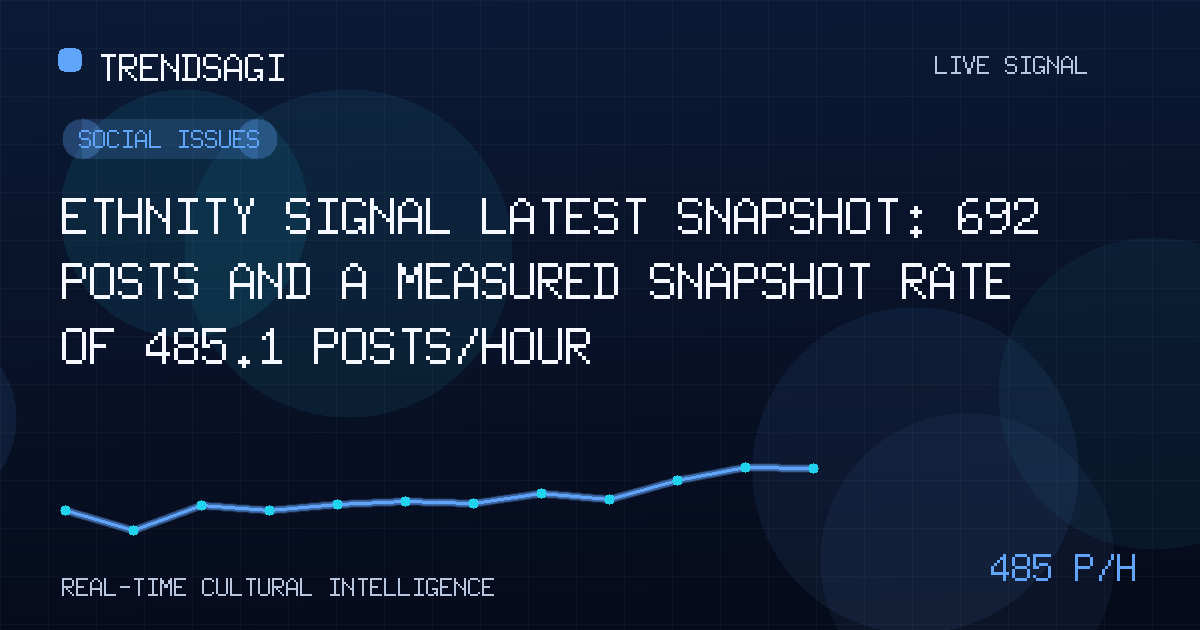
The ethnicity signal contains 692 posts and a measured snapshot rate of 485.1 posts/hour; this briefing separates observed movement from unknown causes.
Automated briefing. Generated from stored signal measurements and source-backed research; it is not manually reviewed. Read the methodology and limitations.
Metrics in this briefing are a snapshot associated with its publication date and may not reflect current conditions.
What changed
The monitored ethnicity signal moved upward in the stored data: the latest snapshot contains 692 posts, and the measured snapshot rate was 485.1 posts/hour. The direct answer is that the count of posts in this collection was rising during the measured window. That makes ethnicity a topic meriting rapid verification, not proof of a settled wider trend.
The measured snapshot rate was recorded at 2026-10-02T09:52:13Z over an exact 1796-second window using 3 stored observations. It is a retrospective measure of change in this monitored collection—not a live or current rate, forecast, reach, engagement total, or unique-person count. The stored record does not identify a trigger, so the reason for the movement remains unclear.
| Measure | Stored observation |
|---|---|
| Observation time | 2026-10-02T09:52:13Z |
| Latest snapshot volume | 692 posts |
| Measured snapshot rate | 485.1 posts/hour |
| Measurement window | Exact 1796-second window |
| Stored observations | 3 |
Read together, the snapshot volume and measured snapshot rate answer a narrow but useful question: where did the monitored stream change enough to deserve attention? They do not establish why it changed, whether the posts represent a single issue or many, or whether the pattern extends beyond this collection.
Why this topic may be moving
A verified public catalyst has not been established. The stored record has no description explaining the signal, and no verified public context accompanies it. The category, Social Issues, and the broad ethnicity label identify the collection, not the event or issue that caused conversation.
Several explanations should be treated as hypotheses until checked:
- A dated news, policy, legal or cultural event prompted renewed discussion about identity, discrimination or belonging.
- A recurring anniversary, awareness campaign or scheduled debate brought existing discussion back into view.
- Conversation migrated from a narrower subject into the broad ethnicity label, combining distinct threads.
- A platform, hashtag or media mix shifted, making the topic more visible to the collection.
- The increase reflects copied content, coordinated posting, spam or a classification change rather than a new public event.
A rising post count can identify a place to investigate, but it cannot show whether the underlying story is new, attention is broadly distributed, or the apparent trend is an artifact.
What the signal can and cannot establish
The signal establishes that the monitored corpus registered upward movement during the stated window and that its latest snapshot contained 692 posts. That is enough to prioritize checking, but not enough to explain the movement or establish its wider importance.
The snapshot cannot establish the geographic reach, platform mix, language distribution, sentiment, factual accuracy or demographic profile of the authors. It also cannot show whether participants posted original material, copied text, reacted to automated accounts or took part in coordinated activity.
Ethnicity is an umbrella label. The collection may combine discussions of discrimination, representation, identity, language, religion, nationality, migration or current events. Without content-level review, those possibilities cannot be separated. The label also provides no reliable basis for inferring any participant’s own ethnicity.
Why it matters
The practical value is triage, not a final verdict. Different readers need different checks before acting on the movement.
- News and social editors should verify a trigger before treating the rise as evidence of a new event or assigning it a political explanation.
- Researchers and civic organizations should not translate post volume into population attitudes; the collection may be narrow, duplicated or unrepresentative.
- Community and policy teams can use the signal to identify where language or monitoring may be needed, while avoiding claims about what an entire ethnic community thinks.
- Platform and trust teams should examine provenance, repetition and coordination before assuming that a broad label describes genuine, organic discussion.
What to watch next
The next checks should distinguish an event-driven spike from topic migration, amplification or a collection artifact. Useful signals include:
- Test a candidate trigger. Search distinctive phrases, named events and policy terms, then inspect relevant publisher or primary-source pages. A named event recurring in the earliest wave, with timing aligned to the movement, is stronger evidence than a vague thematic resemblance.
- Review the onset and provenance. Examine early posts for original reporting, copied text, repeated wording and account behavior. Concentrated copies suggest amplification; varied original contributions suggest a broader conversation.
- Split the umbrella label into subtopics. Group posts around specific incidents, policies, identities and cultural issues. Several unrelated clusters would support topic migration; a repeated shared referent would support a single-event explanation.
- Check who and where the collection sees. Compare platform, geography, language and account overlap. Diverse independent clusters suggest wider discussion; narrow concentration points to a local, platform-specific or collection-specific effect.
- Test persistence. Compare preceding and subsequent snapshots under the same collection rules. A reversal would favor a transient spike; continued movement accompanied by new, distinct clusters would favor an ongoing development.
Methodology and limitations
This briefing uses the supplied snapshot summary and the measured snapshot rate calculated from 3 stored observations across the exact 1796-second window. It does not include post text, account records or a baseline series, so the measurement cannot be independently reproduced here and short-window variation cannot be separated from a durable trend.
The broad label, missing signal description and unknown collection frame limit interpretation. No verified public context establishes a cause, so none is asserted. Any future causal claim should identify its publisher, align its timing with the observed movement and be revised if later snapshots weaken the connection.
Finally, 692 posts is snapshot volume, not audience size; 485.1 posts/hour is the measured snapshot rate, not a live or current rate or a forecast. Neither figure measures sentiment, engagement, unique participants or real-world prevalence.
Track This Topic for New Signals
Set alerts for future velocity or sentiment changes around this topic.
Explore Tracking PlansAbout TrendsAGI research
TrendsAGI's automated research pipeline publishes dated signal snapshots, methodology notes, and practical workflows for teams evaluating cultural momentum. Read how signals are scoped, scored, and limited in our research methodology.