899-second window · 3 observations · Measured Sep 4, 2026, 10:48 AM UTC · Provider: go_recent_snapshot_v2
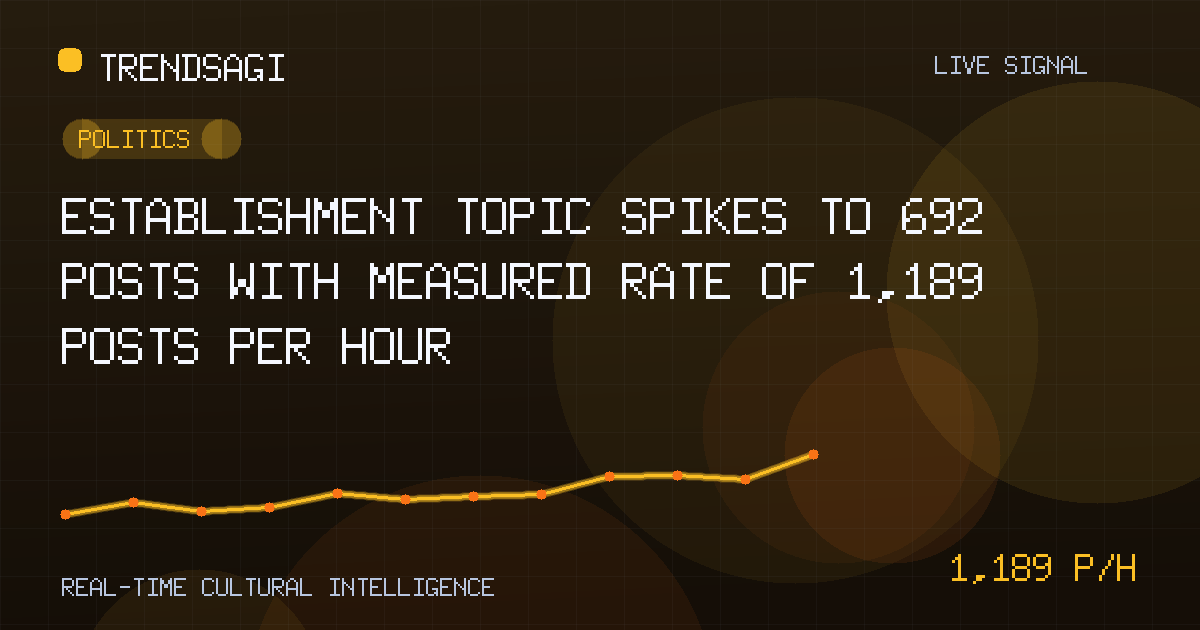
Establishment topic spikes to 692 posts with measured rate of 1,189 posts per hour
Establishment topic hits 692 posts with a measured 1,189 posts/hour rate over 15 minutes. Cause unverified; briefing explains signal limits, who should track
Automated briefing. Generated from stored signal measurements and source-backed research; it is not manually reviewed. Read the methodology and limitations.
Metrics in this briefing are a snapshot associated with its publication date and may not reflect current conditions.
What changed
The "Establishment" topic recorded a snapshot volume of 692 posts at 2026-09-04T10:48:06Z, with a measured change rate of 1,188.9 posts per hour calculated over an exact 899-second window using three stored observations. This measured snapshot rate reflects a short‑term acceleration in posting activity, not a live or projected rate, and does not indicate unique authors or total reach.
| Observation time (UTC) | Measured posts/hour | Snapshot volume |
|---|---|---|
| 2026-09-04T10:48:06Z | 1,188.9 | 692 |
Why this topic may be moving
No verified public event or news story has been confirmed as the driver of this spike. The label "Establishment" is broad and can refer to political institutions, media organizations, cultural gatekeepers, or entrenched power structures across multiple domains. Without a specific news hook — such as a major policy announcement, institutional scandal, or high‑profile resignation — the cause remains unclear. Analysts should treat the surge as a signal of heightened attention rather than evidence of a defined narrative.
Why it matters
Researchers tracking institutional trust, political polarization, or media credibility should note this acceleration. A rapid increase in "Establishment" mentions often precedes or coincides with shifts in public sentiment toward authority figures, regulatory bodies, or legacy media. However, the signal alone cannot establish sentiment direction (positive, negative, or neutral), the specific institution targeted, or whether the conversation is organic or amplified. Brands, policymakers, and communications teams monitoring reputation risk should treat this as an early‑warning indicator warranting deeper qualitative sampling.
"A spike in generic institutional labels typically signals a contested narrative space — audiences are arguing about who counts as the establishment, not just criticizing it."
What to watch next
- Cluster the top 50 posts by engagement to identify whether conversation centers on government, media, academia, corporate boards, or cultural institutions.
- Cross‑reference with sentiment‑tagged datasets to determine if the surge correlates with negative, neutral, or supportive framing.
- Monitor for co‑occurring keywords (e.g., "elite," "mainstream," "deep state," "legacy media") that would narrow the referent.
- Set a threshold alert: if the measured rate exceeds 1,500 posts/hour over a subsequent 15‑minute window, escalate to full narrative analysis.
- Check verified news wires (Reuters, AP, Bloomberg) for any institutional announcements, hearings, or investigations in the 24 hours preceding the snapshot.
Methodology and limitations
The measured rate of 1,188.9 posts/hour derives from three stored observations spanning exactly 899 seconds (approximately 15 minutes) ending at the snapshot timestamp. This is a discrete, short‑window calculation — not a live stream, rolling average, or forecast. Snapshot volume (692) represents the cumulative post count at the observation moment; it is not a rate, engagement metric, or unique‑author count. The "Other" category assignment indicates the signal did not match a predefined thematic bucket. No external verification of causative events was possible at publication time; the briefing will be updated if a confirmed driver emerges.
Track This Topic for New Signals
Set alerts for future velocity or sentiment changes around this topic.
Explore Tracking PlansAbout TrendsAGI research
TrendsAGI's automated research pipeline publishes dated signal snapshots, methodology notes, and practical workflows for teams evaluating cultural momentum. Read how signals are scoped, scored, and limited in our research methodology.