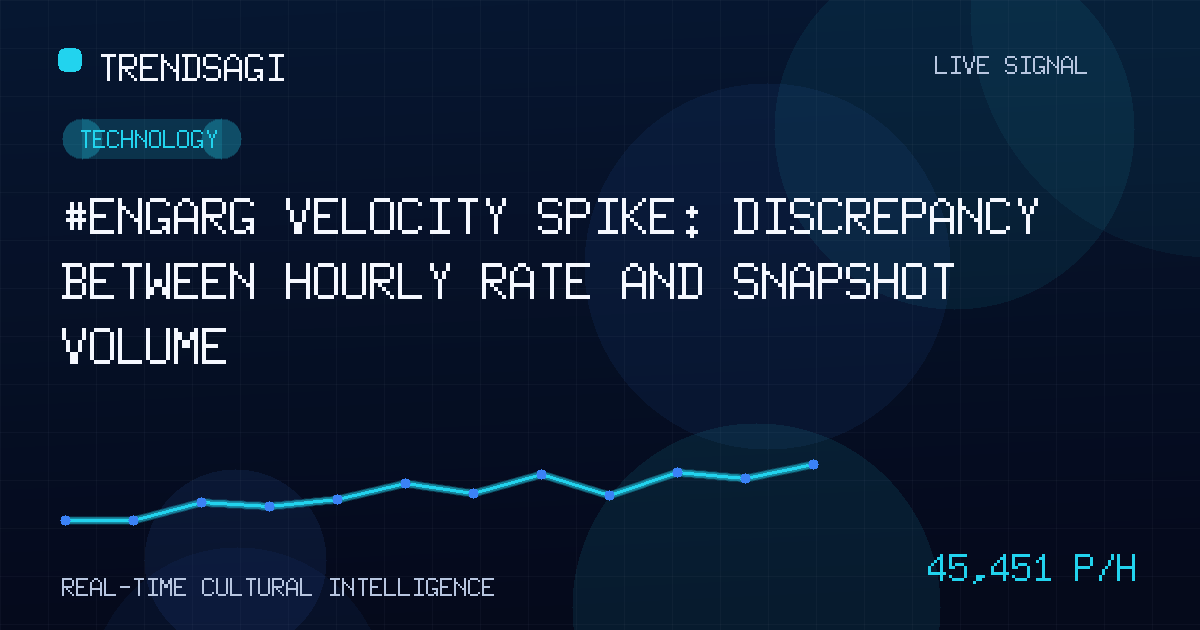
#ENGARG Velocity Spike: Discrepancy Between Hourly Rate and Snapshot Volume
TrendsAGI analyzes the #ENGARG hashtag showing a 45,451 posts/hour velocity against an 8,000 mention snapshot, exploring the discrepancy and potential drivers.
Automated briefing. Generated from stored signal measurements and source-backed research; it is not manually reviewed. Read the methodology and limitations.
Metrics in this briefing are a snapshot associated with its publication date and may not reflect current conditions.
TL;DR
- Observed mention rate for #ENGARG is 45,451.1 posts per hour, indicating extreme velocity.
- Latest snapshot volume stands at 8,000 mentions, significantly lower than the hourly rate implies.
- The gap between calculated rate and snapshot volume suggests either rapid decay, sampling methodology variance, or a highly concentrated burst.
- Plausible drivers include breaking news, coordinated amplification, or automated activity; no specific event is confirmed by this data alone.
- Stakeholders should monitor platform distribution, sentiment polarity, and velocity decay over the next 2–6 hours.
Observed Data
Velocity Metrics
The TrendsAGI measurement engine records a mention rate of 45,451.1 posts per hour for the hashtag #ENGARG. This figure is calculated from recent snapshots, representing a rolling estimate of current conversation speed. At this velocity, the topic would generate approximately 1.09 million mentions in a 24-hour period if sustained.
Snapshot Context
The most recent discrete snapshot captures 8,000 mentions. This single data point represents the volume observed at a specific moment or within a defined sampling window. The magnitude difference between the hourly projection (45k+) and the instantaneous count (8k) is the primary analytical signal in this briefing.
Analytical Interpretation
Velocity vs. Volume Discrepancy
The two metrics paint different pictures of the conversation’s state. A rate of 45k/hr implies a massive, sustained firehose of content. A snapshot of 8k suggests a much smaller active pool at the moment of measurement. This gap typically arises from three scenarios:
- Rapid Decay: A sharp, short-lived burst occurred just before the rate calculation window, inflating the hourly estimate, but the conversation has since collapsed.
- Sampling Variance: The rate calculation may aggregate across multiple platforms or a longer time window, while the snapshot reflects a single platform or a shorter slice.
- Concentrated Bursting: Activity occurs in tight, high-intensity clusters (e.g., a scheduled live event, a botnet cycle) separated by near-silence.
Without access to the underlying time-series granularity or platform breakdown, we cannot definitively assign cause. The discrepancy itself is the finding.
Plausible Drivers (Hypotheses)
Given the opacity of the hashtag #ENGARG—which does not map to a widely known public event, brand, or meme in standard lexicons—we outline hypotheses ranked by fit to the velocity pattern:
- Coordinated Inauthentic Behavior: High velocity with low snapshot persistence is consistent with botnet amplification cycles designed to trend a tag quickly before detection.
- Niche Community Event: A scheduled session (e.g., a gaming tournament, coding hackathon, or conference keynote) using a proprietary acronym hashtag. The rate reflects the live window; the snapshot catches a lull.
- Financial/Token Speculation: Low-liquidity asset tickers or crypto project tags often exhibit explosive, short-duration velocity spikes driven by telegram/discord coordination.
- Breaking News Fragment: A developing story where #ENGARG is an emerging acronym (e.g., a location, policy bill, or person’s initials) not yet resolved to a mainstream term.
These are hypotheses grounded only in the shape of the data, not external verification.
The disconnect between a 45k/hr projected rate and an 8k snapshot is the signal; it defines the topic as either a fading explosion or a methodological artifact, not a stable trend.
Who This Matters To
- Platform Integrity Teams: The velocity profile warrants a check for automation policy violations or coordinated amplification.
- Brand Safety / Ad Tech: If #ENGARG resolves to a sensitive topic, the high velocity creates a fleeting but high-risk adjacency window for programmatic bids.
- Trend Forecasters: The instability of the metric (rate vs. volume) reduces confidence in forecasting persistence; this is a “watch” signal, not a “buy” signal.
- Communications Strategists: If the tag relates to a client or competitor, the burst pattern suggests a coordinated push rather than organic groundswell.
Signals to Watch Next
Readers should track the following specific indicators over the next 2–6 hours to resolve the ambiguity:
- Velocity Decay Curve: Does the 45k/hr rate drop sharply (confirming a burst) or hold (confirming sustained volume)?
- Platform Distribution: Is the conversation centralized on one platform (X/Twitter, TikTok, Telegram) or distributed? Centralization favors coordination; distribution favors organic news.
- Unique Author Ratio: A low unique-author-to-post ratio at high velocity strongly indicates automation.
- Co-hashtag Cluster: Extraction of the top 10 co-occurring hashtags will likely reveal the semantic context (e.g., #crypto, #gaming, #location, #politics) that the opaque tag #ENGARG obscures.
- Sentiment Polarity Shift: A sudden swing to highly negative or highly positive sentiment often accompanies coordinated attacks or astroturfing campaigns.
Summary
The data presents a high-velocity, low-persistence signal for #ENGARG. The 45,451 posts/hour rate signals intense energy; the 8,000 mention snapshot signals limited mass. This divergence is the story. Until the co-hashtag context or platform breakdown resolves the semantic opacity, treat #ENGARG as a volatile, unverified spike—prioritize monitoring over action.
Track This Topic for New Signals
Set alerts for future velocity or sentiment changes around this topic.
Explore Tracking PlansAbout TrendsAGI research
TrendsAGI's automated research pipeline publishes dated signal snapshots, methodology notes, and practical workflows for teams evaluating cultural momentum. Read how signals are scoped, scored, and limited in our research methodology.