921-second window · 2 observations · Measured Oct 6, 2026, 8:40 PM UTC · Provider: go_recent_snapshot_v2
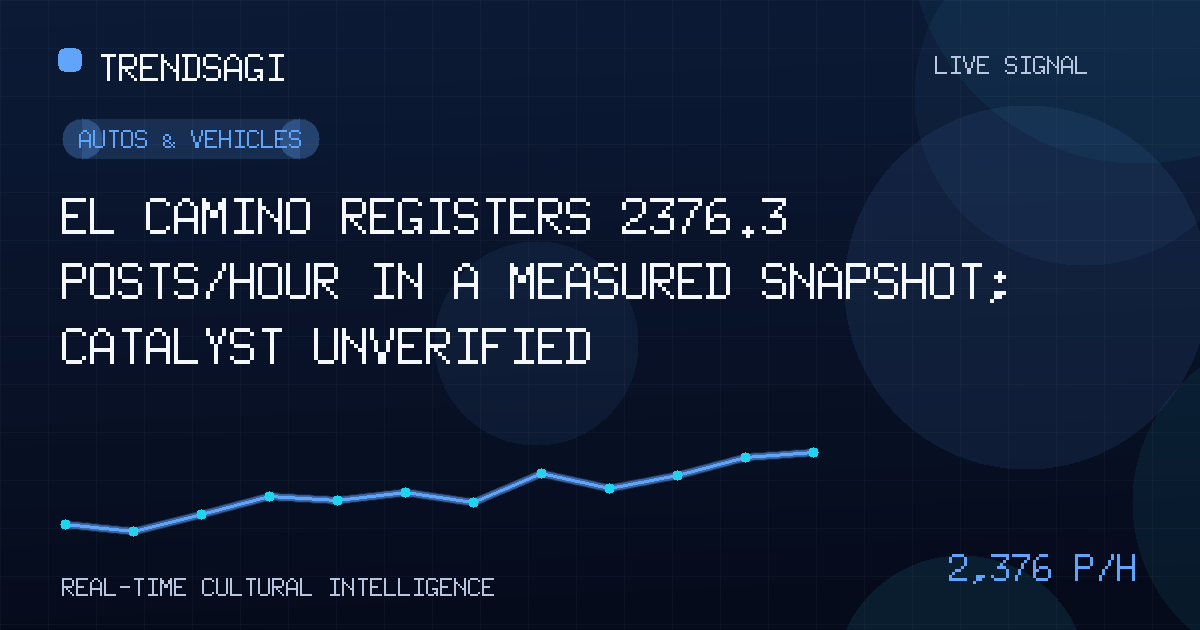
El Camino registers 2376.3 posts/hour in a measured snapshot; catalyst unverified
El Camino registered 2376.3 posts/hour in a measured snapshot; the cause is unverified, with practical checks for scope, timing, and persistence.
Automated briefing. Generated from stored signal measurements and source-backed research; it is not manually reviewed. Read the methodology and limitations.
Metrics in this briefing are a snapshot associated with its publication date and may not reflect current conditions.
What changed
El Camino registered a measured snapshot rate of 2376.3 posts/hour over an exact 921-second window, making the term a priority for rapid verification. The cause remains unclear: no verified public context connects the change to a particular event, announcement, or subject, so this is an activity signal, not yet a confirmed product, news, or audience trend.
The latest observation at 2026-10-06T20:40:51Z contained 1058 posts. That is a snapshot count, not a rate. The 2376.3 posts/hour figure was derived from 2 stored observations and describes change during the 921-second interval; it is not a live or current rate, forecast, reach, engagement figure, or count of unique people.
| Measure | Recorded value |
|---|---|
| Observation time | 2026-10-06T20:40:51Z |
| Measured posts/hour | 2376.3 posts/hour |
| Snapshot volume | 1058 posts |
Why this topic may be moving
No defensible catalyst can be named from the available evidence. The topic label does not establish what “El Camino” refers to in the posts. The stored Autos & Vehicles category supplies context, but it does not prove that every post concerns a vehicle. A vehicle-related discussion, an unrelated use of the same phrase, or a mixture of both could sit under one label; the available record does not show their proportions.
The editorial conclusion should therefore stay narrow: posting frequency changed during the measured window, but the reason did not emerge in the stored signal. A cause would require corroboration from a contemporaneous public source and from a review of representative posts showing what entity or issue they discuss. Until both are available, naming a trigger would turn an observable change into an unsupported story.
The rate shows how busy a label was in a measured window; only corroborated context can show why.
What the signal can establish
The following points are supportable:
- Observed activity: the latest snapshot contains 1058 posts at the stated observation time.
- Short-window change: the measured rate is 2376.3 posts/hour across 921 seconds, based on 2 observations.
- Verification need: the volume and pace justify checking the conversation, even though they do not identify its subject.
The signal cannot establish who posted, whether people were unique, how widely the material circulated, what sentiment dominated, where the audience was, whether activity was spontaneous or automated, or whether the burst continued. It also cannot show business impact, such as consideration, purchase intent, or traffic. Those questions need post-level review and separate audience or outcome data.
Why it matters
For automotive editors, analysts, community teams, and brand monitors, a high posting rate can serve as an early warning that something may be worth checking. The value is in the speed of the alert: verification can happen while the underlying conversation is still developing. That makes the signal useful for editorial monitoring, source checking, and research triage.
Readers should not treat it as a confirmed vehicle story until the referent and trigger are established. Teams that publish or respond based on the label alone risk amplifying the wrong conversation. Teams that ignore it because the cause is unknown risk missing the relevant one. The appropriate response is a short verification pass, not a definitive narrative.
What to watch next
Use the following checks to turn the alert into a supported trend or close it as unresolved:
- Resolve the referent. Read a representative sample of captured posts and record which meaning dominates. Separate posts that discuss a vehicle from other uses of the phrase. A stable identity is a prerequisite for explaining the movement.
- Align the timing. Compare the onset of concentrated activity with verified public announcements and coverage. A credible catalyst should precede or coincide with the activity, not merely appear after it. Timestamp precision matters.
- Test persistence. Compare subsequent stored observations over consistent windows. Determine whether activity stays elevated, fades quickly, or merely rolls from one short burst into another; the current measurement cannot establish a durable trend.
- Measure composition. Check how much activity is original commentary versus quoted or duplicated material, and whether a single account or small cluster is generating much of the volume. This helps distinguish broad discussion from concentration or coordinated posting.
- Track outcome signals. Look for independently verifiable changes in search interest, official-page activity, relevant reporting, or audience behavior. Keep those separate from post volume, which measures conversation frequency rather than reach or commercial effect.
A useful confirmation standard is simple: the topic should have a consistent referent, a time-aligned verified catalyst, and a pattern that persists beyond this 2-observation measurement. Failing one test may justify continued monitoring, but not a confident causal claim.
Methodology and limitations
The measurement uses 2 stored observations over an exact 921-second window, with the rate recorded at 2026-10-06T20:40:51Z. The latest snapshot contains 1058 posts. The snapshot count and rate answer different questions and should not be combined or converted into one another. The available record does not specify that they cover identical collection intervals.
Most importantly, the rate is measured, not live. It can be sensitive to the chosen window and to the behavior captured at each endpoint. Two observations are insufficient to establish seasonality, a normal baseline, a geographic pattern, or the cause of the movement. No verified external context is available here, so this briefing deliberately leaves the catalyst unresolved rather than inferring one from the category or the phrase.
Treat El Camino as a verification lead: the observed volume warrants investigation, but it does not prove a specific trend.
Track This Topic for New Signals
Set alerts for future velocity or sentiment changes around this topic.
Explore Tracking PlansAbout TrendsAGI research
TrendsAGI's automated research pipeline publishes dated signal snapshots, methodology notes, and practical workflows for teams evaluating cultural momentum. Read how signals are scoped, scored, and limited in our research methodology.