901-second window · 3 observations · Measured Sep 7, 2026, 12:55 PM UTC · Provider: go_recent_snapshot_v2
Efficiency-Led Growth: Analyzing the September 2026 Business Signal Surge
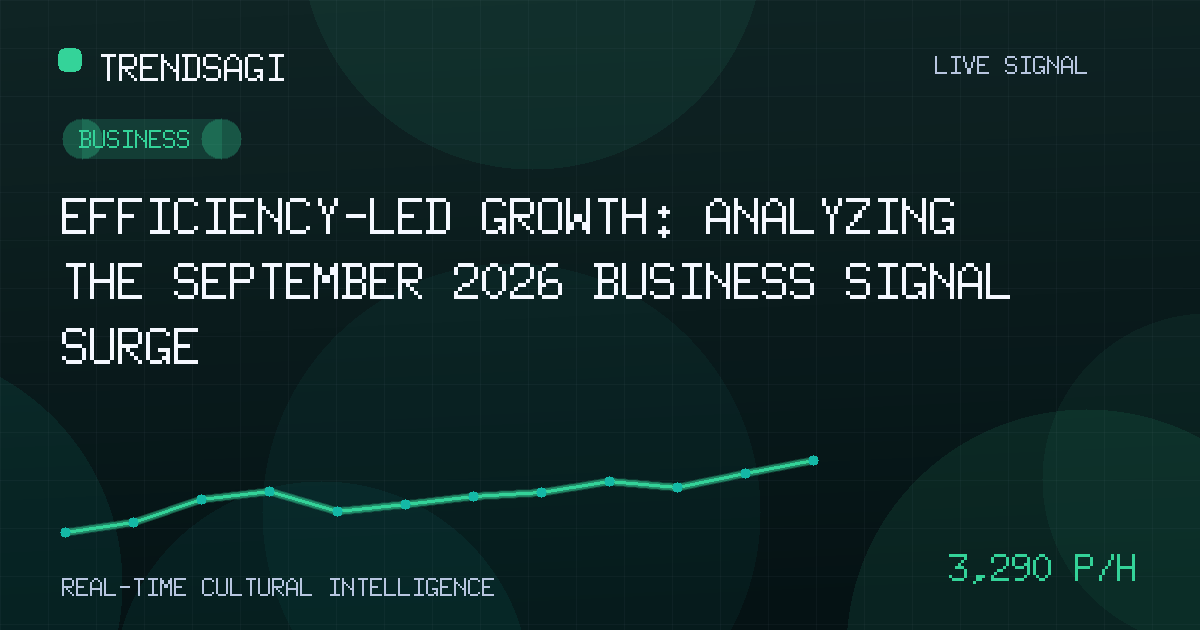
Business growth discourse reached 3,290.1 posts/hour on Sept 7, 2026. Analysis shows a shift toward efficiency-led growth and margin-accretive expansion.
Automated briefing. Generated from stored signal measurements and source-backed research; it is not manually reviewed. Read the methodology and limitations.
Metrics in this briefing are a snapshot associated with its publication date and may not reflect current conditions.
What changed
On September 7, 2026, business discourse surrounding the topic of "Growth" experienced a significant surge in velocity, reaching a measured snapshot rate of 3,290.1 posts per hour. This volume, captured at 12:55:44Z, represents a concentrated peak in strategic planning and macroeconomic discussion. The signal indicates a pivot away from traditional scaling narratives toward a more disciplined, efficiency-first growth model. Unlike previous cycles defined by aggressive capital expenditure, the current signal suggests a market-wide preoccupation with margin-accretive expansion and the optimization of existing assets as the primary drivers of enterprise value.
| Observation Time | Measured Snapshot Rate | Snapshot Volume |
|---|---|---|
| 2026-09-07 12:55:44Z | 3,290.1 posts/hour | 2,880 posts |
Why this topic may be moving
The timing of this signal—occurring in early September—coincides with a critical juncture in the 2026 fiscal calendar. While specific breaking news events are often the catalyst for such surges, the broader context points toward the commencement of the "Q4 Strategic Alignment" window. Traditionally, the first full week after the September Labor Day holiday in the United States serves as the informal kickoff for annual budgeting and long-term planning for the subsequent fiscal year.
At the time of this observation, the business community appears to be wrestling with the transition from the high-growth experiments of the mid-2020s to a more grounded "growth-at-a-reasonable-price" (GARP) sentiment. The velocity of 3,290.1 posts per hour suggests a high degree of consensus-building or, conversely, a sharp debate regarding capital allocation priorities. Specifically, the discussion is moving due to several factors:
- Budgetary Reframing: Corporate leaders are finalizing 2027 projections, with a heavy emphasis on how growth targets can be met without expanding headcount at historical ratios.
- Yield Expectations: Investor pressure has shifted toward the quality of revenue. A signal of this magnitude suggests that "Growth" is no longer being treated as a generic positive, but is being scrutinized for its impact on net income.
- Technological Maturation: By late 2026, the early-adoption phase of autonomous workflows has shifted into a scaling phase. The conversation is likely moving because organizations are now reporting the first meaningful "growth dividends" from these implementations.
"The definition of business growth in 2026 has fundamentally decoupled from the traditional correlation with operating expenses. We are observing a shift where growth is measured not by the size of the footprint, but by the density of the value generated per unit of capital."
Why it matters
For executives and strategists, this signal establishes that the market's appetite for "growth at all costs" has reached a definitive low point. When a topic like Growth surges in a business category at this rate, it signals a shift in the competitive baseline. Companies that continue to pitch traditional expansion strategies may find themselves misaligned with the current institutional sentiment.
Strategic Rebalancing: The surge suggests that the most successful narratives in the current market are those that combine growth with resilience. For founders and CEOs, this means that the internal metrics currently being celebrated by the community are likely efficiency ratios, customer lifetime value (LTV) to acquisition cost (CAC) improvements, and net retention. If your organization is not prioritizing these metrics in its public or investor-facing communications, you are likely operating against the current trend.
Resource Allocation: The signal matters because it often precedes a shift in where capital flows. High-velocity business discussions often translate into a tightening of investment in speculative growth and a redirection toward "Growth Engineering"—the practice of using data and automation to find incremental gains in existing funnels. This is a move toward a more scientific, less speculative form of business development.
What to watch next
To determine if this signal represents a long-term shift in the business cycle or a seasonal spike, several secondary indicators should be monitored over the coming weeks:
- Earnings Call Language: Monitor the Q3 2026 earnings transcripts for a specific increase in the use of the term "efficient growth" vs. "expansion." A 15% increase in this terminology across S&P 500 companies would confirm the signal's durability.
- Labor Productivity Data: Watch for the next release of national productivity statistics. If the growth signal is indeed being driven by efficiency, we should see a corresponding uptick in output per hour worked.
- VC Funding Stages: Observe whether Series B and C funding rounds in late 2026 prioritize companies with lower burn rates over those with higher top-line growth. This will validate the signal's impact on the private markets.
- Growth Engineering Hires: A surge in job postings for roles that blend data science with marketing (Growth Product Managers, Growth Engineers) will indicate that companies are operationalizing the sentiment captured in this signal.
Methodology and limitations
This briefing is based on a measured snapshot rate of 3,290.1 posts per hour, derived from three distinct observations over a 901-second window on September 7, 2026. This is a high-frequency measurement intended to capture real-time sentiment shifts. However, it is important to understand what this signal can and cannot establish.
What it establishes: The signal confirms a high intensity of public and professional discourse regarding the term "Growth" within a business context at a specific point in time. It identifies a significant moment of topical alignment or controversy that is engaging a broad base of observers.
Limitations: This rate is a snapshot and does not constitute a long-term forecast or a measure of unique individuals. The volume of 2,880 posts provides a solid base for sentiment analysis but does not represent the entirety of the global business conversation. Furthermore, as the data is categorized under "Business," it may exclude growth discussions happening in purely technical or political spheres unless they directly intersect with commercial interests. This signal should be used as a lead indicator for further qualitative research rather than a sole basis for major investment decisions.
Track This Topic for New Signals
Set alerts for future velocity or sentiment changes around this topic.
Explore Tracking PlansAbout TrendsAGI research
TrendsAGI's automated research pipeline publishes dated signal snapshots, methodology notes, and practical workflows for teams evaluating cultural momentum. Read how signals are scoped, scored, and limited in our research methodology.