1395-second window · 3 observations · Measured Aug 27, 2026, 9:38 PM UTC · Provider: go_recent_snapshot_v2
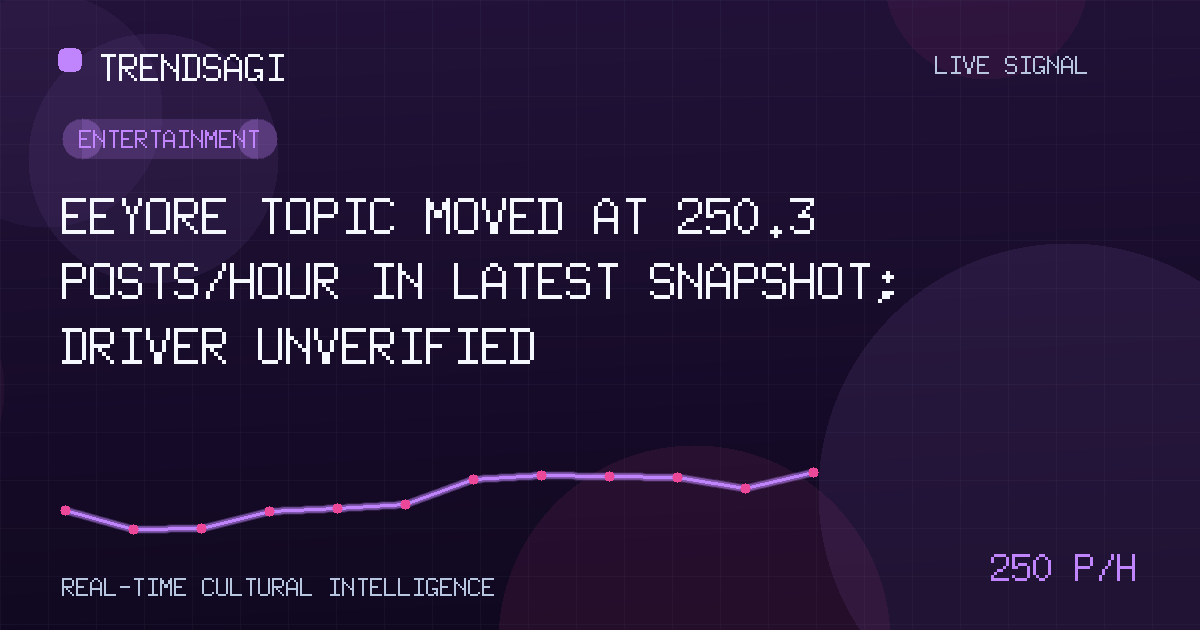
Eeyore Topic Moved at 250.3 Posts/Hour in Latest Snapshot; Driver Unverified
Eeyore topic showed a measured snapshot rate of 250.3 posts/hour with 220 posts at 2026-08-27T21:38:02Z; the driver is unverified.
Automated briefing. Generated from stored signal measurements and source-backed research; it is not manually reviewed. Read the methodology and limitations.
Metrics in this briefing are a snapshot associated with its publication date and may not reflect current conditions.
What changed
The Eeyore topic moved in the latest observation window. Over an exact 1,395-second window ending at 2026-08-27T21:38:02Z, three stored observations produced a measured snapshot rate of 250.3 posts/hour. The latest snapshot volume was 220 posts. This is a snapshot rate, not a live rate, a forecast, reach, engagement, or a unique-person count.
The signal is short on context. The stored category is Other, and the stored description is empty. The label points to Eeyore, but the data alone does not say whether this refers to the Winnie-the-Pooh character, a melancholic mood, a meme, a product, or another usage. The direct answer is therefore a boundary: the topic is measurably moving, but the driver remains unverified.
| Observation time (UTC) | Measured snapshot rate | Snapshot volume |
|---|---|---|
| 2026-08-27T21:38:02Z | 250.3 posts/hour | 220 posts |
Why this topic may be moving
No verified public explanation has been confirmed for this briefing. Without a stored description, the 250.3 posts/hour figure could reflect organic conversation, coordinated posting, reposts of older material, or a short-lived event. The snapshot alone cannot separate those possibilities.
If Eeyore refers to the familiar Winnie-the-Pooh character, plausible drivers would include a media anniversary, a new adaptation, a public figure quoting the character, or a meme cycle built around sadness or resignation. If Eeyore refers to something else, such as a company name, a song, or a product release, the verification path would be different. None of these drivers has been confirmed here.
Why it matters
The signal is useful for teams that need to catch an emerging topic early. At 220 posts and 250.3 posts/hour, this is not a mass-scale conversation, but it is a measurable burst. In social listening, that is enough to justify a closer look before the topic either grows or fades.
A measured snapshot rate of 250.3 posts/hour tells you when and how fast the observed volume moved; it does not tell you why it moved, who moved it, or whether the movement will continue.
Brand and communications teams should care because an unexplained topic burst is sometimes an early warning. Editorial teams should care because the Eeyore label is ambiguous; a story that assumes a Winnie-the-Pooh reference without confirmation would be a reporting risk. Researchers should care because the rate and volume provide a time-bounded measurement, even though the cause is unknown.
Specifically, this signal can establish that a topic labeled Eeyore moved at a measured rate of 250.3 posts/hour during the observation window and that the snapshot volume was 220 posts. It cannot establish whether the posts are positive or negative, whether they come from one platform or many, whether the authors are unique, whether the content is original or repeated, or whether the movement is a reaction to an actual event.
What to watch next
The next checks are practical and cheap. Wait for a second observation window and compare the new measured rate against 250.3 posts/hour, rather than treating this single snapshot as a durable trend. Then inspect the content behind the volume, because the label alone will not tell you what people are actually saying.
- Next snapshot rate: check whether the rate holds above 250.3, rises, or decays. A single window is not a trend.
- Volume growth: watch whether the 220-post snapshot becomes materially larger. A rising volume after a rate spike would suggest amplification.
- Post content: look for a shared phrase, image, or link. A common reference will identify the driver faster than a keyword-only review.
- Account behavior: note whether high-volume accounts repeat identical text. That pattern would point to automation or coordinated posting.
- Baseline comparison: compare against earlier Eeyore-topic snapshots if available. Without a baseline, 250.3 posts/hour is hard to classify as unusually high.
The strongest signal to look for next is a verified external anchor: a widely shared post, a news item, or a public figure mention that explains why this label started moving. Until that anchor appears, the prudent interpretation is that Eeyore is an active but unexplained topic label.
Methodology and limitations
This briefing is based on a canonical stored signal captured at 2026-08-27T21:38:02Z. The measured change rate was calculated from three stored observations over an exact 1,395-second window. The rate is a snapshot rate, not a live or projected rate. The 220-post figure is a point-in-time snapshot volume, not a cumulative count for a longer period.
The stored category is Other, and the stored description is empty. No external source was verified for this briefing, so the cause of the movement remains unconfirmed. The label Eeyore should be treated as an identifier from the signal, not as proof of meaning.
Track This Topic for New Signals
Set alerts for future velocity or sentiment changes around this topic.
Explore Tracking PlansAbout TrendsAGI research
TrendsAGI's automated research pipeline publishes dated signal snapshots, methodology notes, and practical workflows for teams evaluating cultural momentum. Read how signals are scoped, scored, and limited in our research methodology.