902-second window · 3 observations · Measured Sep 27, 2026, 1:41 AM UTC · Provider: go_recent_snapshot_v2
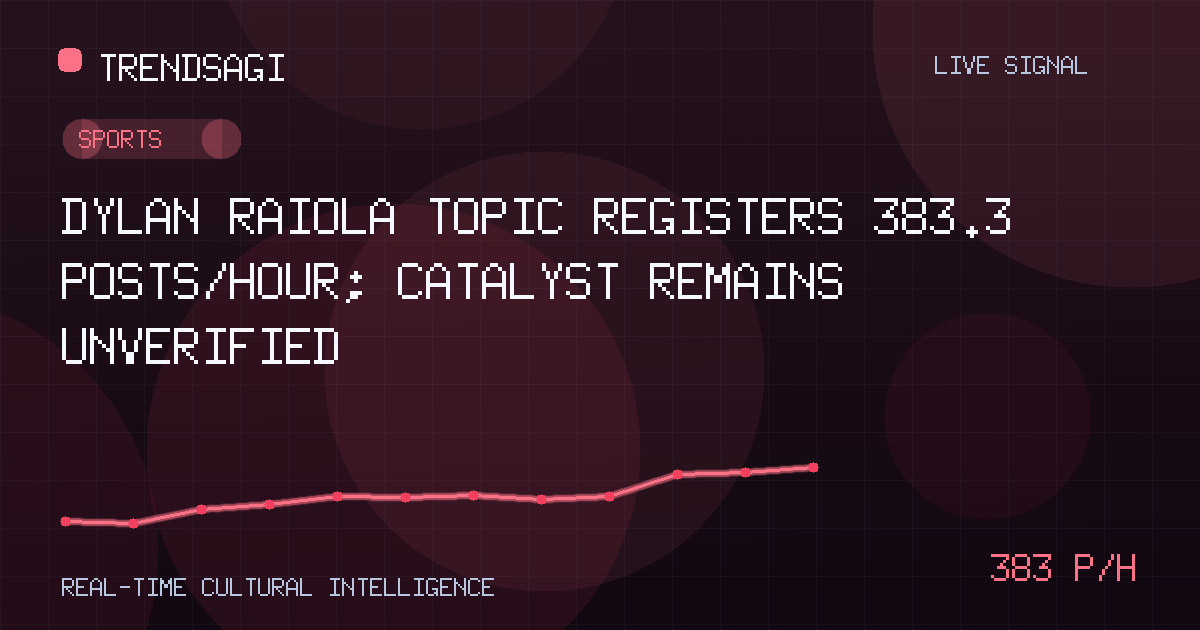
Dylan Raiola topic registers 383.3 posts/hour; catalyst remains unverified
The Dylan Raiola monitor showed 186 posts and a measured 383.3 posts/hour over 902 seconds; verify the event before treating the burst as explained.
Automated briefing. Generated from stored signal measurements and source-backed research; it is not manually reviewed. Read the methodology and limitations.
Metrics in this briefing are a snapshot associated with its publication date and may not reflect current conditions.
What changed
The sports-category monitor labeled “Dylan Raiola” showed 186 posts in its latest stored snapshot, observed at 2026-09-27T01:41:27Z. That is a timestamped count captured by the monitor, not a count of unique people, impressions, engagements, or events.
Across an exact 902-second window using 3 stored observations, the signal registered a measured snapshot rate of 383.3 posts/hour. This establishes the pace of post-volume change inside that sampled window. It is not a live or current rate, a forecast, reach, engagement, or a unique-person count. No verified public context establishes why the topic moved, so the catalyst remains unconfirmed.
| Observation time | Measured snapshot rate | Latest snapshot volume |
|---|---|---|
| 2026-09-27T01:41:27Z | 383.3 posts/hour | 186 posts |
The two figures answer different questions. The 186 posts describe the latest sampled level; 383.3 posts/hour describes measured change between stored observations. Neither should substitute for the other, and the snapshot alone does not show how many posts were original, duplicated, quoted, or automated.
What the signal can—and cannot—establish
The defensible finding is narrow but useful: a monitored name generated concentrated post-volume change in the observed interval.
- Observed movement: The stored calculation identifies a measured change rate, making the movement worth checking.
- Sampled scale: The latest observation supplies a concrete volume, giving later snapshots a reference point.
- Editorial priority: The combination can justify rapid verification, but not a claim about news importance.
It does not establish who posted, whether people were unique, what the posts said, how they felt, where they came from, or whether an external event occurred. It also does not show whether attention persisted after the observation. Any claim about a game, injury, announcement, controversy, record, or social-media clip would need independent confirmation before publication.
A measured rate tells an editor when to look; only verified context tells the editor what happened.
Why this topic may be moving
The available record contains no verified catalyst and no stored description explaining the spike. The rate therefore identifies a change, not its cause.
For a name-centered sports topic, the first verification targets are likely to be event timing and source composition:
- Did a game, result, or roster development occur close to the observation?
- Did the person named Dylan Raiola make a confirmed announcement or appear in a widely shared media moment?
- Did discussion begin with a substantive post, or with quotes, reactions, and recirculation?
- Is the monitor capturing a different Dylan Raiola or unrelated uses of the same name?
These are questions, not findings. Nothing in the stored signal confirms any of them. Until a public event or authoritative statement is verified, the most accurate explanation is simply that post volume changed rapidly for an unidentified reason.
Why it matters
A fast social signal can be useful precisely because it is incomplete: it tells stakeholders where to investigate, not what conclusion to publish.
- Followers and fans should verify whether a real development exists before repeating a performance, availability, or personal-news claim. Name collisions can distort attention.
- Editors and analysts should separate a measurable spike from a verified event and inspect timing, source mix, and duplication before assigning significance.
- Teams, schools, representatives, or other connected stakeholders should treat the snapshot as potential attention, not evidence of reach, impact, or public sentiment. A short spike may be transient.
The practical risk is false specificity: filling the causal gap with a plausible sports story. A restrained briefing is more reliable than a confident but unverified explanation.
What to watch next
The next checks should preserve comparability and seek a verifiable trigger rather than infer one from volume alone.
- Confirm identity and scope. Verify the exact spelling, relevant affiliation, and likely namesake collisions. A Sports category alone does not establish which person the monitor describes.
- Build a timestamped event timeline. Check public search results and first-party pages around 2026-09-27T01:41:27Z for a result, announcement, availability update, interview, or other occurrence. Compare original publication times with the observed interval.
- Audit the earliest posts. Identify what first added information, then separate original posts from quotes, reposts, reactions, copied wording, and media clips. This tests whether the monitor saw a new event or redistribution.
- Look for primary confirmation. Seek a confirmed statement from an organization or person verifiably connected to the topic, or a reliable report that directly attributes the development. Repetition alone is not confirmation.
- Compare subsequent snapshots. Keep the same query, exclusions, and collection method. Determine whether later measured volume remains above, near, or below the 383.3 posts/hour comparison point. That figure describes one window; it is not a threshold or forecast.
- Check concentration and integrity. Review whether activity is dominated by repeated text, synchronized bursts, a small set of repost networks, or unrelated name uses. None of those patterns is established here yet.
A useful stopping point is either a verified catalyst with supporting timestamps or a conclusion that the burst cannot be explained. If neither emerges, report the movement and its limits rather than manufacture a reason.
Methodology and limitations
The quantitative record consists of a latest snapshot of 186 posts at 2026-09-27T01:41:27Z and a measured change rate of 383.3 posts/hour over an exact 902-second window using 3 stored observations. The measured figure is a snapshot rate for the sampled interval, not the latest volume and not a live rate after the observation.
No verified public catalyst was available, and the stored signal contains no descriptive account of the movement. The analysis does not add sentiment, geography, unique-account, engagement, source-level, or duplicate-post findings because those data are absent. The result supports one conclusion: the monitor registered rapid post-volume change, while its cause and persistence remain unknown.
Track This Topic for New Signals
Set alerts for future velocity or sentiment changes around this topic.
Explore Tracking PlansAbout TrendsAGI research
TrendsAGI's automated research pipeline publishes dated signal snapshots, methodology notes, and practical workflows for teams evaluating cultural momentum. Read how signals are scoped, scored, and limited in our research methodology.