895-second window · 2 observations · Measured Oct 3, 2026, 9:10 PM UTC · Provider: go_recent_snapshot_v2
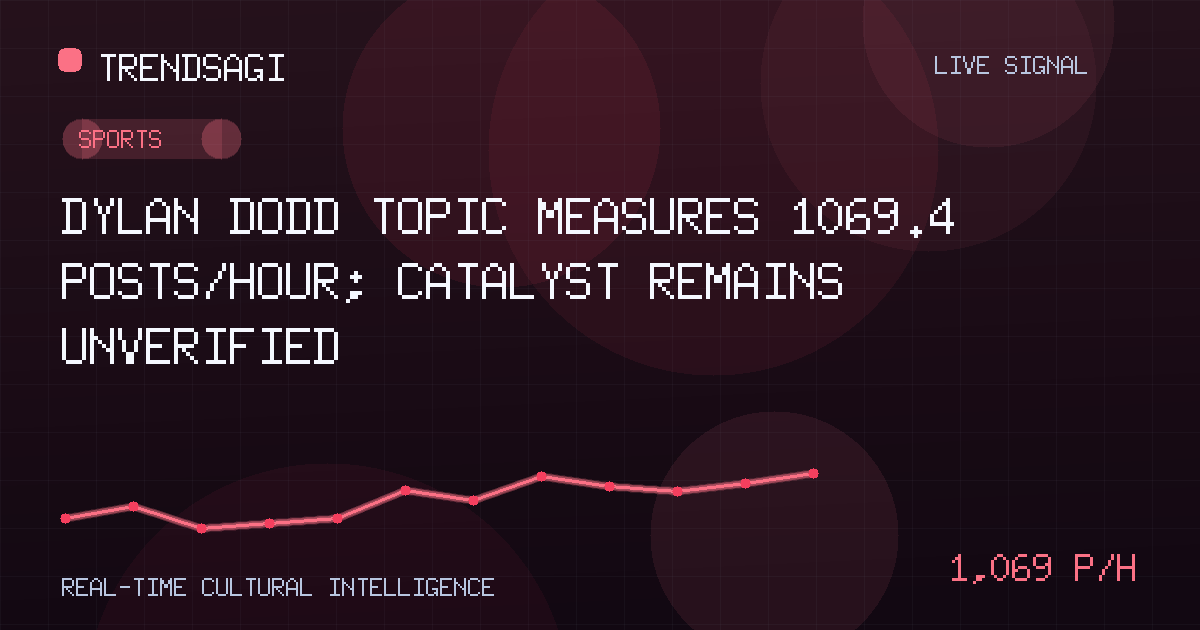
Dylan Dodd topic measures 1069.4 posts/hour; catalyst remains unverified
The Dylan Dodd label recorded a measured 1069.4 posts/hour snapshot change; see what it means, what is unverified, and what to check next.
Automated briefing. Generated from stored signal measurements and source-backed research; it is not manually reviewed. Read the methodology and limitations.
Metrics in this briefing are a snapshot associated with its publication date and may not reflect current conditions.
What changed
The monitored topic labeled “Dylan Dodd” registered a measured increase in stored activity, but the available record does not establish what prompted it. No explanatory description or verified public context connects the label to a particular sports event, so this should not yet be presented as confirmation of a breaking development involving a specific person, team, or organization.
The measured snapshot rate was 1069.4 posts/hour, calculated over an exact 895-second window using two stored observations and measured at 2026-10-03T21:10:33Z. The latest stored snapshot contained 464 posts. These are historical snapshot measurements, not a live rate, forecast, reach figure, engagement total, or count of unique people.
| Field | Value |
|---|---|
| Observation time | 2026-10-03T21:10:33Z |
| Measured snapshot rate | 1069.4 posts/hour |
| Latest snapshot volume | 464 posts |
Why this topic may be moving
The cause remains unclear. The record categorizes the topic as Sports, but classification alone does not show whether the label refers to an athlete, coach, broadcaster, creator, account, quotation, or a different person sharing the same name. It also does not prove that sports news is driving the activity.
Several mechanisms could produce the observed pattern, and each remains a hypothesis rather than a finding:
- A newly published sports item could have prompted reaction, sharing, or follow-up commentary.
- A few highly active accounts could account for a substantial share of the observed posts.
- A quote, repost, or duplicated item could amplify an older story without creating new reporting.
- An older item could have resurfaced after being linked elsewhere.
- A name collision or misspelling could have combined discussion about multiple subjects.
A targeted Google Search should look for a dated report from an identifiable publisher or a primary source that explicitly connects the exact label to the activity. Publication timing should be checked against the observation window, and the connection should be established before assigning a real-world cause. No such verified linkage is available in the supplied record.
The stored data supports a narrow conclusion: activity associated with the label increased at the measured snapshot rate during the sampled window. It does not identify the catalyst, the people posting, or the real-world event behind the posts.
What the signal can and cannot establish
The signal is useful for triage because it identifies where additional verification may be warranted.
- It establishes: a measured snapshot rate of 1069.4 posts/hour, the exact sampling window, the measurement time, and the latest stored post count.
- It does not establish: whether the increase was unusual relative to a longer baseline, how long it lasted, or whether activity continued afterward.
- It does not measure: unique authors, original posts, impressions, engagement, sentiment, geography, or audience size.
- It does not resolve: the identity behind the Dylan Dodd label, whether multiple subjects were conflated, or whether the activity was organic, automated, coordinated, or largely duplicated.
The Sports category is therefore a routing label, not causal evidence. Any article, alert, or social response should distinguish clearly between the observed post activity and the still-unverified reason for it.
Why it matters
- Sports editors should verify the entity and event before producing follow-up coverage. A fast-moving label is not a substitute for a confirmed news hook.
- Newsroom and audience teams need to know whether discussion represents broad interest or repetition concentrated among a small group of accounts.
- Communication, brand, and reputation teams should first confirm which Dylan Dodd is involved so that monitoring is not misdirected because of a name collision.
- Trend and social analysts should treat the measurement as a short-window alert that requires baseline, duplication, and account-level checks.
What to watch next
The immediate objective is not to amplify the label but to determine whether the spike has a verifiable, durable explanation.
- Resolve the entity: Check whether reputable reporting or a primary sports source identifies the relevant Dylan Dodd and supplies a role, team, or other context. Do not infer an identity from the topic label alone.
- Verify the catalyst: Use Google Search to find timely reporting that predates or aligns with the observation window. Attribute any accepted external fact to the publisher that reported it.
- Inspect the burst: Review the earliest and most frequently copied posts, separate original material from quotes and reposts, and check whether a small set of accounts dominates the count.
- Establish a baseline: Compare this 895-second window with adjacent windows and a longer period. That would show whether 1069.4 posts/hour reflects a sustained shift or a brief burst.
- Look for independent confirmation: Multiple reputable publishers or a primary source linking the same person and event would be stronger evidence than repeated links to one originating post.
- Watch for weakening evidence: A rapid drop in the next observation, heavy duplication, or evidence that unrelated people share the label would argue against treating the spike as a unified sports trend.
A stronger case for a genuine event would require both a verified catalyst and evidence that the post activity centers on the same resolved subject. A weaker case would be one dominated by a single account, copied text, or mixed identities.
Methodology and limitations
The 1069.4 posts/hour figure is a measured snapshot rate based on two stored observations across an exact 895-second window associated with 2026-10-03T21:10:33Z. It describes the measured change between those observations; it is not a live rate, a projection, or evidence of audience reach.
The 464-post figure is the latest stored snapshot volume. It answers a different question from the rate and should not be substituted for it, added to it, or interpreted as a unique-person count.
No longer-term baseline, account-level distribution, query definition, deduplication method, geographic scope, language filter, sentiment breakdown, or verified event linkage is supplied. With only two observations, the signal can flag a change for investigation but cannot establish its duration, cause, authenticity, or broader significance. The appropriate editorial posture is therefore to preserve the alert while withholding a causal claim pending verification.
Track This Topic for New Signals
Set alerts for future velocity or sentiment changes around this topic.
Explore Tracking PlansAbout TrendsAGI research
TrendsAGI's automated research pipeline publishes dated signal snapshots, methodology notes, and practical workflows for teams evaluating cultural momentum. Read how signals are scoped, scored, and limited in our research methodology.