911-second window · 3 observations · Measured Sep 3, 2026, 12:37 AM UTC · Provider: go_recent_snapshot_v2
Dragon Ball Super snapshot: 192 posts and 304.3 posts/hour measured rate
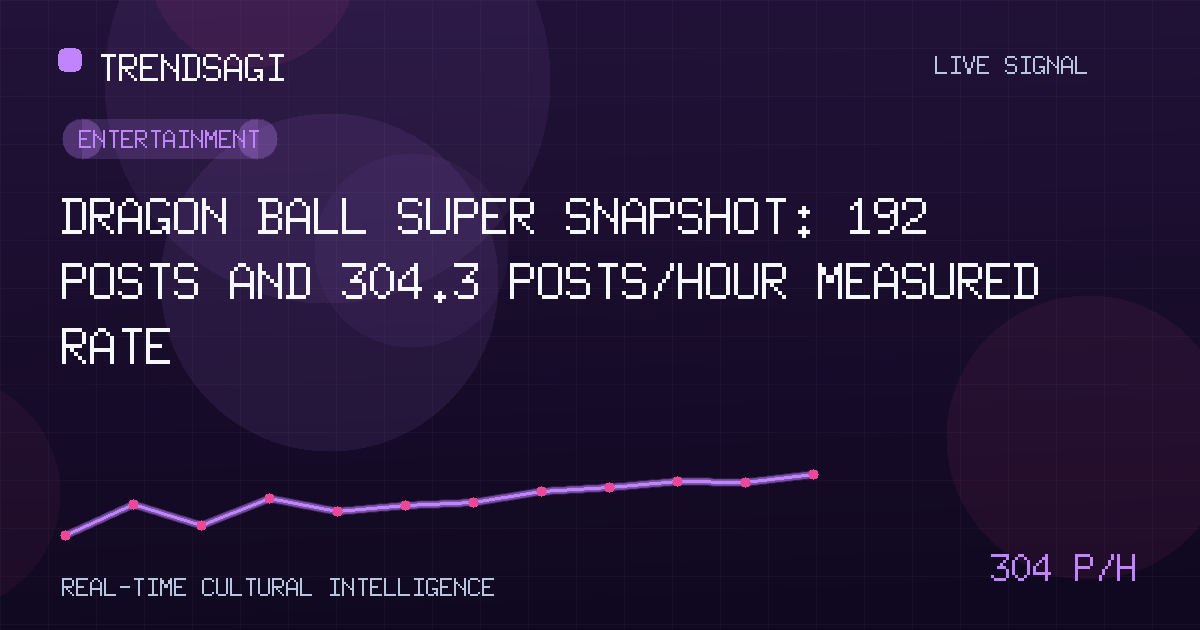
Stored signal recorded 192 posts and a 304.3 posts/hour measured snapshot rate at 2026-09-03T00:37:08Z; cause remains unverified.
Automated briefing. Generated from stored signal measurements and source-backed research; it is not manually reviewed. Read the methodology and limitations.
Metrics in this briefing are a snapshot associated with its publication date and may not reflect current conditions.
What changed
At the 2026-09-03T00:37:08Z snapshot, the stored Dragon Ball Super signal showed 192 posts and a measured snapshot rate of 304.3 posts/hour over an exact 911-second window using three stored observations. That is a high short-term posting speed for the monitored Entertainment topic, but it does not by itself explain why the topic is moving or establish a live current rate, audience size, or engagement level.
| Observation time | 2026-09-03T00:37:08Z |
| Measured posts/hour | 304.3 |
| Snapshot volume | 192 posts |
Why this topic may be moving
The available stored signal does not include a verified public cause for the increase. The practical interpretation is therefore narrow: the monitored source produced 192 posts and a 304.3 posts/hour measured snapshot rate during the 911-second window, and the topic was classified as Entertainment. That can be consistent with several ordinary explanations, including a new episode or announcement, a fan-driven discussion, a clip or edit circulating, a release related to the franchise, or a spike in repetitive or coordinated posting. Without verified public context, none of those explanations should be stated as fact. The absence of a verified cause is not a failure; it is the correct state until external checks can be completed.
A useful distinction is between the signal and the story. The signal tells us that posting speed was high in a short stored window. It does not tell us whether the posts were original, positive, critical, promotional, spammy, or related to a single event. It also does not tell us whether the spike was broad or concentrated in a small set of accounts, posts, or media formats.
A 304.3 posts/hour measured snapshot rate is a speed indicator, not proof of an official announcement, a franchise milestone, or a change in overall audience size.
Why it matters
For entertainment monitoring, a topic that moves quickly can be early evidence of audience attention. The value of this particular signal is that it gives a compact, timestamped baseline: 192 posts and 304.3 posts/hour in a measured 911-second window. That baseline can be compared with later snapshots to decide whether the topic is accelerating, flattening, or fading. The topic also matters because it is a named entertainment property with a fan base; even when the immediate cause is unclear, the stored rate creates a concrete trigger for verification.
The signal is useful for several readers:
- News desks need a prompt to check whether a franchise update is generating broader coverage.
- Franchise and brand teams need to know if audience conversation is shifting, positive, or distressed.
- Community teams need to identify whether fan discussion is organic or distorted by repetitive posting.
- Research teams need a clean example of how short-window rates can look dramatic without a verified story behind them.
If the rate is driven by a real event, early detection can support faster reporting, social response, content scheduling, or audience analysis. If the rate is not tied to a verified event, the main value is still diagnostic: it shows the monitoring system has captured a notable short-term burst and gives the team a clear point from which to investigate.
What to watch next
The next useful step is not to interpret the first spike as the full story, but to compare it against what happens in the following snapshots. A short burst can be a one-time spike, a gradual climb, or the beginning of a longer discussion. A good target is to identify whether the next two snapshots show the same magnitude, because two consecutive comparable snapshots are stronger evidence than one.
Practical checks to run next include:
- Compare the next measured posts/hour against 304.3 and note whether the topic is rising, holding, or falling.
- Check the timestamp and platform source for the 192-post snapshot to confirm the observation window is still valid.
- Sample a small number of posts to see if they refer to a specific episode, announcement, image, clip, quote, or controversy.
- Look for repeated phrases, hashtags, or media formats that may indicate coordinated activity rather than organic conversation.
- Check whether the topic appears in other monitored sources or public entertainment coverage at the same time.
- Track related terms, character names, release titles, or creator names that may clarify the cause.
If a cause becomes verified, the briefing should update from unverified cause to a specific explanation. If no cause appears after several snapshots, the more honest conclusion is that the signal captured a short-term posting burst without a confirmed public driver.
Methodology and limitations
This briefing uses the stored observation only. The snapshot was observed at 2026-09-03T00:37:08Z, the latest stored volume was 192 posts, and the measured change rate was 304.3 posts/hour over an exact 911-second window using three stored observations. The posts/hour figure is described as a measured snapshot rate, not a live current rate, forecast, reach metric, engagement metric, or unique-person count.
The main limitations are:
- The stored signal description is empty, so there is no stored narrative to confirm the cause.
- No verified public context was available, so the cause remains unclear.
- A 911-second window can be sensitive to timing; short windows can overstate or understate longer movement.
- Post counts do not establish reach, unique users, sentiment, quality, or commercial relevance.
- The topic label is treated as an entertainment signal, not as proof that every post is on-topic or high-quality.
The appropriate next use of this data is triage: preserve the baseline, verify the source behavior, and only then connect the topic to a specific public event or explanation.
Track This Topic for New Signals
Set alerts for future velocity or sentiment changes around this topic.
Explore Tracking PlansAbout TrendsAGI research
TrendsAGI's automated research pipeline publishes dated signal snapshots, methodology notes, and practical workflows for teams evaluating cultural momentum. Read how signals are scoped, scored, and limited in our research methodology.


