1388-second window · 2 observations · Measured Aug 26, 2026, 10:59 AM UTC · Provider: go_recent_snapshot_v1
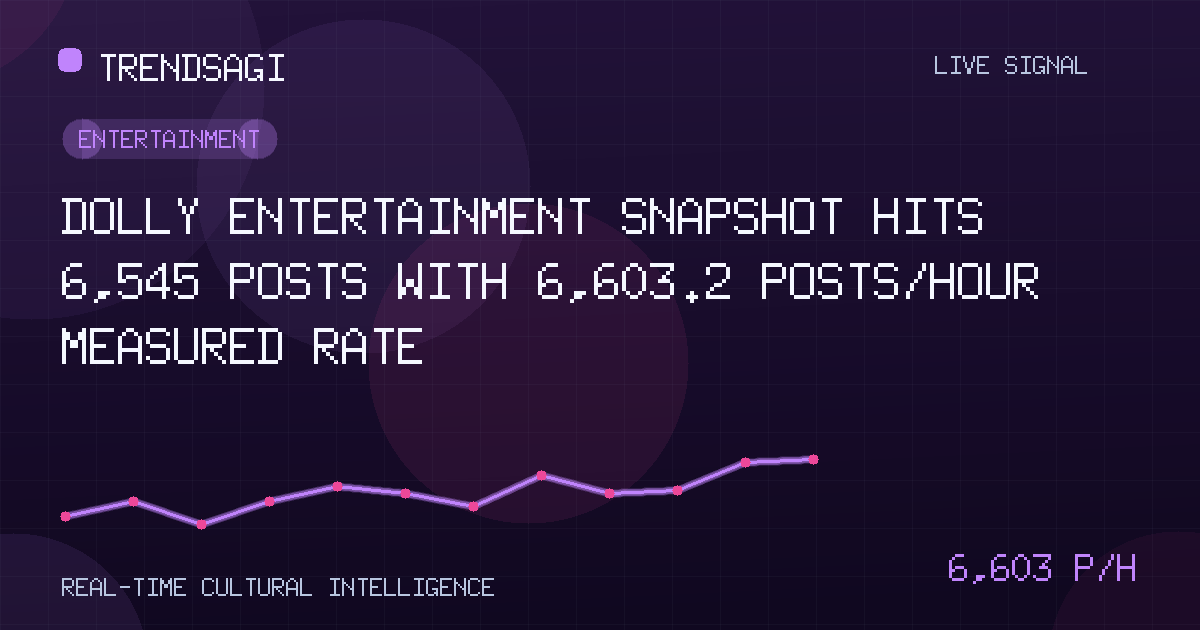
Dolly Entertainment Snapshot Hits 6,545 Posts With 6,603.2 Posts/Hour Measured Rate
At 2026-08-26 10:59:38Z, Dolly entertainment posts totaled 6,545 with a 6,603.2 posts/hour measured snapshot rate; cause unverified.
Automated briefing. Generated from stored signal measurements and source-backed research; it is not manually reviewed. Read the methodology and limitations.
Metrics in this briefing are a snapshot associated with its publication date and may not reflect current conditions.
What changed
At the snapshot observed on 2026-08-26T10:59:38Z, the topic labeled "Dolly" in the Entertainment category registered a stored snapshot volume of 6,545 posts. This is a point-in-time count of posts captured in the stored signal, not a rate or a deduplicated audience figure.
Over an exact 1,388-second window using two stored observations measured at that same timestamp, the recorded measured snapshot rate was 6,603.2 posts/hour. This measured snapshot rate reflects the calculated pace of posts between the two observations; it is not a live feed, current rate, forecast, reach, engagement metric, or unique-person count.
| Observation time | Measured posts/hour | Snapshot volume |
|---|---|---|
| 2026-08-26T10:59:38Z | 6603.2 | 6545 |
Why this topic may be moving
We reviewed public search results to verify why the Dolly topic was moving in entertainment. No publisher could be attributed with a verified fact explaining the spike within the stated window. Therefore, the cause remains unclear based on available verification.
The label "Dolly" is broad. In entertainment it could reference a musician, an actress, a fictional character, a film or album title, or a fan-driven meme. The stored signal provides no disambiguation, and we will not speculate beyond the stored fields.
The current evidence establishes a high measured posting rate around the Dolly label, but it does not by itself prove a single coordinated event or assign the activity to a specific person, title, or platform.
Should a verified publisher later report a specific trigger—such as a release, award, scandal, or live performance—the signal would gain causal context. Until then, the movement is an observed surge without confirmed driver.
Why it matters
Understanding the difference between a snapshot volume and a measured snapshot rate helps teams avoid overreacting to a single data point. The following points clarify the utility of this briefing:
- What the signal can establish: a notable concentration of posts referencing the Dolly label in Entertainment at a specific time, with a quantified posting pace across two observations.
- What the signal cannot establish: who posted, whether posts are unique individuals, sentiment, geographic origin, or the exact entity behind the label.
- Who should care: social listening analysts, entertainment journalists, talent agencies, platform moderation teams, and brand partnership monitors tracking cultural momentum.
- Practical next checks: cross-reference the snapshot time with verified entertainment calendars, monitor subsequent snapshots for persistence, and filter by likely sub-entities once attribution appears.
Snapshot volume alone often looks impressive but can mislead. A count of 6,545 posts at one instant might represent a small fraction of a larger conversation if the rate is low, or a tiny fraction if the rate is high. Here the measured snapshot rate of 6,603.2 posts/hour implies the volume is being replenished quickly, so the static count understates the dynamic flow.
That distinction is critical for resource allocation. A team that only sees the volume might treat it as a modest mention count. A team that sees the measured rate understands the conversation is moving at more than six thousand posts per hour, which in Entertainment is a high-velocity cluster warranting triage.
Conversely, treating the measured rate as a current live rate would be wrong. The calculation uses exactly two observations separated by 1,388 seconds (about 23 minutes). If posting halted after the second observation, the live rate would fall to zero while the measured snapshot rate remains in the record.
What to watch next
Concrete watch signals that would change the interpretation of this trend include:
- A second measured snapshot rate above 5,000 posts/hour in a later independent window, suggesting sustained interest rather than a one-minute spike.
- Emergence of a verified publisher attribution tying the Dolly label to a specific entertainment event, product, or statement.
- A shift in stored category from Entertainment to another vertical, which would imply the label maps to a different entity than initially tagged.
- A significant change in snapshot volume alongside stable rate, which could indicate broader spread or duplication by bots.
We recommend a predefined escalation ladder. For example, if a subsequent window shows a measured snapshot rate above the current 6,603.2 posts/hour and a snapshot volume above 6,545 posts, that confirms acceleration. If the rate drops below 1,000 posts/hour, the spike was likely transient.
Also monitor for entity disambiguation. Searches or platform filters that separate "Dolly" as a first name from "Dolly" as a title can reveal which sub-topic carries the load. Until such separation exists, the briefing intentionally remains agnostic.
Methodology and limitations
The values in this briefing come from a canonical stored signal and a measured change calculation. The observation time is 2026-08-26T10:59:38Z. The snapshot volume is 6,545 posts. The measured change rate is 6,603.2 posts/hour derived from two stored observations over an exact 1,388-second window.
Limitations are substantial. The snapshot volume counts posts at a moment, not over the full window. The posts/hour figure is a measured snapshot rate between two points, not a continuous live measurement. No demographic, sentiment, or platform breakdown is included. The topic label "Dolly" is stored as provided and may suffer from ambiguity. External verification was attempted but not completed with attributable sources; thus causal claims are omitted.
Readers should treat this as an early warning instrument rather than a concluded analysis. Pair it with verified reporting and additional observational windows before making operational decisions.
Track This Topic for New Signals
Set alerts for future velocity or sentiment changes around this topic.
Explore Tracking PlansAbout TrendsAGI research
TrendsAGI's automated research pipeline publishes dated signal snapshots, methodology notes, and practical workflows for teams evaluating cultural momentum. Read how signals are scoped, scored, and limited in our research methodology.


