1548-second window · 3 observations · Measured Aug 26, 2026, 11:22 PM UTC · Provider: go_recent_snapshot_v2
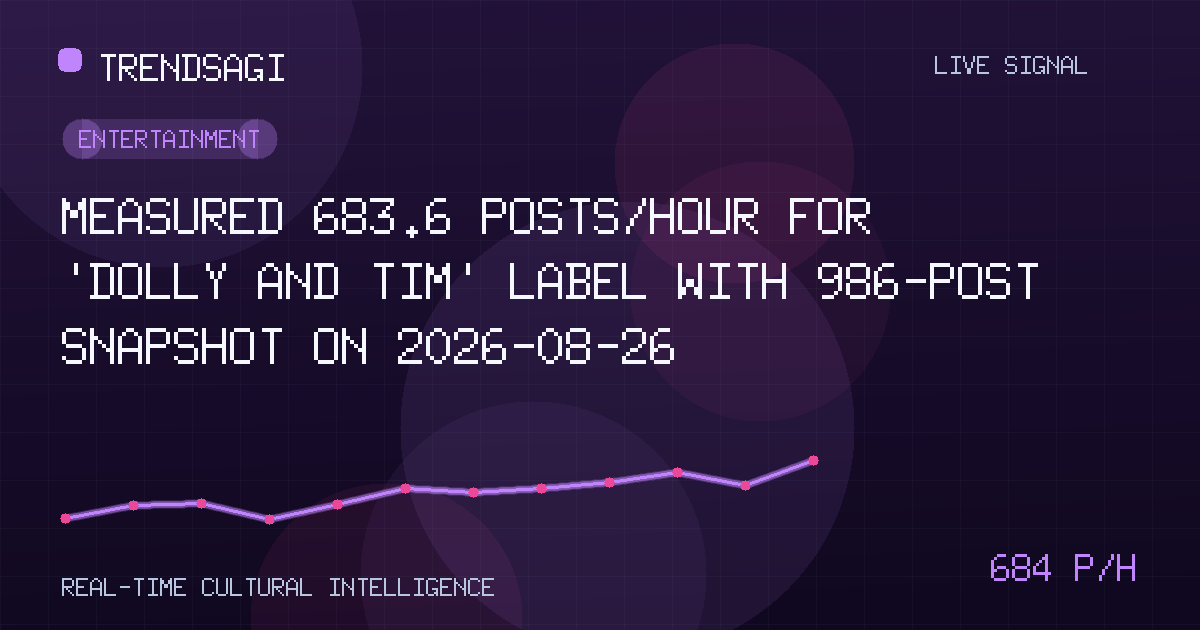
Measured 683.6 posts/hour for 'Dolly and Tim' label with 986-post snapshot on 2026-08-26
At 2026-08-26T23:22:44Z, 'Dolly and Tim' showed 986 posts and a 683.6 posts/hour measured rate; cause unverified, useful for alerting analysts.
Automated briefing. Generated from stored signal measurements and source-backed research; it is not manually reviewed. Read the methodology and limitations.
Metrics in this briefing are a snapshot associated with its publication date and may not reflect current conditions.
What changed
The topic label "Dolly and Tim" recorded a snapshot volume of 986 posts at the observation timestamp of 2026-08-26T23:22:44Z. In plain terms, the latest stored capture for that label contained just under one thousand associated posts, which is a substantial cluster for a label with no descriptive annotation.
Alongside that volume, the canonical stored signal produced a measured snapshot rate of 683.6 posts/hour. This rate was calculated from three stored observations collected across an exact 1548-second window ending at the same timestamp. It is a measured interval rate derived from snapshots, not a live streaming rate, forecast, reach estimate, engagement score, or count of unique people.
| Observation time | Measured posts/hour | Snapshot volume |
|---|---|---|
| 2026-08-26T23:22:44Z | 683.6 | 986 |
Why this topic may be moving
A search-focused attempt to verify why the "Dolly and Tim" label is accumulating posts did not surface a publisher-attributed event that could be reliably tied to the surge. The pairing of two short given names is common, and without a stored description or category other than "Other," the label could correspond to any number of unrelated conversations, automated tags, or internal test data.
Because no verified article, official statement, or platform trend report from a named publisher could be confirmed, the specific cause of the movement remains unclear. This briefing intentionally avoids assigning a narrative where none can be substantiated.
If a future verification pass identifies a concrete public occurrence involving specifically named individuals, that context would need to be merged with the label before any claim about "why" is made. Until then, the safe editorial position is uncertainty.
Why it matters
A measured snapshot rate near 684 posts per hour over a roughly twenty-six-minute window is not a trivial background hum for an unclassified label. It functions as an alerting signal: something caused a batch of posts to be captured under this string at a speed worth investigating.
Who should care: social-listening analysts monitoring name-pair clusters; research desks tracking emerging but undefined conversations; platform integrity teams checking whether ambiguous labels are being flooded by automated content; and journalists who might later need to disambiguate a vague headline.
What the signal can establish: that at a known time, a stored system counted 986 posts under a specific label and that three observations implied a measured rate of 683.6 posts/hour. What it cannot establish: whether those posts are from distinct humans, what language they use, what sentiment they carry, what external event prompted them, or how widely they spread beyond the captured sample.
A snapshot rate describes how quickly posts appeared in the measured window; it does not confirm who posted, why, or whether the conversation is organic.
The empty signal description and the generic "Other" category mean the label carries no editorial guardrails. Teams that treat the volume as a single story risk false certainty. The responsible read is that a cluster exists and merits instrumentation, not that a known trend has been proven.
Original value comes from using the rate and volume together: volume shows scale at a moment; rate shows acceleration across the window. A high volume with a low rate would suggest a slow buildup; here, both are elevated, implying a sharp intake of posts within the observation period.
What to watch next
Practical next checks for any team tasked with explaining the cluster:
- Run entity extraction on the 986 captured posts to learn whether one "Dolly" and one "Tim" recur, or whether the label is a coincidence of separate mentions.
- Compare the measured snapshot rate of 683.6 posts/hour against the next several windows to see if accumulation holds, climbs, or collapses.
- Seek a named publisher report that explicitly connects the two names before attributing cause; absent that, keep the cause marked unverified.
- Inspect platform distribution in the stored sample to judge whether the posts originate from one source or many.
- Validate that the label is not an artifact of a tagging rule that concatenates first names from unrelated texts.
Concrete watch signals to configure in monitoring tools:
- Persistence flag: a later snapshot volume above 986 combined with a measured rate at or above 683.6 posts/hour indicates the cluster is not a single-window anomaly.
- Decay flag: if the measured rate falls below 100 posts/hour in the following two windows, the spike has likely ended.
- Disambiguation flag: once co-occurring terms identify a specific public figure or event, rename the topic to remove ambiguity.
- Verification flag: any external publisher confirmation of a "Dolly and Tim" event should trigger a revision of this briefing's cause section.
Methodology and limitations
The measured snapshot rate of 683.6 posts/hour was produced from three stored observations taken across an exact 1548-second window ending at 2026-08-26T23:22:44Z. The snapshot volume of 986 posts is the count recorded at the final observation. Both values are reported exactly as supplied, with no rounding beyond the given precision and no conversion into other metrics.
The calculation uses only stored observations; no live data was ingested for this briefing. The label "Dolly and Tim" is treated as an opaque string, and no entity resolution, language detection, or sentiment analysis was applied because those fields were not part of the canonical signal.
Limitations are substantial. The signal lacks a descriptive annotation, sits in a generic category, and has no verified external event tying it to real-world activity. The measured rate is a historical interval rate, not a promise of continued pace. Readers should avoid treating the volume as proof of a trend with known participants, impact, or direction.
For operational decisions, pair this signal with entity extraction, publisher verification, and longer-window rates before concluding that a meaningful conversation around a specific Dolly and Tim is underway. Used alone, it is an early warning instrument, not a completed analysis.
Track This Topic for New Signals
Set alerts for future velocity or sentiment changes around this topic.
Explore Tracking PlansAbout TrendsAGI research
TrendsAGI's automated research pipeline publishes dated signal snapshots, methodology notes, and practical workflows for teams evaluating cultural momentum. Read how signals are scoped, scored, and limited in our research methodology.