15-minute window · 3 observations · Measured Sep 29, 2026, 4:36 PM UTC · Provider: go_recent_snapshot_v2
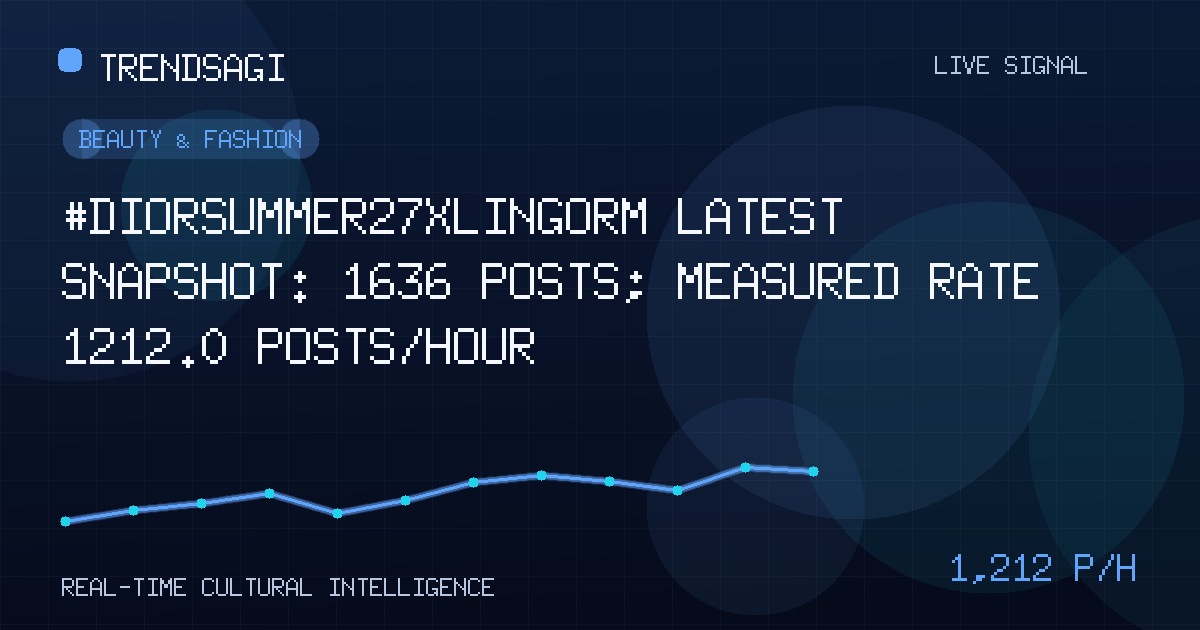
#DiorSummer27xLingOrm latest snapshot: 1636 posts; measured rate 1212.0 posts/hour
#DiorSummer27xLingOrm logged 1636 posts in the latest snapshot, with a measured 1212.0 posts/hour rate; the cause remains unverified.
Automated briefing. Generated from stored signal measurements and source-backed research; it is not manually reviewed. Read the methodology and limitations.
Metrics in this briefing are a snapshot associated with its publication date and may not reflect current conditions.
What changed
The stored signal for #DiorSummer27xLingOrm shows a concentrated increase in tagged posting activity: the latest snapshot contained 1636 posts at 2026-09-29T16:36:30Z. The measured snapshot rate was 1212.0 posts/hour, derived from an exact 900-second window using 3 stored observations. That is the defensible headline: activity was increasing around the tag, but the reason for that change is not established.
The posts/hour figure is a measured snapshot rate, not a live or current rate, forecast, reach figure, engagement total, or count of distinct people. Likewise, 1636 is the volume observed in the latest snapshot, not a rate. No verified public context accompanies the signal, so it would be premature to attribute the movement to a launch, appearance, collaboration, controversy, or celebrity post.
| Observation time | Measured snapshot rate | Snapshot volume |
|---|---|---|
| 2026-09-29T16:36:30Z | 1212.0 posts/hour Exact 900-second window; 3 stored observations | 1636 posts |
Why this topic may be moving
The signal is stored under Beauty & Fashion, but its description is blank. The wording of the tag appears to connect Dior, Summer 27, and LingOrm. It does not establish what Summer 27 denotes, whether LingOrm is a person, account, campaign label, or another reference, or what the x is intended to mean.
With no verified trigger, several explanations remain possible. They should be treated as checks to run, not findings:
- Verified first-party activity: An official Dior announcement, relevant verified channel post, collection or editorial release, or public appearance could seed conversation. Confirmation would require a matching first-party source and a timeline that explains the tag.
- Amplification by publishers or creators: Coverage, creator reposting, or a fan campaign could extend an initial post. The key test is whether public items cite an earlier, identifiable source rather than merely repeating the hashtag.
- Audience reaction: Positive attention, criticism, surprise, or confusion could all produce volume. Without post-level review, none should be presented as the dominant sentiment.
- Coordinated or repetitive use: Invitation threads, duplicate text, repost chains, or automated behavior can raise a post count faster than distinct participation. Account-level review is needed to separate those patterns.
- Topic ambiguity: A loosely formed or crowded tag may be adopted for relevance rather than one specific event. Adjacent hashtags and the words used alongside the exact tag would help clarify its boundaries.
Why it matters
For brand, communications, and talent teams, the signal is best treated as an early warning that attention may be forming around a particular label. It can prioritize verification and monitoring. It cannot yet support a claim that a campaign succeeded, that a collaboration is confirmed, or that a public figure is driving demand.
For fashion and beauty editors, the value is temporal rather than interpretive: the tag merits a source check while the observed activity is recent. For trend and social analysts, it creates a testable benchmark. The next useful question is not simply whether the number grows, but whether verified origins, original contributions, distinct accounts, and sustained activity corroborate it.
The signal establishes concentrated tagged-post activity at the measured moment, but it does not establish who generated the posts, why they appeared, how many people were involved, or how long the activity will last.
What to watch next
- Identify the earliest verifiable source. Review accessible posts around the observation time and follow their cited announcements or media. Record who made the first substantiated claim, what it concerned, and whether the exact tag appeared in the original material.
- Check the relevant official channels. Look for matching updates from verified Dior channels and from a channel verified as belonging to LingOrm, if that identity and account are confirmed. A display name or fan account is not enough.
- Test whether the rate persists. Compare subsequent stored observations using the same 900-second approach and the same exact-tag definition. A continued elevated measured rate would be more informative than carrying the current 1212.0 posts/hour figure forward as if it remained current.
- Separate originals from duplication. Classify sampled posts as original, repost, reply, or copy; inspect repeated text and media; and count distinct posting accounts where the available data permits. This is the clearest route to testing whether 1636 posts represent broad participation or repeated circulation.
- Measure breadth and context. Check whether activity spans unrelated accounts, languages, markets, and media types rather than a single cluster. Review adjacent tags and common accompanying words to determine whether the conversation is about one event or several colliding stories.
- Read the claims, not just the volume. Distinguish praise, criticism, questions, and neutral mentions, then identify the concrete product, event, appearance, or claim driving them. A verified explanation should be supported by the cited source and timing, not inferred from the tag.
Escalation signals: corroboration from a verified first-party source; growth in original posts and distinct accounts; sustained measured activity across later windows; or credible coverage that links back to the same originating event. A larger raw post count by itself is weaker evidence than these checks.
Methodology and limitations
The supplied record categorizes the topic as Beauty & Fashion but provides no stored description. The 1212.0 posts/hour figure is the supplied measured snapshot rate for an exact 900-second window using 3 stored observations, and the 1636 figure is the latest snapshot volume. They are different measures and should not be substituted for one another.
The underlying observations, collection platform, query rules, deletion handling, duplication controls, and account-level data are not provided here. The rate therefore cannot be independently reconstructed, and the snapshot cannot be used to estimate unique participants, reach, engagement, sentiment, or future demand.
The evidence can support a concise conclusion about observed and changing posting activity. It cannot establish authenticity, organic momentum, causation, or persistence. Because no verified public context identifies the trigger, the cause remains unclear and is intentionally left unresolved.
Track This Topic for New Signals
Set alerts for future velocity or sentiment changes around this topic.
Explore Tracking PlansAbout TrendsAGI research
TrendsAGI's automated research pipeline publishes dated signal snapshots, methodology notes, and practical workflows for teams evaluating cultural momentum. Read how signals are scoped, scored, and limited in our research methodology.


