1805-second window · 3 observations · Measured Sep 28, 2026, 4:56 AM UTC · Provider: go_recent_snapshot_v2
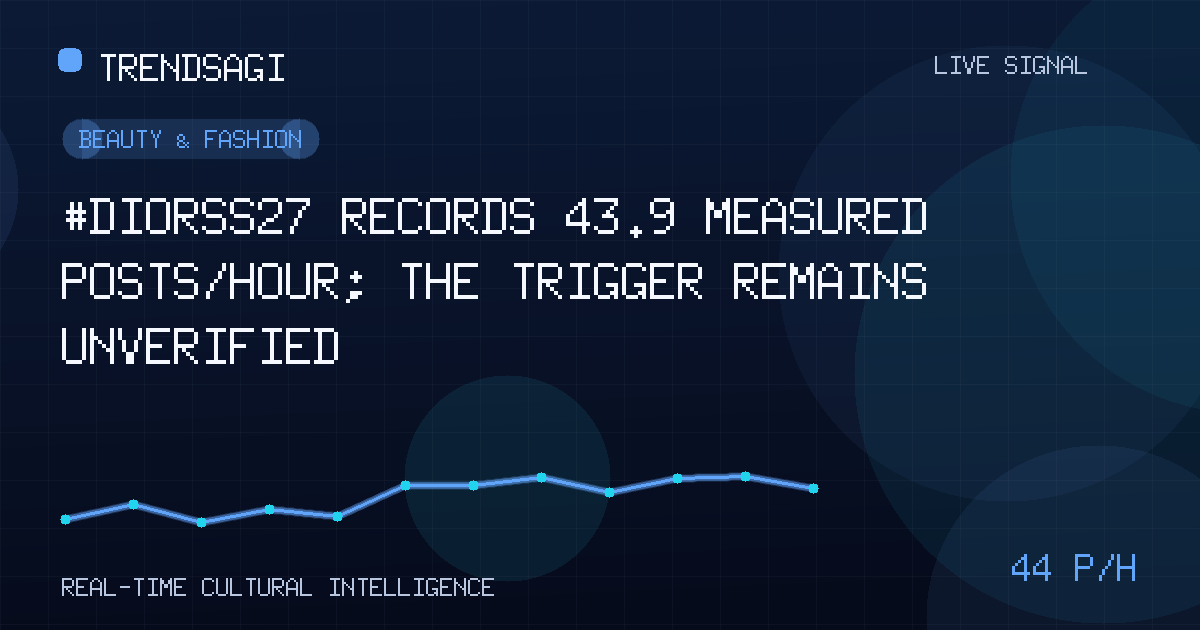
#DiorSS27 records 43.9 measured posts/hour; the trigger remains unverified
The #DiorSS27 snapshot contains 60 posts and a measured rate of 43.9 posts/hour; the cause remains unverified.
Automated briefing. Generated from stored signal measurements and source-backed research; it is not manually reviewed. Read the methodology and limitations.
Metrics in this briefing are a snapshot associated with its publication date and may not reflect current conditions.
What changed
#DiorSS27 is showing a short-window burst of social posting activity, but the reason for the movement is not verified. The latest stored snapshot, observed at 2026-09-28T04:56:30Z, contains 60 posts. The signal is categorized as Beauty & Fashion, but the available record does not identify a confirmed Dior announcement, collection release, runway event, campaign, or media story behind the increase.
Across an exact 1805-second window using 3 stored observations, the measured change rate was 43.9 posts/hour. That is a measured snapshot rate, not a live or current rate, forecast, level of reach, engagement measure, or count of unique people. Separately, the snapshot volume of 60 posts is the amount collected at the observation time, not a rate.
| Observation time | Measured snapshot rate | Latest snapshot volume |
|---|---|---|
| 2026-09-28T04:56:30Z | 43.9 posts/hour | 60 posts |
Why this topic may be moving
The measurement establishes when activity appeared, but not what caused it. Several mechanisms could produce a concentrated burst under this label, and each still requires source verification:
- Official material: A verified Dior post, campaign asset, product page, or seasonal announcement could have supplied the original content.
- Event coverage: Runway discussion, livestreaming, show commentary, or related appointment coverage could have accelerated posting.
- Creator and media response: Fashion accounts, editors, commentators, or attendees could have reacted to imagery, garments, casting, styling, or production choices.
- Reposting and coordination: A campaign, shared press material, duplicated posts, or a highly followed account could make the activity look broader than the underlying source discussion.
- Hashtag adoption: Users may simply have adopted #DiorSS27 as a convenient label without a specific news trigger.
These are hypotheses, not verified explanations. The stored record supplies no post-level wording, images, account identities, cited announcements, or publisher context with which to confirm a catalyst. It would therefore be premature to attribute the movement to a collection reveal, celebrity endorsement, controversy, or sales event. The cause remains unclear until the earliest accessible posts and the sources they reference are inspected.
What the signal can and cannot establish
The signal is useful as a timely prompt for verification. It establishes a measured short-window rate of 43.9 posts/hour, a latest snapshot containing 60 posts, and a topic classification of Beauty & Fashion. Together, those observations justify checking the label more closely.
They do not establish:
- whether the posts came from distinct authors or were copied, reposted, or coordinated;
- whether the discussion was positive, critical, neutral, or mixed;
- whether Dior initiated, sponsored, endorsed, or merely appeared in the conversation;
- which countries, languages, or communities generated the activity;
- whether the posts reached a meaningful audience relative to the brand’s wider conversation;
- whether the activity persisted beyond the exact measurement window;
- whether interest translated into product searches, purchases, store traffic, or another business outcome.
A measured snapshot rate is evidence of observed posting pace, not proof of organic demand, broad public interest, or a confirmed event trigger.
The distinction is especially important for fashion topics, where a visually striking item can prompt rapid reposting while still representing concentrated activity from a limited source set. Aggregate post volume alone cannot resolve that question.
Who should care
Fashion editors should treat the signal as a verification queue rather than a confirmed news peg. Before connecting the hashtag to a collection, show, or campaign, they should identify the earliest substantive posts and trace their claims to an official or independently verifiable source.
Brand and social teams can use the timestamp to inspect source mix, message consistency, and whether discussion originated on their own channels or elsewhere. A high measured rate is not automatically favorable: copying, repetition, criticism, or unrelated use of the label can produce similar movement.
Creators and community managers may find the label useful for locating a developing conversation, but they should inspect post context before presenting it as a broad sentiment shift. Reposts and reactions should not be counted as independent viewpoints without checking their origin.
Retailers, investors, and market analysts should not infer demand or commercial impact from this signal by itself. The appropriate next question is whether the conversation connects to a verified product event and whether it persists in subsequent observations, not whether 60 posts appeared in the latest snapshot.
What to watch next
- Subsequent snapshots: Compare later measured snapshot rates to determine whether activity holds, eases, or reverses. This will describe subsequent movement without turning the stored figure into a forecast.
- The earliest identifiable posts: Determine which post introduced the relevant image, claim, product reference, or event detail, and whether later posts cite that origin.
- Source composition: Separate official Dior material from media, creators, attendees, retailers, and general participants. This will show whether the label is being driven by a narrow source cluster or broader adoption.
- Content consistency: Check whether posts discuss the same subject. A burst driven by one asset has a different interpretation from a burst covering multiple garments, reviews, reactions, or event updates.
- Originality and duplication: Look for repeated captions, identical media, quote-posts, and campaign-like distribution. This helps distinguish substantive conversation from recirculation.
- Verified linkage: Search for an official announcement, product page, event listing, or editorial report that the earliest posts explicitly reference. A temporal match alone is not enough to establish causation.
- Downstream evidence: If the conversation proves persistent and source-led, then examine credible engagement, search behavior, retailer discussion, or follow-up coverage. None should be inferred from the current snapshot alone.
The most important next check is provenance. Identifying who started the relevant discussion, what they published, and who amplified it would do more to explain the movement than another unlabeled volume count.
Methodology and limitations
This briefing uses the canonical observation recorded at 2026-09-28T04:56:30Z. The latest snapshot volume is 60 posts. The measured change rate of 43.9 posts/hour was supplied for an exact 1805-second window based on 3 stored observations. It has not been recalculated, annualized, extrapolated, or converted into another metric.
The available record does not include a signal description, post-level content, source accounts, engagement data, audience composition, or verified public context explaining the trigger. The category and hashtag are metadata; they do not prove official Dior involvement or a particular cultural event. For that reason, potential drivers are presented only as items to verify.
The result should be read as a point-in-time measurement suitable for deciding whether further investigation is warranted. It is not evidence of current momentum beyond the stored timestamp, and it cannot establish unique participation, sentiment, reach, commercial performance, or the cause of the activity. Subsequent observations and source-level review are required before drawing those conclusions.
Track This Topic for New Signals
Set alerts for future velocity or sentiment changes around this topic.
Explore Tracking PlansAbout TrendsAGI research
TrendsAGI's automated research pipeline publishes dated signal snapshots, methodology notes, and practical workflows for teams evaluating cultural momentum. Read how signals are scoped, scored, and limited in our research methodology.