911-second window · 3 observations · Measured Oct 2, 2026, 11:57 AM UTC · Provider: go_recent_snapshot_v2
Digger signal shows measured snapshot rate of 655.9 posts/hour; cause unverified
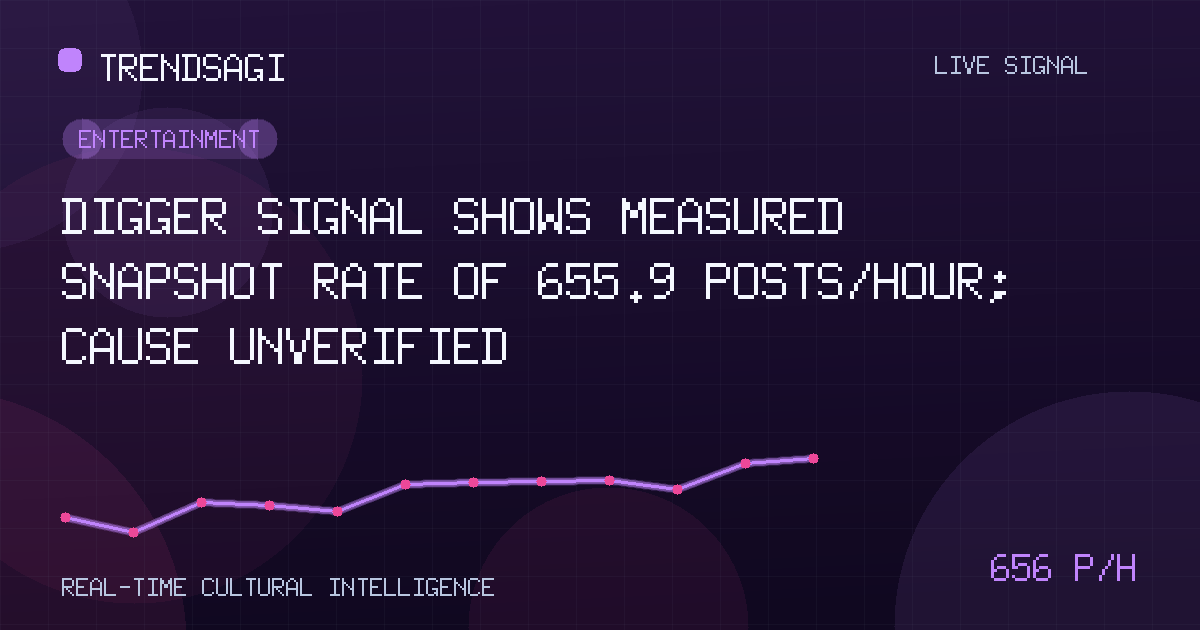
Digger had 418 posts in the latest snapshot and a measured 655.9 posts/hour rate, but no verified cause is established.
Automated briefing. Generated from stored signal measurements and source-backed research; it is not manually reviewed. Read the methodology and limitations.
Metrics in this briefing are a snapshot associated with its publication date and may not reflect current conditions.
What changed
The entertainment-category signal labeled “Digger” contained 418 posts in its latest snapshot at 2026-10-02T11:57:06Z. Its measured snapshot rate was 655.9 posts/hour, based on 3 stored observations across an exact 911-second window measured at that time.
The direct conclusion is that “Digger” produced a concentrated burst of captured posts during the measured interval, but the available evidence does not establish why. The 655.9 figure is a measured snapshot rate, not a live or current rate, forecast, reach, engagement total, or count of unique people. The 418 figure is snapshot volume, not a rate.
| Measure | Observed value |
|---|---|
| Observation time | 2026-10-02T11:57:06Z |
| Measured snapshot rate | 655.9 posts/hour |
| Latest snapshot volume | 418 posts |
Why this topic may be moving
No verified public catalyst can yet be attached to the burst. The label “Digger” and the entertainment classification do not establish which entity or event the posts concern. The name could refer to a title, character, person, nickname, or recurring phrase; until the underlying posts are examined, those readings remain possibilities rather than facts.
Potential explanations to test include a release, episode, clip, announcement, performance, or controversy. None should be reported as the cause without direct evidence connecting it to the posts. A later news article may help explain the conversation, but it is not automatically its trigger.
- Entity ambiguity: Posts using the same word may refer to unrelated subjects, splitting one apparent spike into several smaller conversations.
- Catalyst chronology: The relevant event should appear before or alongside the rise, rather than emerge only after discussion had already begun.
- Repetition and distribution: Reposts, quotations, automated accounts, or a single widely shared item can increase post volume without representing equivalent independent interest.
- Platform mix: Activity concentrated on one service may behave differently from a broad conversation spread across several platforms.
The strongest conclusion supported by this signal is that posting about “Digger” clustered during the measured window. Any claim about the catalyst remains provisional until the referent and earliest public event are verified.
Until that verification is possible, “Digger” is best treated as a monitoring lead rather than a fully explained trend. A keyword spike is sufficient to justify checking, but not sufficient to invent a narrative around it.
Why it matters
The immediate value is triage: readers and editors now know where attention is occurring, while the missing context defines the next reporting task. Different groups should interpret the signal differently.
- Entertainment editors: The signal may point to a developing story, but entity resolution and catalyst verification should precede a segment, headline, or trend explanation.
- Social and community teams: A sustained, coherent conversation could indicate audience interest. A brief or repetitive burst may instead reflect a platform artifact.
- Brand, talent, and public-relations teams: The label is too ambiguous for action until monitoring confirms which entity is involved and whether the activity is organic, coordinated, or reactive.
- Researchers: The case illustrates why post volume, posting rate, reach, and unique participation must be analyzed separately rather than treated as interchangeable measures.
What to watch next
The next step is not another broad mention of the spike. It is a sequence of checks capable of distinguishing a real public event from name collision or short-lived platform activity.
- Resolve what “Digger” means. Inspect the underlying post text, linked references, hashtags, quoted names, and context. Separate posts that clearly concern the same subject from incidental uses of the word.
- Find the earliest credible catalyst. Use a targeted Google Search to identify the first relevant public post, release, episode, clip, announcement, or reporting. A candidate should be supported by a publisher or source that directly documents it.
- Compare chronology. Check whether the proposed event precedes the increase. Later summaries can create a plausible explanation while missing the item that actually initiated discussion.
- Audit volume quality. Look for duplicate wording, quote-post behavior, automated activity, and concentration around one dominant item. Do not assume every post represents a different person or independent reaction.
- Recheck persistence with the same method. Compare subsequent observations on a comparable basis. Determine whether activity remains elevated, changes character, or quickly recedes.
Concrete confirming or weakening signals
- A dominant cluster of posts tied to the same verifiable public artifact would strengthen the trend interpretation.
- Multiple credible publishers describing the same development would corroborate the event, provided each publisher’s claim is verified separately.
- Continued elevated activity in later comparable observations would suggest something broader than an isolated posting spike.
- A rapid decline would support a transient burst, while sharply conflicting meanings would indicate that aggregate volume is masking separate subjects.
Methodology and limitations
The reported 655.9 posts/hour is a measured snapshot rate derived from 3 stored observations over an exact 911-second window. The latest observation contained 418 posts. These measures describe different aspects of the captured activity and should not be combined to imply a live rate, total audience, or forecast.
The record does not provide the raw post sample, platform coverage, collection method, geographic or language distribution, duplication controls, or account-quality measures. It therefore cannot establish sentiment, organic participation, unique-person activity, causation, or the likely duration of the signal. The entertainment classification provides category context but does not verify the identity being discussed. No external event is attributed here because the cause remains unclear.
Track This Topic for New Signals
Set alerts for future velocity or sentiment changes around this topic.
Explore Tracking PlansAbout TrendsAGI research
TrendsAGI's automated research pipeline publishes dated signal snapshots, methodology notes, and practical workflows for teams evaluating cultural momentum. Read how signals are scoped, scored, and limited in our research methodology.


