902-second window · 3 observations · Measured Sep 30, 2026, 11:07 AM UTC · Provider: go_recent_snapshot_v2
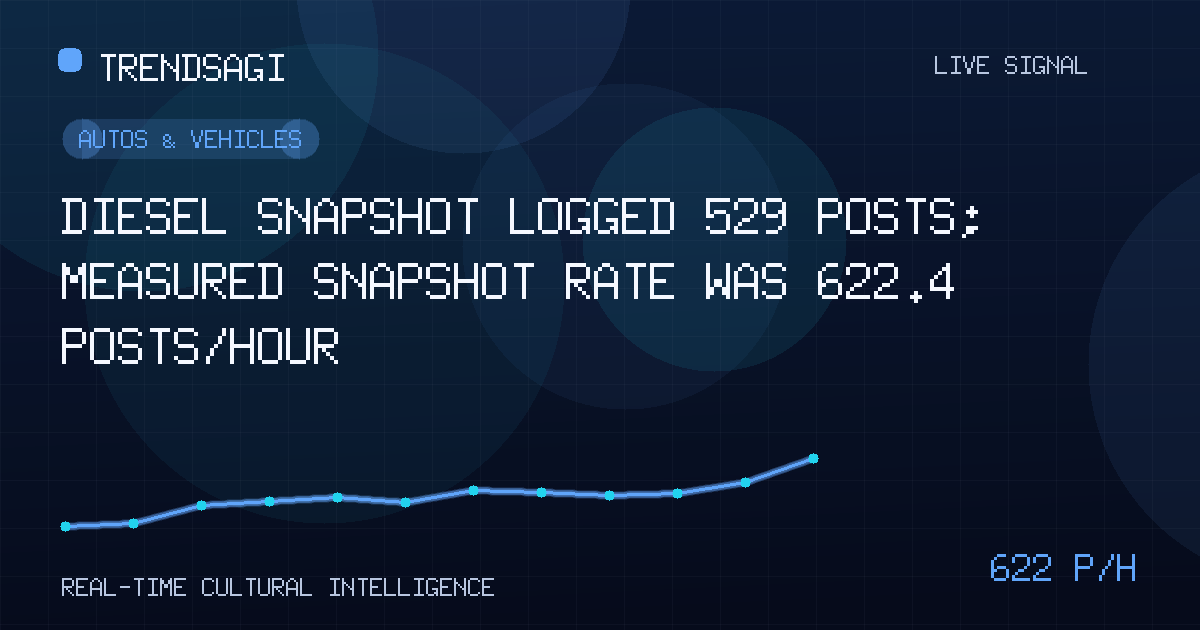
Diesel snapshot logged 529 posts; measured snapshot rate was 622.4 posts/hour
The latest diesel signal contained 529 posts and a 622.4 posts/hour measured snapshot rate; the cause and broader significance remain unconfirmed.
Automated briefing. Generated from stored signal measurements and source-backed research; it is not manually reviewed. Read the methodology and limitations.
Metrics in this briefing are a snapshot associated with its publication date and may not reflect current conditions.
What changed
The latest stored observation shows concentrated short-window activity in the conversation assigned the Diesel label, but the record does not identify a verified catalyst. It should be treated as a monitoring signal, not proof of a durable shift in diesel markets, vehicle demand, fuel use, or emissions policy.
At 2026-09-30T11:07:00Z, the latest snapshot contained 529 posts carrying the stored label. The measured snapshot rate was 622.4 posts/hour over an exact 902-second window using 3 stored observations. It is a historical, point-in-time measure of the sampled series—not a live or current rate, forecast, reach estimate, engagement measure, or unique-person count.
| Observation time | 2026-09-30T11:07:00Z |
|---|---|
| Measured snapshot rate | 622.4 posts/hour |
| Rate basis | Exact 902-second window; 3 stored observations |
| Latest snapshot volume | 529 posts |
The direct conclusion is narrow: diesel-labeled post activity was moving quickly within the sampled interval, but why it moved is unclear. The figures cannot show whether the activity came from a genuine diesel event, repeated material, a small set of active accounts, or several unrelated uses of the word.
What the signal can establish
The signal establishes the pace of the sampled post series within the stated window and shows that 529 posts were present in the latest snapshot. It does not establish a normal baseline, a durable trend, or the cause of the activity.
- Observed pace: The measured flow during the specified interval provides a basis for comparison with other matched windows.
- Separated measures: The 529-post figure is snapshot volume, while 622.4 posts/hour is the measured snapshot rate.
- Monitoring value: The point-in-time result can trigger closer review where diesel is operationally relevant.
Important gaps remain:
- There is no supplied prior baseline showing what is normal for this topic.
- Snapshot volume does not reveal unique authors, account concentration, or duplication.
- There is no content-level breakdown establishing sentiment, geography, language, platform mix, or the dominant subtopic.
The stored Autos & Vehicles category supplies broad context, but it does not prove that every post concerned diesel vehicles rather than fuel, freight, equipment, policy, or another use of the term.
Why this topic may be moving
No verified public-source explanation accompanies the stored signal, so the cause remains unclear. Several mechanisms are worth testing, but none is established here:
- Vehicle or product news, recalls, launches, motorsport, or heavy-equipment discussion.
- Diesel prices, supply conditions, freight activity, or fleet-operating changes.
- Emissions rules, court decisions, or official policy developments.
- Keyword ambiguity, entertainment content, or social amplification.
Each is a hypothesis to test, not a reported fact. A candidate explanation becomes useful only if its timing aligns with the observed window and numerous posts point to the same subject. Volume alone cannot distinguish an industry event from a platform-specific burst.
The stored signal documents a fast-moving conversation, not a verified diesel-market event; volume supplies the alert, while corroboration must supply the explanation.
Why it matters
The signal matters first as a triage tool. It tells diesel-linked audiences where to inspect, not what to believe, purchase, forecast, or change operationally.
- Vehicle and fleet teams: Check whether discussion clusters around a model, equipment issue, regulation, or operating cost before changing communications or procurement assumptions.
- Fuel suppliers and retailers: Corroborate with transaction, inventory, or freight data before treating conversation velocity as evidence of diesel demand.
- Policy and compliance teams: Look for an official text or confirmed report that explains time-specific discussion; broad chatter is not policy change.
- Media, communications, and market analysts: Use the alert to prioritize review while avoiding claims about prices, sales, sentiment, or public opinion without content-level evidence.
Topic ambiguity makes this restraint important. Diesel may refer to fuel, a vehicle, equipment, or a cultural reference. A high posting rate can therefore be meaningful to a communications team while remaining commercially inconclusive.
What to watch next
- Persistence: Compare the 622.4 posts/hour result with subsequent matched 902-second windows and prior windows of the same duration.
- Snapshot discipline: Keep 529 posts as the latest observed count; determine each new rate from its own observations rather than carrying this rate forward.
- Content mix: Classify posts into fuel prices, regulation, vehicles, freight, equipment, sport, and ambiguous uses. Note which group dominates.
- Source concentration: Check platform, geography, language, account activity, and duplicate text. A narrow cluster may behave differently from broad public discussion.
- Causal timing: Look for a verified event first appearing within or shortly before the measurement window. Reject explanations whose chronology does not fit.
- Real-world confirmation: Compare the conversation with diesel transaction volumes, fuel prices, vehicle registrations, freight activity, or other directly relevant measures. None is present in the stored signal itself.
Escalate this from a monitoring alert only when the rate persists in matched windows, one subtopic dominates, and independent evidence confirms a time-aligned event. If those conditions do not align, retain it as an unexplained conversation burst and keep commercial conclusions limited.
Methodology and limitations
The measured snapshot rate was recorded at 2026-09-30T11:07:00Z using 3 stored observations across an exact 902-second window. Snapshot volume was a separate 529-post count. The rate is historical rather than live or current and is not reach, engagement, a forecast, or a unique-person count.
The record does not supply a longer baseline, full time series, collection coverage, deletion history, geography, language, sentiment, account concentration, or duplicate controls. The category is metadata, not content verification. Because no verified external explanation is present, this briefing makes no causal attribution.
Track This Topic for New Signals
Set alerts for future velocity or sentiment changes around this topic.
Explore Tracking PlansAbout TrendsAGI research
TrendsAGI's automated research pipeline publishes dated signal snapshots, methodology notes, and practical workflows for teams evaluating cultural momentum. Read how signals are scoped, scored, and limited in our research methodology.