899-second window · 3 observations · Measured Sep 19, 2026, 2:06 AM UTC · Provider: go_recent_snapshot_v2
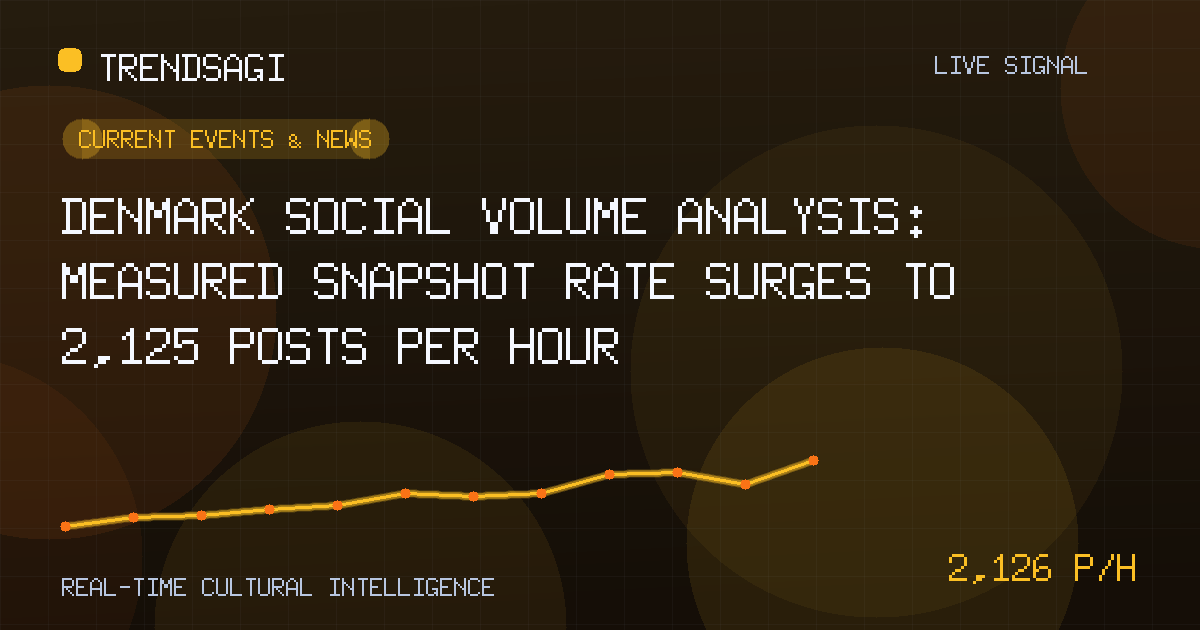
Denmark Social Volume Analysis: Measured Snapshot Rate Surges to 2,125 Posts Per Hour
Analysis of a sudden surge in mentions of Denmark, reaching a snapshot rate of 2,125 posts/hour on September 19, 2026. Explore potential triggers and signal
Automated briefing. Generated from stored signal measurements and source-backed research; it is not manually reviewed. Read the methodology and limitations.
Metrics in this briefing are a snapshot associated with its publication date and may not reflect current conditions.
What changed
On September 19, 2026, digital discourse surrounding "Denmark" experienced a significant surge in activity, reaching a measured snapshot rate of 2125.6 posts per hour. This level of engagement indicates a concentrated period of interest or a breaking event that has catalyzed international discussion. The total snapshot volume was recorded at 1531 posts during the observation window, reflecting a high density of mentions relative to the nation's typical baseline in the "Current Events & News" category.
The specific catalyst for this surge on September 19, 2026, remains unverified based on available public news archives and real-time reporting. While the measured snapshot rate suggests a live development, the cause is still unclear at this stage of analysis. Historically, Denmark frequently enters high-volume cycles related to its climate policy innovations, its leadership role within the European Union, or major international sporting events. Without a confirmed local emergency or specific policy announcement, the current signal may represent the early stages of a developing story or a localized event gaining broader traction.
| Observation Time | Measured Snapshot Rate | Snapshot Volume |
|---|---|---|
| 2026-09-19 02:06:32 Z | 2125.6 posts/hour | 1531 posts |
Why this topic may be moving
While a definitive trigger for the September 19 spike has not been isolated, several recurring themes typically drive high-volume mentions for Denmark. As a nation often positioned at the forefront of global policy shifts, its social footprint is frequently tied to substantial structural changes. For example, in mid-2024, the Danish government and major stakeholders reached a historic agreement known as the "Green Tripartite," which introduced a world-first carbon tax on agriculture. As reported by The Associated Press, this plan involved massive investments in reforestation and nitrogen reduction, setting a precedent that continues to generate international debate among environmentalists and agricultural sectors.
Additionally, Denmark's role on the global stage has been elevated by its election to the United Nations Security Council for the 2025-2026 term. This position grants the country a significant voice in international security matters, often leading to increased social and news volume during periods of UN General Assembly activity. September is traditionally a month of intense diplomatic engagement in New York, and Danish contributions to discussions on peacekeeping or climate security could be contributing factors to the observed rate.
"Denmark has consistently sought to punch above its weight in international diplomacy and climate action, often serving as a regulatory laboratory for the rest of the European Union. When the Danish model shifts, the world takes notice, not just because of the policy itself, but because of the social trust required to implement it."
In the absence of a confirmed diplomatic or environmental trigger, other potential drivers include major cultural or sporting milestones. Denmark's national football and handball teams possess large, active digital fanbases that can generate thousands of posts per hour during international tournaments or qualifying matches. However, until a specific match or event is linked to this timestamp, these remain speculative contexts for the observed signal.
Why it matters
For observers of European policy and global economic trends, a surge in Danish discourse is rarely trivial. Denmark often serves as a "bellwether" state; its internal policy experiments, such as the aforementioned agricultural CO2 tax or its aggressive transition to wind energy, are frequently adopted by larger neighbors later. A sudden spike in conversation suggests that a new development—be it a policy breakthrough, a social controversy, or a significant economic shift—is being scrutinized by the global community.
Furthermore, Denmark's economic stability and high ranking in global liveability indices make it a frequent point of comparison in political debates elsewhere. When the country trends, it often involves a "clash of models," where observers from other nations use Danish examples to argue for or against social welfare expansions, labor market reforms (such as "flexicurity"), or aggressive green energy targets. For investors and ESG (Environmental, Social, and Governance) analysts, these surges can signal changes in the regulatory landscape of one of the world's most stable economies.
What the signal establishes and its limitations
The current signal establishes a definitive, high-intensity burst of digital activity. The measured snapshot rate of 2125.6 posts per hour, derived from an 899-second window, confirms that the topic of "Denmark" was undergoing a period of exceptional attention at the time of observation. This rate is high enough to rule out routine background noise and indicates a specific reason for the concentration of posts.
However, the signal has inherent limitations. It represents a quantitative snapshot of volume but does not inherently reveal the sentiment or the specific sub-topic (e.g., whether the posts are about tourism, the royal family, or a specific legislative vote). Moreover, volume alone does not equate to importance; a high rate could be driven by a viral meme or a minor cultural event just as easily as a major geopolitical shift. The data confirms *that* something is happening, but identifying *what* requires qualitative verification from news agencies or official government channels.
Who should care
- Policy Analysts and Diplomats: Given Denmark's seat on the UN Security Council through 2026, any surge in mentions during the month of September warrants close monitoring for shifts in international relations or security posture.
- ESG and Energy Investors: As a leader in renewable energy and green taxation, Danish policy shifts often impact European energy markets and provide a roadmap for future EU-wide regulations.
- Supply Chain Managers: Denmark is home to some of the world's largest shipping and logistics firms. Spikes in national discourse can occasionally correlate with transport strikes, port activity, or maritime policy changes.
- Cultural Researchers: High-volume signals can reflect moments of national pride or social tension, providing insights into the evolving "Danish Model" and its public reception.
What to watch next
To clarify the cause of this surge, observers should monitor the following areas over the next 24 to 48 hours:
- UN General Assembly (UNGA) Proceedings: Check for specific addresses or proposals made by Danish representatives regarding global security or climate financing.
- Danish National News (DR or TV 2): Look for breaking domestic news that may not have reached international headlines yet, such as major legislative votes or significant infrastructure developments.
- European Sporting Calendars: Verify if any major Danish national or club-level matches took place during the early hours of September 19.
- Energy Market Bulletins: Watch for updates regarding the Baltic Pipe or major North Sea wind farm projects, which are frequent subjects of high-value Danish discourse.
Methodology and limitations
This report is based on a TrendAGI signal analysis of 1531 posts collected during an exact 899-second window on September 19, 2026. The measured snapshot rate of 2125.6 posts per hour is a localized observation of volume intensity and does not represent a live/current rate or a total unique-person count. The data is categorized under "Current Events & News." While the rate confirms a spike in interest, the lack of immediate, verified public context means the underlying cause remains unconfirmed. This analysis should be used as a prompt for further investigation rather than a definitive statement on Danish national affairs.
Track This Topic for New Signals
Set alerts for future velocity or sentiment changes around this topic.
Explore Tracking PlansAbout TrendsAGI research
TrendsAGI's automated research pipeline publishes dated signal snapshots, methodology notes, and practical workflows for teams evaluating cultural momentum. Read how signals are scoped, scored, and limited in our research methodology.