1029-second window · 3 observations · Measured Sep 30, 2026, 8:56 AM UTC · Provider: go_recent_snapshot_v2
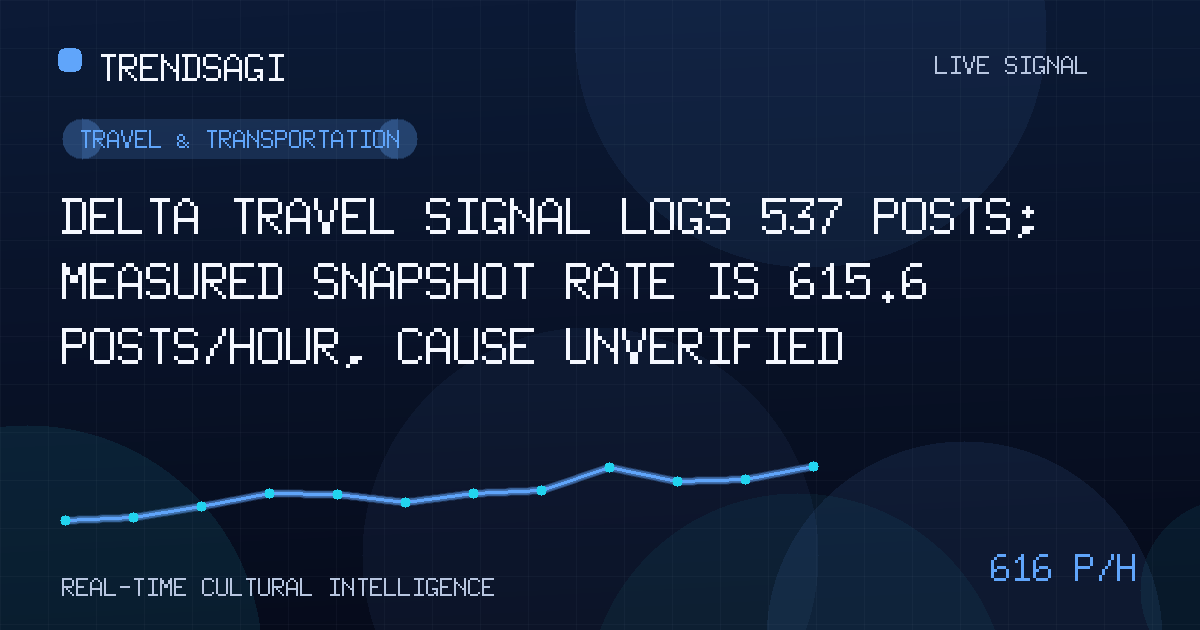
Delta travel signal logs 537 posts; measured snapshot rate is 615.6 posts/hour, cause unverified
Delta shows 537 snapshot posts and a measured 615.6 posts/hour rate; this briefing separates established facts from unresolved causes and next checks.
Automated briefing. Generated from stored signal measurements and source-backed research; it is not manually reviewed. Read the methodology and limitations.
Metrics in this briefing are a snapshot associated with its publication date and may not reflect current conditions.
What changed
The direct answer is that the stored Travel & Transportation signal labeled “Delta” recorded concentrated posting activity, but no specific trigger has been verified. The latest stored snapshot contains 537 posts. Because “Delta” can identify more than one subject, the category and label alone do not establish whether the posts concern an airline, a geographic feature, or another travel-related subject. Treat this as an investigation lead, not proof of an airline event.
The measured snapshot rate was 615.6 posts/hour over an exact 1029-second window using 3 stored observations, with the latest observation at 2026-09-30T08:56:11Z. This describes the sampled window only. It is not a live/current rate, forecast, reach, engagement, or unique-person count.
| Observation time | Measured posts/hour | Snapshot volume |
|---|---|---|
| 2026-09-30T08:56:11Z | 615.6 posts/hour | 537 posts |
Why this topic may be moving
No verified public context establishes why the topic is moving, so the cause remains unclear. A category tag supplies context, not causation. The first unresolved issue is entity resolution: what does “Delta” mean in the posts? The travel classification makes an airline-related interpretation plausible, but it does not prove that interpretation.
Possible mechanisms include an operational disruption, a schedule or fare change, a promotion, regulatory or security news, seasonal demand, or an event involving a geographic delta. These are hypotheses, not verified explanations. The signal could also reflect ordinary conversation, repeated or syndicated posts, or classification error. No descriptive context accompanies the stored topic, so there is no supplied event summary to test.
A measured burst under the label “Delta” is a reason to investigate, not evidence that a particular Delta event caused it.
The right next check is post-level review. Sample the underlying items; determine what Delta refers to; note geography, language, route or place references, and whether the count is driven by distinct contributions or repeated copies. Then use Google Search to find primary notices or reporting published in the same period, open the underlying publisher pages, and compare the publisher, timestamp, and claim with the observed window. Search snippets alone are not enough. A cause should be assigned only when the post content and public reporting point to the same event.
Why it matters
For travelers, correctly identifying the subject can separate a potentially actionable service issue from a non-airline use of the word Delta. For airlines, airports, tourism operators, and communications teams, an ambiguous spike can produce wasted response or mask a real issue. For analysts, the episode highlights why keyword volume should not be treated as an event diagnosis.
The stored numbers establish that the monitoring system recorded activity. They do not establish importance. No baseline is supplied to show how 537 posts compares with normal activity, and no audience, reach, sentiment, geography, or duplication data is provided. The 615.6 posts/hour figure also does not show how many people participated.
Snapshot volume and measured snapshot rate answer different questions: the former is the count attached to the latest snapshot; the latter summarizes change across the exact observation window. They should not be arithmetically combined or reconciled without collection details. Because the rate uses 3 observations in that 1029-second window, isolated activity or classification choices may have substantial influence.
What can—and cannot—be concluded
The evidence supports these narrow conclusions:
- At the stated observation time, the latest snapshot contains 537 posts.
- The measured snapshot rate is 615.6 posts/hour across the exact 1029-second window using 3 observations.
- The stored category is Travel & Transportation, and the topic label is Delta.
It does not establish:
- A specific causal event or whether the posts are airline-related.
- The geographic, language, or audience distribution.
- Whether posts are original, unique, or repeated.
- Sentiment, operational consequences, reach, impact, or coordinated activity.
What to watch next
- Entity mix: Determine whether posts consistently resolve to an airline or split among place, business, and unrelated uses. A stable airline-specific reading is required before treating the signal as travel-operations news.
- Public corroboration: Use Google Search to check for primary notices and reporting from reputable publishers whose timestamps and claims match the observed window. Attribute a cause only after verifying the underlying publisher page.
- Content markers: Watch for route, airport, booking, schedule, cancellation, delay, or fare-related language and consistent geography. These are clues, not confirmation, and should not replace source verification.
- Persistence: Check later stored snapshots for continued movement under the same entity reading. A brief isolated burst warrants less confidence than repeated observations.
- Counterevidence: Watch for corrections, clarifications, denials, or a shift toward geographic uses of Delta. Those outcomes would weaken an airline or disruption explanation.
- Decision rule: Strengthen the interpretation only when entity, content, timing, and independent public corroboration align. Keep monitoring when activity persists but cause remains unresolved; downgrade it if review points to duplicate-heavy or unrelated material.
Methodology and limitations
The reported figures are reproduced from the stored observation: 537 posts at 2026-09-30T08:56:11Z and a measured snapshot rate of 615.6 posts/hour over the exact 1029-second window using 3 observations. The evidence does not supply a baseline, platform mix, collection logic, post samples, deduplication method, geography, language, or verified trigger. The rate therefore describes observed movement, not its cause or business impact.
No external fact is used to fill that evidence gap. The practical conclusion is narrow: Delta merits immediate content review and verification, but claims about disruption, demand, news, or manipulation remain unproven.
Track This Topic for New Signals
Set alerts for future velocity or sentiment changes around this topic.
Explore Tracking PlansAbout TrendsAGI research
TrendsAGI's automated research pipeline publishes dated signal snapshots, methodology notes, and practical workflows for teams evaluating cultural momentum. Read how signals are scoped, scored, and limited in our research methodology.