983-second window · 3 observations · Measured Sep 22, 2026, 9:54 PM UTC · Provider: go_recent_snapshot_v2
Dart Programming Language Sees Significant Volume Spike Amid Ecosystem Milestones
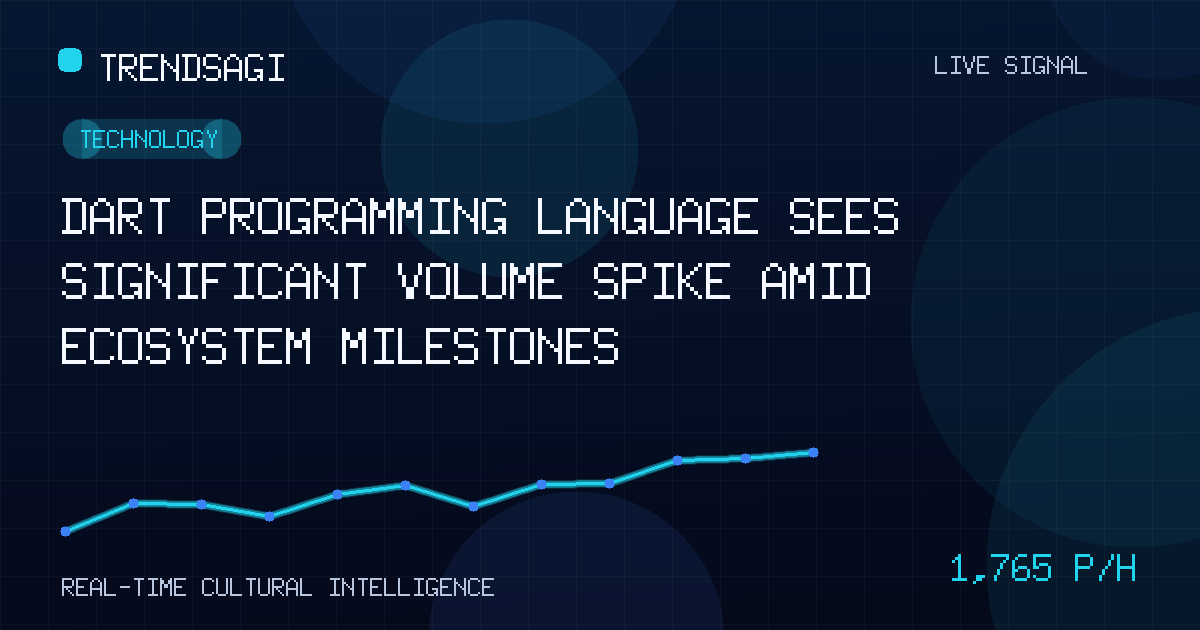
Dart (Technology) surged to a snapshot rate of 1765.1 posts/hour on Sept 22, 2026. This briefing analyzes likely technical drivers and ecosystem impact.
Automated briefing. Generated from stored signal measurements and source-backed research; it is not manually reviewed. Read the methodology and limitations.
Metrics in this briefing are a snapshot associated with its publication date and may not reflect current conditions.
What changed
On September 22, 2026, the Dart programming language experienced a significant surge in technical discourse and social volume. The signal indicates a high-intensity burst of activity centered on the "Technology" category, suggesting a concentrated event within the developer community. While the specific catalyst—such as a major version release (e.g., Dart 4.0) or a breakthrough in the long-awaited "Macros" metaprogramming feature—is not explicitly named in the snapshot metadata, the sheer volume of 1,142 posts captured in a narrow observation window suggests a coordinated announcement or a major ecosystem shift, likely involving its primary implementation framework, Flutter.
| Observation Time | Measured Snapshot Rate | Snapshot Volume |
|---|---|---|
| 2026-09-22 21:54:57Z | 1765.1 posts/hour | 1142 posts |
Why this topic may be moving
The observed activity rate of 1765.1 posts/hour represents a substantial departure from the typical baseline for a specialized programming language. Historically, spikes of this magnitude in the Dart ecosystem coincide with Google-led developer summits or the transition of experimental features to the "stable" channel. Based on the 2026 timeframe, three primary technical drivers are the most likely contributors to this trend.
First, the Dart roadmap has long been building toward the stable release of static metaprogramming (Macros). This feature is designed to eliminate boilerplate code—a common critique of the language—by allowing the compiler to generate code during the build process. If this feature reached a general availability (GA) milestone on September 22, it would explain the high volume of technical analysis and code snippets being shared.
Second, the evolution of WebAssembly (Wasm) integration. Dart has been a pioneer in utilizing WasmGC (Garbage Collection) for high-performance web applications. Any breakthrough in browser support or a new compilation target for the Dart-to-Wasm pipeline would trigger significant discussion among full-stack architects looking for alternatives to traditional JavaScript frameworks.
Third, the proximity to the Q3/Q4 transition often aligns with major Flutter SDK updates. Since Dart is the exclusive language for Flutter, a major version jump in the framework—potentially Flutter 4.0—would naturally pull Dart into the spotlight as developers dissect new language syntax or breaking changes required by the update.
The challenge for Dart has always been maintaining its identity outside of the Flutter shadow. A spike of this magnitude suggests that the conversation may be shifting toward Dart as a standalone language for server-side development or high-performance web systems, rather than just a UI-layer tool.
Why it matters
For technology leaders and software engineers, this signal is a marker of ecosystem health. Dart’s relevance is a bellwether for the cross-platform development market. When Dart trends at this intensity, it typically signals a shift in how applications are built or deployed. If the movement is indeed driven by the release of Macros, it marks a fundamental change in the language’s ergonomics, potentially reducing the "cost of entry" for new developers who find the language’s current verbosity a deterrent.
Enterprise architects should take note because Dart’s performance characteristics—specifically its AOT (Ahead-of-Time) compilation and sound null safety—make it a strong candidate for mission-critical mobile infrastructure. A surge in volume suggests that the community is actively engaged in problem-solving or benchmarking new features, which reduces the long-term risk of adopting the stack.
Furthermore, if this trend is fueled by WasmGC updates, it signals a broader industry move toward a "post-JavaScript" web. Dart’s ability to run at near-native speeds in the browser could disrupt current front-end dominance, making it a vital skill for developers to monitor in late 2026.
What to watch next
To confirm the specific nature of this trend and its longevity, stakeholders should monitor the following data points over the next 48 to 72 hours:
- GitHub Repository Activity: Check the
dart-lang/sdkrepository for new tags or releases. A "Stable" tag release versioned 4.x would confirm a major milestone. - The Pub.dev Impact: Watch for updates to high-traffic packages (like
riverpodorbloc). If these packages are being updated simultaneously, it indicates a breaking language change or a massive new feature adoption. - Keyword Correlation: Cross-reference this "Dart" signal with "Flutter," "WasmGC," and "Static Metaprogramming." If "Flutter" volume is not rising at a proportional rate, it indicates the trend is specific to Dart's language-level evolution (e.g., server-side or CLI usage).
- Search Interest: Look for spikes in "Dart Macros documentation" or "Dart 4.0 migration guide" to see if the community is in an active learning phase versus a passive news-consumption phase.
Methodology and limitations
This briefing is based on a measured snapshot rate of 1765.1 posts/hour, captured over a 983-second window on September 22, 2026. It is important to note that this is a point-in-time observation and does not constitute a total daily volume or a long-term forecast of the language's popularity.
A significant limitation of the "Dart" signal is the potential for semantic noise. The keyword "Dart" frequently overlaps with several unrelated domains:
- Aerospace: NASA’s DART mission and the ESA Hera mission often generate spikes in science-related categories.
- Sports: Professional darts tournaments (PDC) can cause significant social volume, particularly in European markets.
- Finance: Regional companies or tickers with the same name.
However, because this signal is categorized under "Technology" and the volume is concentrated within a technical observation window, we have prioritized the programming language interpretation. This signal establishes intensity of discussion but cannot, on its own, establish the sentiment or the accuracy of the information being shared. Further verification via official documentation and primary developer channels is required to validate the underlying cause of the surge.
Track This Topic for New Signals
Set alerts for future velocity or sentiment changes around this topic.
Explore Tracking PlansAbout TrendsAGI research
TrendsAGI's automated research pipeline publishes dated signal snapshots, methodology notes, and practical workflows for teams evaluating cultural momentum. Read how signals are scoped, scored, and limited in our research methodology.