6299-second window · 3 observations · Measured Sep 27, 2026, 1:07 AM UTC · Provider: go_recent_snapshot_v2
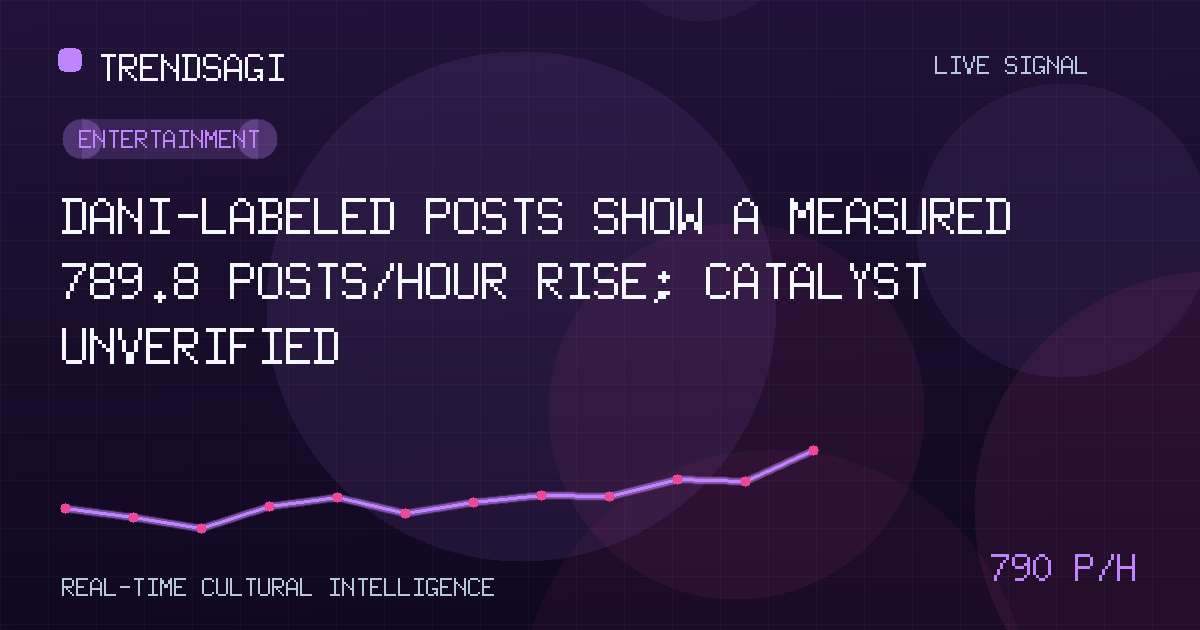
Dani-labeled posts show a measured 789.8 posts/hour rise; catalyst unverified
Dani’s entertainment signal recorded 789.8 posts/hour over 6299 seconds, with 1636 posts at the snapshot; editors get an alert, not a verified cause.
Automated briefing. Generated from stored signal measurements and source-backed research; it is not manually reviewed. Read the methodology and limitations.
Metrics in this briefing are a snapshot associated with its publication date and may not reflect current conditions.
What changed
The monitored “Dani” topic shows a measured rise at the latest observation, but the available evidence does not establish what prompted it. The direct answer is therefore limited: posting activity accelerated inside this dataset, while the cause remains unverified. This is not confirmation of a specific event or a wider public trend.
At 2026-09-27T01:07:04Z, the measured snapshot rate was 789.8 posts/hour over an exact 6299-second window using 3 stored observations. The latest snapshot contained 1636 posts. That snapshot volume is not a rate, and the figure is not reach, engagement, a unique-person count, a live reading, or a forecast.
| Observation time | 2026-09-27T01:07:04Z |
|---|---|
| Measured snapshot rate | 789.8 posts/hour |
| Measurement window | 6299 seconds |
| Stored observations | 3 |
| Latest snapshot volume | 1636 posts |
Why this topic may be moving
No verified public context in the available record links the bare label to a specific entertainment event. “Entertainment” is the stored category, not proof of what happened. The label also does not establish whether Dani is a full name, stage name, character, account name, or a collision among different subjects. Each possibility would change how the increase should be interpreted.
Without source-level examples, this rate cannot distinguish a genuinely new conversation from repeated copying, unrelated name matches, or measurement noise. The category alone does not resolve that ambiguity.
- Source concentration: Determine whether a single item is being copied widely or whether many distinct posts drove the change.
- Timing: Connect the burst only to an independently verified public timestamp.
- Entity mixing: Check whether multiple people or accounts with the same label were combined.
- Breadth: Determine whether activity reflects diverse independent discussion; no audience, sentiment, or geography breakdown is supplied.
These are unresolved explanations, not findings. The evidence supports a rate change; it does not support attributing that change to a particular person or incident.
The strongest supported finding is that the monitored “Dani” label rose at a measured 789.8 posts/hour at this snapshot; its identity, cause, audience, and persistence still require verification.
Why it matters
The signal is useful as an alert, not as an explanation. Its speed gives editors a reason to investigate now; its sparse labeling gives them an equally strong reason not to publish a causal headline. Acting on the count before resolving the subject could amplify a mistaken identity or turn duplicated posts into a false trend narrative.
There is also a measurement lesson: the snapshot total and measured change answer different questions. The total describes volume present at the observation, while the rate describes change across the supplied window. Neither says who participated, whether people agreed, or whether the activity mattered outside the monitored environment.
- Entertainment and social editors: Use the alert to identify the underlying posts, then decide whether a confirmed event warrants coverage.
- Newsrooms: Avoid treating an ambiguous name label as sufficient identification for a breaking-news report.
- Talent, public-relations, and brand-safety teams: First confirm which Dani is involved; only then assess reputational or campaign implications.
- Researchers and analysts: Preserve the timestamp, window, observation count, and entity definition so comparisons remain valid.
For general readers, the practical value is triage. This signal can say where to look next, but it cannot yet supply a reliable “why.”
What to watch next
The next step is to turn the label into a resolved entity and the rate into a time series. Both are necessary before calling the movement sustained.
- Pin down the identity. Confirm the exact spelling, handle, platform, and associated person or work. Record any alternate names that could be colliding in the dataset.
- Inspect the burst. Review the earliest high-volume posts, the items copied most often, and the source each copy cites. Separate original posts from duplicates, reactions, automated activity, and unrelated name matches.
- Check time alignment. Compare the onset of activity with independently verified public timestamps around the observation date. Temporal alignment would support context, but would not alone prove causation.
- Verify the catalyst. Use Google Search with the exact handle or resolved full identity and relevant date, then require an official statement or reputable publisher before assigning a reason.
- Test persistence. Add later observations and determine whether activity remains elevated, reverses, or represents a single burst. Do not extend this snapshot’s rate beyond its measurement window.
- Audit identity drift. If posts refer to multiple Danis, separate those series and recalculate before comparing momentum.
Concrete watch signals would include a verified event tied to the same identity, later observations showing similarly elevated measured change, a stable mix of independent posts rather than a single repeated source, or a correction that separates the label into distinct subjects. A cluster of official and reputable references would be stronger context than unexplained volume alone.
Methodology and limitations
The reported 789.8 posts/hour is a measured snapshot rate derived from 3 stored observations across 6299 seconds ending at the stated observation time. It should be described only with that temporal scope. The 1636 posts are the latest observed volume, not the number added during the window and not a measure of audience size.
The signal does not provide a prior baseline, post text, platform coverage, collection method, deduplication rules, sentiment, location, or verified entity details. Those omissions constrain interpretation:
- A positive change cannot show whether momentum will persist.
- Post volume cannot establish unique participants or authentic authorship.
- A category assignment cannot confirm that all posts concern one subject.
- A catalyst cannot be inferred from volume without source-level evidence.
Accordingly, “Dani” is a fast-moving signal with an unresolved cause, not a verified entertainment storyline. The next credible update should add identity, timing, source, and persistence—not merely repeat the rate.
Track This Topic for New Signals
Set alerts for future velocity or sentiment changes around this topic.
Explore Tracking PlansAbout TrendsAGI research
TrendsAGI's automated research pipeline publishes dated signal snapshots, methodology notes, and practical workflows for teams evaluating cultural momentum. Read how signals are scoped, scored, and limited in our research methodology.