761-second window · 2 observations · Measured Sep 24, 2026, 3:09 PM UTC · Provider: go_recent_snapshot_v2
Dakota snapshot measured 1305.4 posts/hour; public catalyst remains unverified
A Dakota snapshot measured 1305.4 posts/hour; the cause is unconfirmed, so verify the subject before reporting an explanation.
Automated briefing. Generated from stored signal measurements and source-backed research; it is not manually reviewed. Read the methodology and limitations.
Metrics in this briefing are a snapshot associated with its publication date and may not reflect current conditions.
What changed
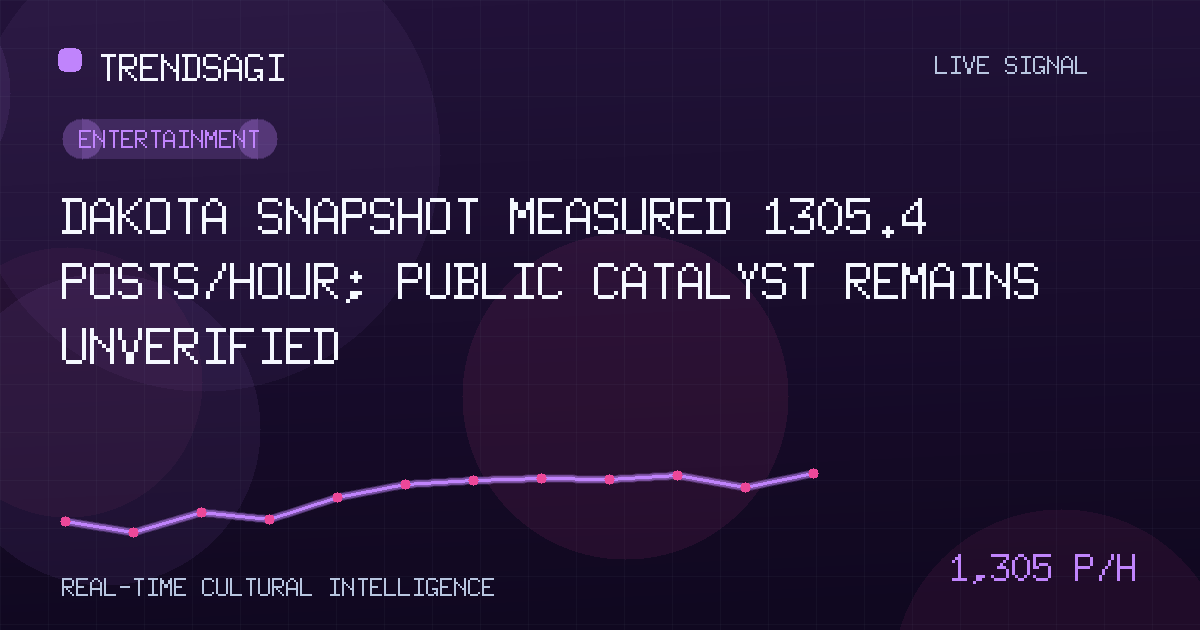
Posts carrying the “Dakota” topic label recorded a measured increase of 1305.4 posts/hour. That is a measured snapshot rate, not a live or current rate, forecast, reach estimate, engagement metric, or unique-person count. The cause is still unclear: no public catalyst has been verified.
The latest observation, recorded at 2026-09-24T15:09:23Z, contained 654 posts. The rate was calculated over an exact 761-second window using 2 stored observations. These are distinct measures: 654 is the post volume in the latest snapshot, while 1305.4 posts/hour describes the measured change during the window.
| Measure | Recorded value |
|---|---|
| Observation time | 2026-09-24T15:09:23Z |
| Measured snapshot rate | 1305.4 posts/hour |
| Latest snapshot volume | 654 posts |
The change is a reason to investigate the topic, not yet evidence for a particular headline.
Why this topic may be moving
No verified public context establishes whether the movement reflects a new entertainment event, a reaction to existing material, or a change in how the label was being posted. The Entertainment classification provides a broad editorial category, but it does not identify the subject or establish a cause. Naming a celebrity, release, controversy, or song as the trigger would therefore add specificity the record cannot support.
“Dakota” is also ambiguous on its face. It could be a name, part of a longer name, a title, or a term used in an unrelated context. Those are possibilities to test, not findings. A sample of the posts should reveal whether full names, related terms, and destinations consistently point to one subject—or whether the label is collecting separate conversations.
Volume alone cannot distinguish a burst of original conversation from repeated content, coordinated promotion, or collection artifacts. None of those alternatives is established here; they are reasons to examine the composition of the posts. The useful question is not simply “What happened?” but “Which explicitly identified Dakota subject and event connect these posts, and can its timing be corroborated?”
The strongest supported conclusion is that the monitored “Dakota” label registered increased posting activity during the measured window—not that a specific person, release, or controversy caused it.
Why it matters
This signal is useful because it directs attention, not because it already supplies an explanation.
- Editors and reporters: Verify the subject and catalyst before turning a generic label into a named news claim. The opportunity is a timely follow-up on a developing conversation, not a license to guess.
- Community and audience teams: Do not read the 654-post snapshot as 654 participants, or the rate as evidence of favorable sentiment. Increased volume can coexist with criticism, curiosity, copying, or mixed reactions.
- Analysts and moderators: Preserve the distinction between observed posts and independently supported activity. Check repetition and account patterns before interpreting the burst as broad adoption.
These teams should care if the topic resolves to a credible event, because the conversation may then have immediate editorial, community, or measurement implications. If it does not resolve, the main value is preventing a false attribution.
The signal supports investigation of conversation around a monitored label. It does not establish which event happened, who participated, what they thought, or whether the increase will continue. Those are separate questions requiring separate evidence.
What to watch next
The next checks should be concrete enough to change or reject the working explanation.
- Resolve the entity. Inspect a sample for full names, related names, titles, and contextual terms. Record which interpretations recur. If the label points to different subjects, separate the signal before drawing conclusions about any one of them.
- Find a time-aligned catalyst. Look for an official announcement, publication, release, or other public item explicitly connected to the verified subject. Compare its timestamp with the measured window. Later coverage may describe a reaction, but it should not automatically be treated as the cause of earlier activity.
- Separate post types. Distinguish original reactions, shared excerpts, promotional material, and apparent duplicates. Repetition or automation may contribute to a short burst, but that must be demonstrated rather than assumed. A count of posts is not a count of independent voices.
- Extend the observation. Collect additional comparable windows using the same matching rule, language settings, and collection coverage. Record whether activity continues, fades, or shifts to another subject. Persistence would support an ongoing conversation, not prove what caused the initial increase.
- Log decision signals. A newly clarified entity, a timestamped official item, converging independent references, or a change in repetition would materially improve the briefing. A falling measured rate without a verified catalyst would weaken the case for a durable event story.
The most important watch signal is corroboration: public evidence that identifies the same subject and places an event alongside the observed activity. Without that link, the responsible conclusion remains an unexplained increase in posts under the “Dakota” label.
Methodology and limitations
The measurement uses 2 stored observations, an exact 761-second window, and the latest snapshot’s 654 posts. Rate and volume must remain separate: one describes change over time; the other describes the observed count at a particular moment. Neither is a forecast.
The record does not specify the exact matching phrase, collection coverage, geographic or language scope, deletion handling, or duplicate-removal method. Those omissions limit representativeness and comparability. It also does not report sentiment, original-post share, verified account status, or interaction levels.
Accordingly, the briefing can establish that the monitored label registered increased observed activity in this window. It cannot establish the identity of the underlying subject, the cause of the movement, the number of people involved, or the conversation’s tone. Those limitations are material, especially for a brief measurement window.
Bottom line: “Dakota” merits a verification pass because its measured snapshot rate rose, but it is not yet a verified entertainment event. Confirm what the label denotes, what happened, when public evidence appeared, and whether the activity persisted before publishing a causal account.
Track This Topic for New Signals
Set alerts for future velocity or sentiment changes around this topic.
Explore Tracking PlansAbout TrendsAGI research
TrendsAGI's automated research pipeline publishes dated signal snapshots, methodology notes, and practical workflows for teams evaluating cultural momentum. Read how signals are scoped, scored, and limited in our research methodology.


