905-second window · 3 observations · Measured Sep 27, 2026, 7:10 PM UTC · Provider: go_recent_snapshot_v2
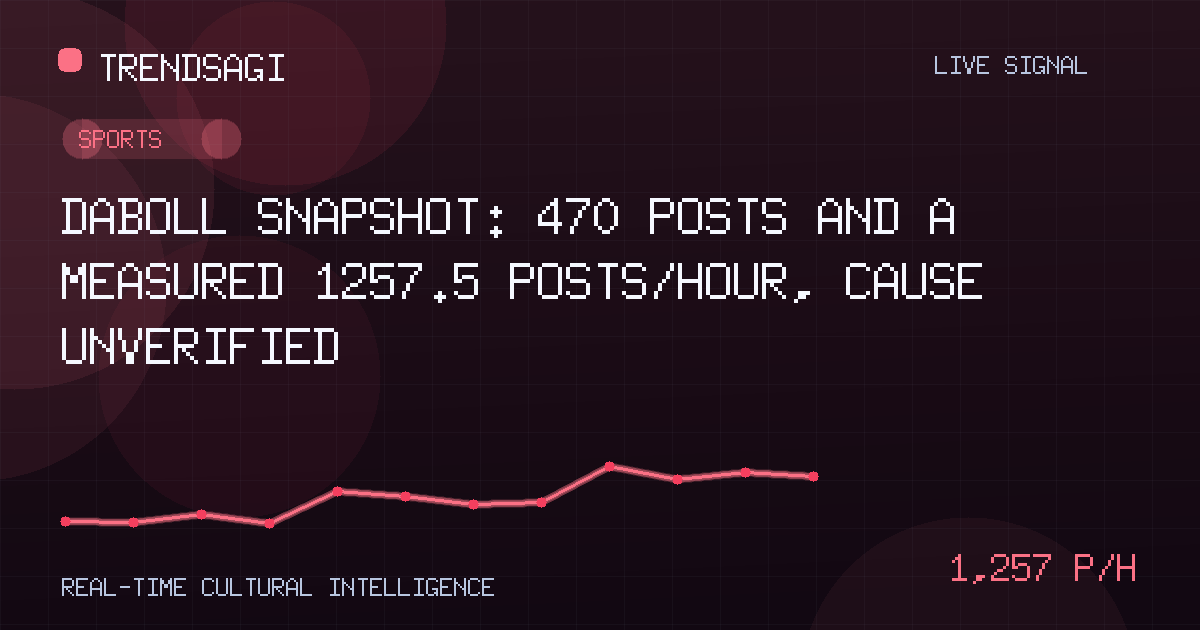
Daboll snapshot: 470 posts and a measured 1257.5 posts/hour, cause unverified
Daboll reached 470 posts in a snapshot with a measured 1257.5 posts/hour rate, while the cause remains unverified.
Automated briefing. Generated from stored signal measurements and source-backed research; it is not manually reviewed. Read the methodology and limitations.
Metrics in this briefing are a snapshot associated with its publication date and may not reflect current conditions.
What changed
The sports-labeled “Daboll” signal shows a sharp short-window increase, with the latest stored snapshot containing 470 posts. The direct conclusion is limited: conversation around an ambiguous label accelerated, but the available evidence does not identify a verified event, person, team, announcement, or controversy behind it. Velocity alone is not confirmation of a meaningful sports development.
The measured change is 1257.5 posts/hour over an exact 905-second window using 3 stored observations, measured at 2026-09-27T19:10:29Z. This is a measured snapshot rate, not a live or current rate, forecast, reach estimate, engagement measure, or unique-person count. The pace warrants prompt verification, while the cause remains unclear.
| Measure | Stored value |
|---|---|
| Observation time | 2026-09-27T19:10:29Z |
| Measured snapshot rate | 1257.5 posts/hour over 905 seconds using 3 stored observations |
| Latest snapshot volume | 470 posts |
Why this topic may be moving
No verified public context establishes why “Daboll” is moving. The label may point to a person, a quoted term, a spelling or truncation error, or a grouping error; none of those possibilities can be confirmed from the stored signal alone. The Sports category makes sports relevance plausible, but it does not resolve the referent or prove that the posts describe the same subject.
Until the underlying posts are inspected, several mechanisms remain only hypotheses: a fresh public statement could have prompted repeated copying; a popular story could have introduced the name; users could be reacting to a mistaken match; or automated collection could be amplifying repetition. A numerical burst can reflect coordinated posting, repeated content, or multiple conversations, so it should not be read automatically as broad public interest.
The key distinction is between a fast-moving label and an understood event: the first is visible in the snapshot, while the second requires corroboration.
Importantly, a clear increase in posts does not reveal sentiment. Posts could be positive, critical, corrective, or simply referential. Nor does the snapshot show whether the term is being used as a surname, a mistaken spelling, or something else. Resolving those questions requires looking at the actual posts and their context rather than inferring a story from volume.
What the signal can and cannot establish
The signal is useful as an alert because it combines a large snapshot count with rapid measured movement. It establishes that the collection system recorded many posts in a narrow period and assigned the topic to Sports. It gives editors a reason to inspect the stream before a fast-moving conversation fades or becomes harder to reconstruct.
- It does not identify the catalyst. No verified announcement, result, incident, or publication is established as the trigger.
- It does not measure audience scale. Posts are not people, and repeated posts from one account would still count within the volume.
- It does not establish impact. The snapshot provides no reach, engagement, sentiment, geography, or demographic evidence.
- It does not establish persistence. A narrow burst may disappear quickly, and no later observation is supplied here.
- It does not validate the label. A category assignment is not proof that every post concerns sports or even the same referent.
The practical value is therefore triage rather than interpretation. The measurement identifies a fast-moving stream that deserves review, but assigning a news angle would go beyond what the stored evidence supports.
Why it matters
For sports desks, the immediate risk is not missing a confirmed event; it is prematurely assigning the burst to the wrong person or story. A fast label can attract coverage before its meaning is clear, and an ambiguous name makes that error especially easy. Editors should treat the pattern as a verification task, not a ready-made headline.
For audience and platform teams, the measured rate is a prioritization signal. It says where investigation may be most time-sensitive, while offering no basis for claims about how many people were reached or how strongly they reacted. Any summary should preserve that distinction.
For researchers and fact-checkers, the episode illustrates why volume, velocity, and meaning must be analyzed separately. The first two are visible in the stored observations; meaning requires source-level review and corroboration. Combining them too early turns measurement into narrative.
What to watch next
- Inspect the original post sample. Confirm the exact spelling, quoted wording, linked entities, and whether the same referent appears across the captured items. Preserve examples rather than relying on a search-result snippet.
- Find a primary catalyst. Look for a directly attributable statement, official record, broadcast, filing, or established publication that predates the burst and explicitly uses the same term. A causal link should be explicit, not merely temporal.
- Check classification quality. Determine whether Sports is supported by the post text and whether unrelated uses of the label were grouped together. The category is a clue, not a conclusion.
- Test for repetition and coordination. Compare repeated wording, account behavior, posting timing, and repost patterns. This can reveal whether the rate reflects broad discussion or a narrower copying event.
- Look for independent corroboration. Multiple credible outlets should converge on the same person, event, and timeframe before a broader sports interpretation is justified.
- Extend the observation window. Check whether activity persists, changes wording, or resolves into a specific subtopic. The current 905-second measurement cannot answer that question by itself.
Concrete confirmation would look like a verified source using “Daboll” in the same context as the burst, independent coverage converging on one explanation, or subsequent stored observations showing that the conversation retained a coherent meaning. Concrete warning signs would include inconsistent spellings, unrelated post clusters, unsupported category labels, or a rapid drop after the measured window. None of those outcomes is established yet.
Methodology and limitations
The snapshot was observed at 2026-09-27T19:10:29Z and contained 470 posts. The 1257.5 posts/hour figure was measured from 3 stored observations over an exact 905-second window. It is reported as a measured snapshot rate and should not be compared with a live dashboard unless the collection method and window are equivalent.
Volume counts posts, not unique authors or people. The signal description is empty, and no verified external explanation was established for this briefing. As a result, the analysis identifies the movement, its measurement limits, and the checks needed to resolve meaning; it does not assert a news event. The best current editorial description is a rapid, cause-unverified burst in a sports-labeled topic called “Daboll.”
Track This Topic for New Signals
Set alerts for future velocity or sentiment changes around this topic.
Explore Tracking PlansAbout TrendsAGI research
TrendsAGI's automated research pipeline publishes dated signal snapshots, methodology notes, and practical workflows for teams evaluating cultural momentum. Read how signals are scoped, scored, and limited in our research methodology.