792-second window · 2 observations · Measured Oct 9, 2026, 3:53 PM UTC · Provider: go_recent_snapshot_v2
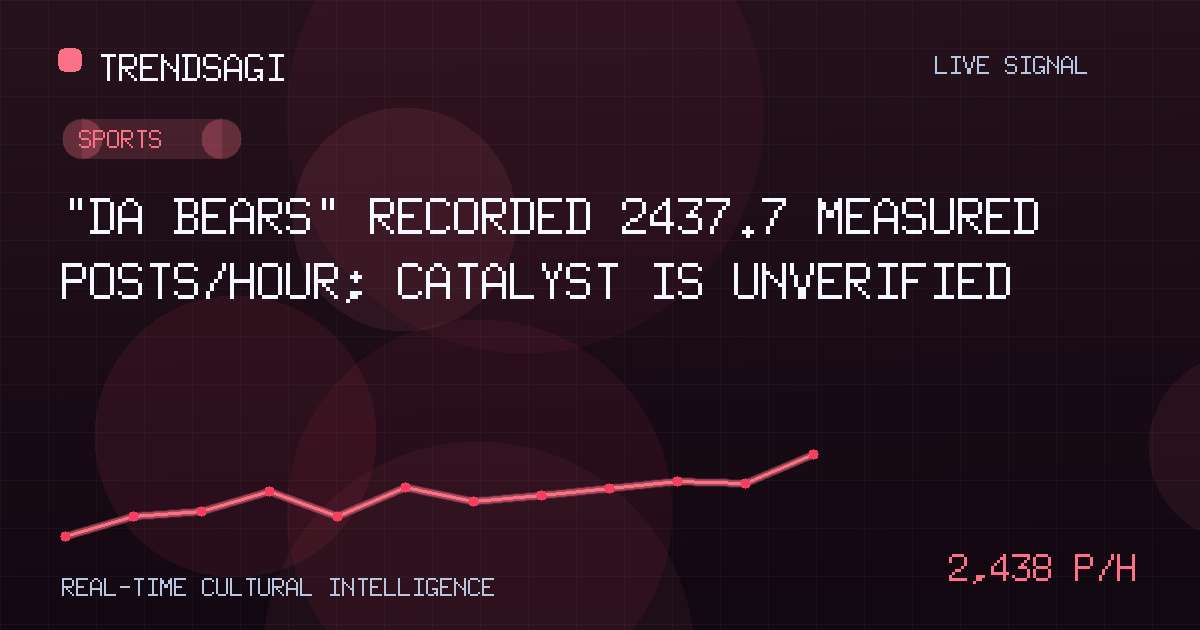
“Da Bears” recorded 2437.7 measured posts/hour; catalyst is unverified
At the 2026-10-09 snapshot, “Da Bears” logged a measured 2437.7 posts/hour over 792 seconds; the cause is unverified, and these checks can resolve it.
Automated briefing. Generated from stored signal measurements and source-backed research; it is not manually reviewed. Read the methodology and limitations.
Metrics in this briefing are a snapshot associated with its publication date and may not reflect current conditions.
What changed
“Da Bears” registered a measured change rate of 2437.7 posts/hour across an exact 792-second window, based on 2 stored observations, with the measurement timestamped 2026-10-09T15:53:33Z. The latest snapshot contained 1241 posts. In short, the monitored topic moved rapidly within the sampled interval, but the available record does not identify the entity or event behind the movement, and no external catalyst has been verified.
| Observation time | Measured posts/hour | Snapshot volume |
|---|---|---|
| 2026-10-09T15:53:33Z | 2437.7 | 1241 posts |
This is a measured snapshot rate, not a live or current rate, forecast, estimate of reach, engagement total, or count of unique people. Snapshot volume and posts/hour answer different questions: volume describes the captured collection at an observation point, while the rate describes change during the specified window. A posts/hour rate can be numerically higher than a point-in-time post count because it is expressed per hour; that alone is not evidence of an error or exceptional reach.
Why this topic may be moving
No external catalyst could be verified for this observation. The label is ambiguous, and the supplied Sports category does not establish which team, player, game, clip, or phrase is being discussed. It would be unsupported to attribute the movement to a result, roster development, injury, controversy, or viral media without timestamped evidence that such a development preceded the change.
The signal can support several working explanations, not a causal conclusion:
- Event reaction: a timely development may have prompted immediate reaction. The signal contains no event description, so the proposed event still needs verification.
- Network amplification: replies, quote posts, screenshots, or repeated wording may inflate apparent activity without representing equivalent independent participation.
- Collection effects: changes in query scope, collection boundaries, or a concentrated burst of duplicated content can affect a short-window rate. The available record does not show whether collection rules were stable.
Semantic spillover is also possible: an ambiguous phrase can attract discussion beyond its original context. That is a monitoring hypothesis, not a finding. Entity resolution—checking which concrete referent dominates representative posts—should come before any narrative is assigned.
A fast change in post count can make a topic newsworthy before it makes the topic intelligible. Resolving the entity and verifying the catalyst must precede explanation.
Why it matters
For sports editors, this is a verification lead rather than a ready-to-use story. Publishing “Da Bears is trending because…” would overstate what the measurement shows. A sampled post review can reveal whether the phrase points to a game, a team, a person, or an unrelated use, while timestamped public reporting can test whether a real development came first.
For communication, community, and audience teams, the signal may warrant monitoring for correction needs, misleading claims, or stakeholder attention. It should not be converted into claims about public sentiment, market demand, or audience size. A large volume of posts can still come from a narrow set of accounts or repeated content, and those data are not supplied here.
For trend analysts, the useful finding is the measured change and its unresolved context. The next analytical task is not to invent a cause; it is to join the topic to a stable entity, preserve the collection method, and test whether the movement persists outside the exact observation window.
What to watch next
- Resolve the label from content. Review a representative cross-section of posts for named entities, links, quoted text, and recurring context. A category tag alone is not enough. Separate the dominant interpretation from isolated examples.
- Establish time order. Compare the timing of original posts with the timing of any relevant public reporting or announcement. Coverage published after the burst may be a consequence of attention rather than its cause.
- Look for independent confirmation. Prefer a direct statement from the relevant organization or attributable reporting from a reputable publisher. Repetition inside the conversation is not independent confirmation.
- Check persistence. Compare later snapshots under the same topic definition and collection conditions. Determine whether the rate remains elevated, eases, or reverses; the present 2 observations cannot establish duration.
- Audit post composition. Distinguish original reactions from replies, reposts, quotations, media copies, promotional material, and automated-looking patterns. Check whether claims converge around the same fact or split into competing narratives.
- Track resolution signals. Follow corrections, official responses, clarifications, and credible follow-up reporting. A verified explanation should connect a named actor and action to the observed timing, not merely repeat the popular phrase.
The strongest next signal would be time-aligned public evidence that resolves the ambiguous label and is followed by sustained activity under the same monitoring definition. Without that combination, treat the movement as an unresolved spike.
Methodology and limitations
This briefing uses the supplied snapshot at 2026-10-09T15:53:33Z, a latest snapshot volume of 1241 posts, and a supplied measured change rate of 2437.7 posts/hour over an exact 792-second window using 2 stored observations. The rate and volume are kept separate and are not treated as interchangeable.
A change rate based on 2 observations over such a defined window can flag activity for review, but it cannot establish a normal baseline or a durable trend. The record does not provide historical comparisons, collection-method diagnostics, sentiment, geography, source quality, engagement, reach, or unique-person counts. It also does not show whether the label consistently denotes the same entity over time.
No external public fact is asserted because no catalyst could be independently verified for this observation. The defensible conclusion is therefore narrow but actionable: “Da Bears” produced a measured short-window burst in the monitored collection, while its cause and broader significance remain unconfirmed.
Track This Topic for New Signals
Set alerts for future velocity or sentiment changes around this topic.
Explore Tracking PlansAbout TrendsAGI research
TrendsAGI's automated research pipeline publishes dated signal snapshots, methodology notes, and practical workflows for teams evaluating cultural momentum. Read how signals are scoped, scored, and limited in our research methodology.