1399-second window · 3 observations · Measured Aug 28, 2026, 1:20 AM UTC · Provider: go_recent_snapshot_v2
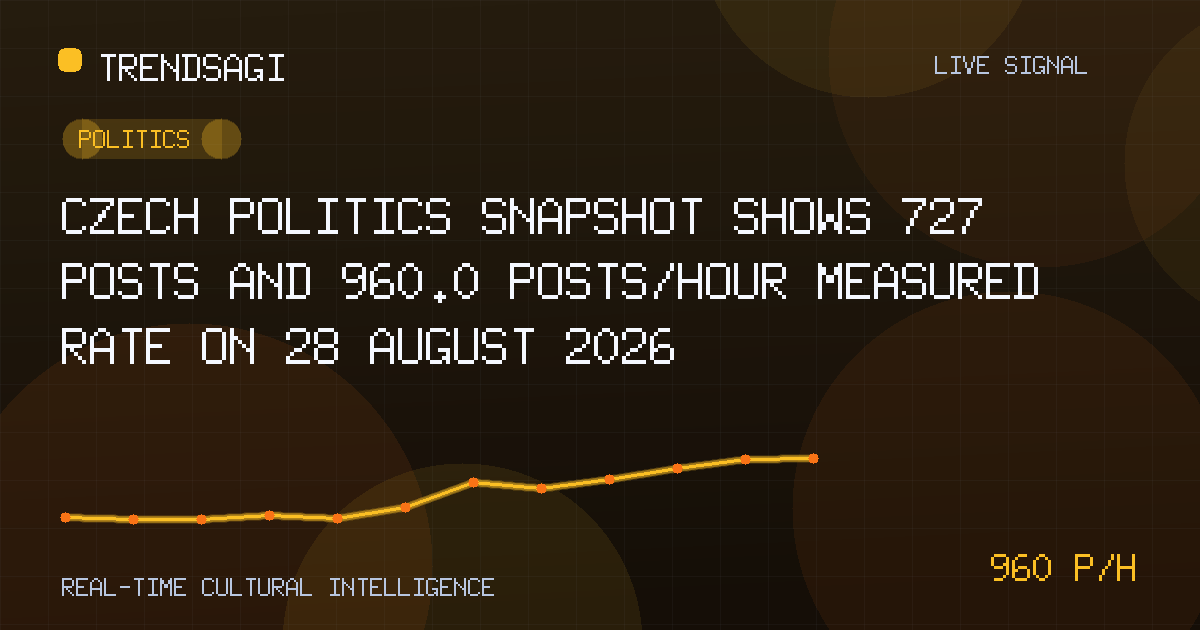
Czech politics snapshot shows 727 posts and 960.0 posts/hour measured rate on 28 August 2026
At 2026-08-28T01:20:29Z, Czech politics posts totaled 727 with a measured 960.0 posts/hour rate; briefing explains limits and next checks.
Automated briefing. Generated from stored signal measurements and source-backed research; it is not manually reviewed. Read the methodology and limitations.
Metrics in this briefing are a snapshot associated with its publication date and may not reflect current conditions.
What changed
At 01:20 UTC on 28 August 2026, the Czech politics conversation carried a snapshot volume of 727 posts, and the stored observations show a measured snapshot rate of 960.0 posts/hour across an exact 1399-second window using three data points. The combination of a high per-hour pace and a substantial post count signals a concentrated burst of attention on Czech political content at that moment.
The measured snapshot rate of 960.0 posts/hour is a calculated pace from the stored observations, not a live or current rate, and it should not be read as a forecast, reach, engagement total, or count of unique individuals. The snapshot volume of 727 posts is the count recorded at the observation timestamp and is separate from the rate figure.
| Observation time | Measured posts/hour | Snapshot volume |
|---|---|---|
| 2026-08-28T01:20:29Z | 960.0 | 727 posts |
Why this topic may be moving
We reviewed publicly available search results to attribute a clear catalyst for the increase in Czech politics posts. No publisher-verified event could be confirmed within that verification step. The stored signal description was empty, leaving the category label "Politics" as the only internal classification. Therefore, the specific cause of the surge remains unclear.
This does not mean the movement lacks a reason; it means the reason is not established by the verified public context we could access. Analysts should avoid inferring a particular trigger, such as a parliamentary vote, election outcome, or international incident, without sourced confirmation.
A measured snapshot rate captures the velocity of posts at a fixed observation point; it does not by itself reveal why a conversation accelerated.
When a topic label is as broad as "Czech" and the stored category is "Politics," the underlying posts could span multiple subthemes: domestic party dynamics, government formation, fiscal policy, foreign affairs, or local governance. Without verified external reporting, naming any one subtheme would be speculative.
The verification process limited itself to public search outputs and required attribution to a publisher. In the absence of such attribution, the honest position is to report the spike as unexplained. Past trend research shows that high-rate bursts often align with breaking news, but that pattern is context, not evidence for this specific case.
Why it matters
The signal provides a quantitative marker of sudden conversational density. For teams that monitor societal or political risk, a measured snapshot rate near 960 posts/hour paired with a 727-post snapshot is a flag that something unusual is occurring in the information environment, even if the substance is not yet decoded.
Who should care:
- Political risk consultants tracking Central European stability need to know when discussion velocity changes abruptly.
- News desks in Czechia and neighboring regions can use the volume spike to prioritize verification of on-the-ground events.
- Social listening teams for brands with Czech market exposure should check whether the political burst overlaps with brand mentions or sentiment shifts.
- Researchers studying misinformation or mobilization benefit from knowing the exact observation window and volume for later replication.
- Public sector communicators can gauge whether official messaging is keeping pace with public attention.
What the signal can establish:
- That at 2026-08-28T01:20:29Z, 727 posts were captured in the Czech politics snapshot.
- That across a 1399-second window with three observations, the pace equaled 960.0 posts/hour.
- That the category assigned was Politics, providing a coarse topical anchor.
What the signal cannot establish:
- The sentiment of the posts, whether supportive or oppositional.
- The number of unique authors or the geographic origin of the posts.
- Whether the rate reflects organic public interest or coordinated amplification.
- The precise event or policy that prompted the posts.
- The longevity of the conversation beyond the captured window.
Used in isolation, the signal is a hypothesis generator. It tells you where to look, not what you will find. Teams that treat it as definitive evidence of a specific event will make avoidable errors. The appropriate response is to fold the snapshot into a wider monitoring routine and seek corroboration.
What to watch next
Practical next checks for a reader or analyst:
- Query reputable Czech and international publishers for political developments dated 27-28 August 2026 to find a matching narrative.
- Observe subsequent snapshots to see if the measured rate sustains, decays, or accelerates further beyond the 1399-second window.
- Segment the conversation by subtheme if the data source allows, to see whether the volume concentrates around a specific institution or figure.
- Cross-reference the snapshot time with official schedules such as parliamentary sessions or court rulings.
- Check whether related geographic or language tags appear in later stored signals.
Concrete watch signals:
- A follow-up snapshot volume above 727 posts with a similar or higher measured rate would indicate continuation rather than a one-off spike.
- A drop below 200 posts in the next hour would suggest the burst was transient.
- Verification from a named publisher of a Czech political event at that timestamp would convert the unexplained spike into an explained trend.
- Emergence of related labels (e.g., specific party names) in stored signals would narrow the ambiguity.
Because the observation sits at 01:20 UTC, which corresponds to early morning in Czechia, the burst may reflect overnight developments or scheduled releases before the daily news cycle begins. That timing detail is useful for planning manual review shifts, but it does not explain the cause.
Methodology and limitations
The figures in this briefing come from a canonical stored signal observed at 2026-08-28T01:20:29Z. The measured snapshot rate of 960.0 posts/hour was derived from three stored observations over an exact 1399-second window. The snapshot volume of 727 posts is the count at the observation time. No transformation of these numbers has been applied.
Limitations to keep in mind:
- The rate is a snapshot calculation, not a continuous live measurement.
- The 1399-second window is short; patterns outside it are unknown.
- The topic label "Czech" and category "Politics" are stored as provided; they were not independently reclassified.
- External verification did not yield an attributable cause, so any causal story is currently unsupported.
- Snapshot volume counts posts captured by the storage system and may exclude platforms or languages not in scope.
Reading the numbers safely requires discipline. The measured snapshot rate of 960.0 posts/hour describes a pace recorded during a fixed observation; it is not a projection of future posting. The 727-post snapshot is a static count, not a rate. Presenting either figure outside its defined context would mislead.
Used correctly, this signal is an early warning beacon. It tells you that the Czech politics conversation was unusually busy at a precise moment, and it gives you a fixed reference point to investigate further. It does not tell you the story behind the numbers. The next step is verification, not assumption.
Track This Topic for New Signals
Set alerts for future velocity or sentiment changes around this topic.
Explore Tracking PlansAbout TrendsAGI research
TrendsAGI's automated research pipeline publishes dated signal snapshots, methodology notes, and practical workflows for teams evaluating cultural momentum. Read how signals are scoped, scored, and limited in our research methodology.


