912-second window · 3 observations · Measured Oct 6, 2026, 1:11 PM UTC · Provider: go_recent_snapshot_v2
‘Cube’ stored signal measures 449.9 posts/hour; public catalyst remains unverified
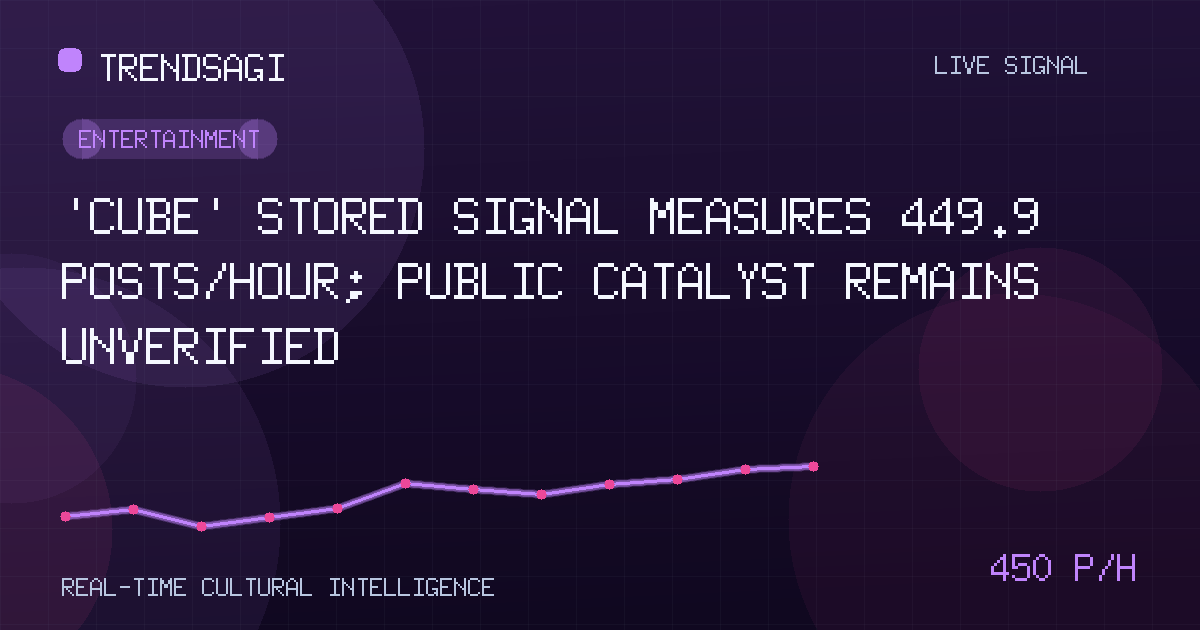
The stored Cube signal measures 449.9 posts/hour across a 912-second window and records 286 snapshot posts, but the cause and durability are unverified.
Automated briefing. Generated from stored signal measurements and source-backed research; it is not manually reviewed. Read the methodology and limitations.
Metrics in this briefing are a snapshot associated with its publication date and may not reflect current conditions.
What changed
The stored “Cube” signal shows a measurable short-window increase in posts, but no specific public catalyst has been verified. The defensible conclusion is momentum in the monitored entertainment stream—not yet a confirmed news event, release, controversy, or durable audience trend.
At the latest observation, 2026-10-06T13:11:43Z, the stored data recorded a measured snapshot rate of 449.9 posts/hour over an exact 912-second window using 3 stored observations. The latest snapshot volume was 286 posts. The rate and volume answer different questions: the rate captures change during the observed interval, while volume is the post count at the snapshot. The 449.9 figure is not a live or current rate, and neither metric is a forecast, reach, engagement, or unique-person count.
| Metric | Stored value |
|---|---|
| Observation time | 2026-10-06T13:11:43Z |
| Measured snapshot rate | 449.9 posts/hour |
| Rate window | Exact 912-second window |
| Stored observations used | 3 |
| Latest snapshot volume | 286 posts |
Why this topic may be moving
No verified public catalyst is attached to the stored record, so the reason for the increase remains unclear. The label “Cube” is also broad, and no supporting signal description was supplied. Posts assigned to that label may therefore concern different people, works, products, companies, or unrelated uses of the word. Separate conversations can be pooled under a generic topic label.
The movement could reflect a real public event, repeated discussion, coordinated posting, duplicate content, a taxonomy change, or ordinary volatility. These are possibilities to test, not findings. Without representative post text, account information, and source-backed public context, it would be misleading to select any one of them as the explanation.
What the signal can—and cannot—establish
The metric is useful as an alert because it identifies when and how quickly the monitored post count changed. It can prompt an editor to inspect the underlying stream, compare neighboring labels, and preserve subsequent observations under the same collection conditions.
- Established: The stored system recorded a short-term posting velocity for items classified as “Cube” within the category designated as entertainment.
- Not established: The posts do not necessarily refer to one identifiable entity or narrative.
- Not established: The signal cannot show whether the activity is organic, coordinated, automated, or amplified by duplicate submissions.
- Not established: Post volume alone does not reveal sentiment, audience size, engagement quality, geography, influence, or commercial impact.
Why it matters
For entertainment editors, the immediate question is not whether 449.9 posts/hour is striking in isolation, but whether the activity is coherent enough to explain and report. A generic label can trigger a rapid newsroom check without supporting a specific headline.
- Entertainment editors should inspect the actual posts before connecting the increase to a release, performer, franchise, or controversy.
- Trend and audience researchers should use the signal as a prompt to examine entity resolution, duplication, account concentration, and longer-term persistence.
- Brand and communications teams should verify what share of the activity refers to their organization rather than assuming every “Cube” post is relevant.
- General readers should distinguish a burst of discussion from broad public importance; posting velocity is not a measure of popularity or credibility.
A rise in posting is evidence of attention within the monitored stream, not proof of a durable trend or a verified catalyst.
What to watch next
Several follow-up checks would turn this alert into a better-supported trend assessment:
- Persistence: Determine whether the measured snapshot rate remains elevated across subsequent observation windows or quickly returns to its prior pattern. Sustained movement would provide stronger evidence than a brief burst.
- Entity convergence: Review a representative sample of posts and ask whether they consistently point to the same subject. Repeated names, links, hashtags, or contextual phrases would support a coherent conversation.
- Catalyst chronology: Use Google Search to locate an original, timestamped publisher page that predates the acceleration. A search snippet alone should not be treated as verification.
- Account concentration: Check whether a small set of accounts produced much of the activity and whether text is duplicated or posted in closely timed sequences. This helps distinguish conversation from a posting spike.
- Narrative breadth: Look for multiple distinct claims, reactions, and counter-arguments. Similar wording repeated across posts may indicate amplification rather than independent discussion.
- Collection consistency: Confirm that the topic definition, category assignment, and monitoring method did not change. Comparison with adjacent entertainment topics can reveal whether the movement is specific to “Cube” or part of a broader stream change.
Methodology and limitations
This briefing uses the supplied canonical measurement: a rate of 449.9 posts/hour calculated across an exact 912-second window from 3 stored observations, with 286 posts in the latest snapshot. Those figures describe the stored observation only. They do not describe the live/current rate, future activity, total audience, engagement, or unique participants.
The short window and limited observation set do not reveal the full shape or cause of the movement. No raw-post sample or verified public event linkage is included, so the topic’s entity scope, authenticity, sentiment, and durability remain unresolved. The appropriate use is as a triage alert: verify the posts and public context first, then decide whether the activity represents a reportable trend.
Track This Topic for New Signals
Set alerts for future velocity or sentiment changes around this topic.
Explore Tracking PlansAbout TrendsAGI research
TrendsAGI's automated research pipeline publishes dated signal snapshots, methodology notes, and practical workflows for teams evaluating cultural momentum. Read how signals are scoped, scored, and limited in our research methodology.


