902-second window · 3 observations · Measured Oct 5, 2026, 6:07 PM UTC · Provider: go_recent_snapshot_v2
Stored Croatia signal records 650.5 posts/hour in latest monitoring snapshot
Stored Croatia data shows 650.5 posts/hour over 902 seconds and 220 snapshot posts; the cause remains unverified, with limits and next checks.
Automated briefing. Generated from stored signal measurements and source-backed research; it is not manually reviewed. Read the methodology and limitations.
Metrics in this briefing are a snapshot associated with its publication date and may not reflect current conditions.
What changed
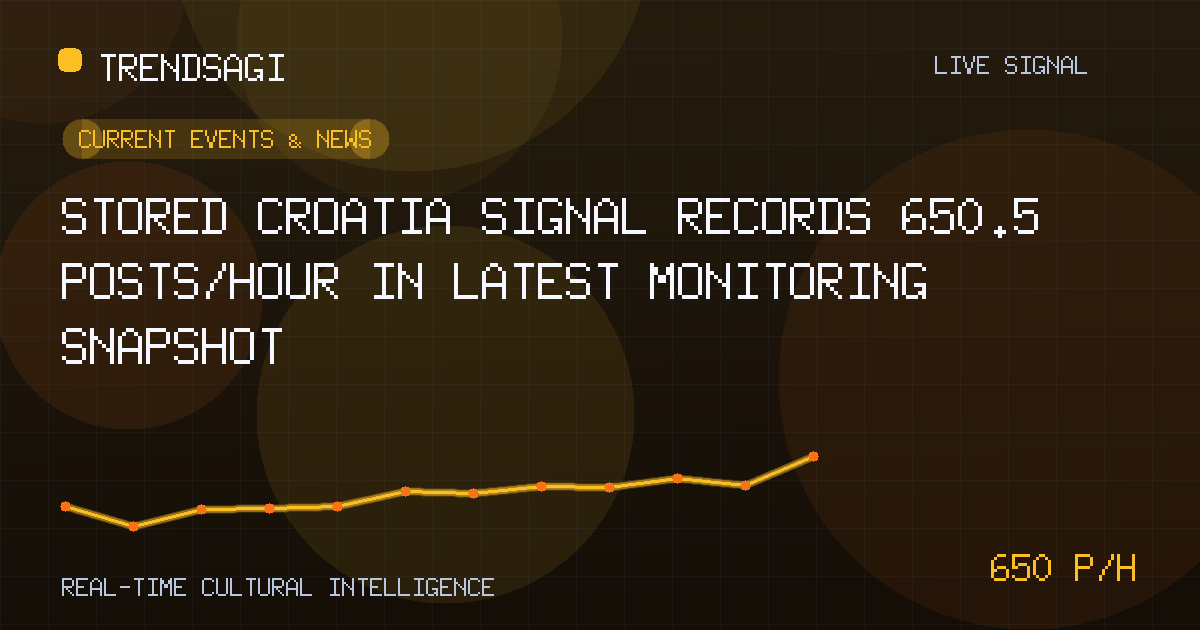
The latest stored signal for Croatia records a measured snapshot rate of 650.5 posts/hour. It uses 3 stored observations across an exact 902-second window and was measured at 2026-10-05T18:07:06Z. The direct conclusion is limited: monitored conversation around Croatia showed measurable activity at that recorded point, but the evidence does not identify why it was moving or whether the pace was unusually high.
The same latest snapshot contains 220 posts. Snapshot volume is not a rate, and neither figure is a live or current rate, forecast, reach estimate, engagement measure, or count of unique people. No baseline is supplied, so the pace cannot be labeled a rise, fall, surge, or record. The defensible conclusion is only that monitored activity was present at the stated time; its catalyst and persistence remain unverified.
| Metric | Recorded value |
|---|---|
| Observation time | 2026-10-05T18:07:06Z |
| Measured snapshot rate | 650.5 posts/hour |
| Exact measurement window | 902 seconds |
| Stored observations used | 3 |
| Latest snapshot volume | 220 posts |
Why this topic may be moving
No topic-specific catalyst is verified in the stored material. Its category, Current Events & News, says how the signal was classified, not what happened. Croatia is also a broad place label: posts collected under it could concern government, sport, culture, tourism, weather, an international relationship, or people merely using the country name. None should be presented as the cause without post-level and public-source confirmation.
With no verified public context attached to the observation, the reason remains unclear. Explanations to test, not findings, include:
- A newly reported domestic or international event involving Croatia.
- A scheduled sports, cultural, tourism, or other occurrence that prompted timed posts.
- A social post or media report that encouraged recirculation.
- Keyword ambiguity, including unrelated uses of the word Croatia.
- A query, collection, or sampling change that affected the measured pace.
The strongest supported statement is that Croatia-related monitoring was active in the recorded snapshot. A stronger statement—that a specific event caused a national or cross-platform trend—would require evidence the signal does not contain.
Why it matters
This signal is useful as a prompt to investigate, not as proof that an event happened or that public opinion changed. Its value depends on who follows up and what evidence they can add.
- Newsrooms and editors can use it to decide which claims require urgent verification before publication.
- Organizations with interests in Croatia can check whether a confirmed development affects travel, operations, reputation, or public information.
- Researchers and analysts can compare the observation with a stable baseline, related keywords, and other collection methods.
- Readers and communities should avoid treating post volume as public consensus, evidence of accuracy, or a substitute for confirmed news.
What the signal can—and cannot—establish
The stored evidence supports a narrow set of factual observations:
- The observation was recorded at 2026-10-05T18:07:06Z.
- The measured snapshot rate was 650.5 posts/hour.
- The rate used 3 stored observations across an exact 902-second window.
- The latest snapshot volume was 220 posts.
- The signal was classified under Current Events & News.
It does not establish:
- What event, statement, story, or behavior caused the activity.
- Whether the posts expressed approval, criticism, fear, curiosity, or another sentiment.
- Whether the authors were unique people, located in Croatia, or active across multiple platforms.
- Whether the posts were accurate, organic, influential, or widely seen.
- Whether the rate was high relative to normal activity or sustained beyond the measured window.
What to watch next
A sound follow-up should preserve the metric distinctions and seek corroboration rather than fill an evidence gap with a plausible story.
- Repeat the measurement under comparable conditions. Keep the query, collection window, language settings, and source scope stable so a later signal can be compared fairly.
- Inspect a representative post sample. Record repeated names, phrases, claims, links, and posting times; separate Croatia-focused discussion from incidental mentions.
- Verify the catalyst. Use Google Search for distinctive names, quoted phrases, or event claims from the sample. Treat a cause as verified only when a credible publisher’s dated account or an official statement aligns with both the subject and timing.
- Test persistence. Examine later snapshots for the same subject and rate pattern rather than extrapolating from this observation alone.
Concrete watch signals
- A later comparable snapshot shows a similar rate, supporting a persistence hypothesis rather than an isolated window.
- Posts repeatedly name the same event, entity, place, or claim, and independent credible sources converge on it.
- An official event calendar, statement, or update aligns with the observation time and topic.
- The pattern remains visible when the query and collection method are held constant.
- A marked divergence between the rate and snapshot volume appears, prompting an audit of aggregation and sampling.
Methodology and limitations
The 650.5 posts/hour figure is a measured snapshot rate based on 3 stored observations over an exact 902-second window, measured at 2026-10-05T18:07:06Z. The 220 posts figure is latest snapshot volume. The record does not define their shared aggregation scope or state that 220 is the numerator for the rate; the values should not be multiplied, divided, annualized, or used to forecast another interval.
The supplied record contains no post text, source distribution, sentiment, author counts, engagement data, historical baseline, or verified public explanation. The timestamp identifies when the signal was observed, not when each post was created. Consequently, the data can locate a monitoring event in time, but it cannot establish its cause, audience, consensus, or persistence. With external corroboration absent, naming a catalyst would go beyond the evidence.
Track This Topic for New Signals
Set alerts for future velocity or sentiment changes around this topic.
Explore Tracking PlansAbout TrendsAGI research
TrendsAGI's automated research pipeline publishes dated signal snapshots, methodology notes, and practical workflows for teams evaluating cultural momentum. Read how signals are scoped, scored, and limited in our research methodology.