15-minute window · 3 observations · Measured Sep 25, 2026, 12:51 PM UTC · Provider: go_recent_snapshot_v2
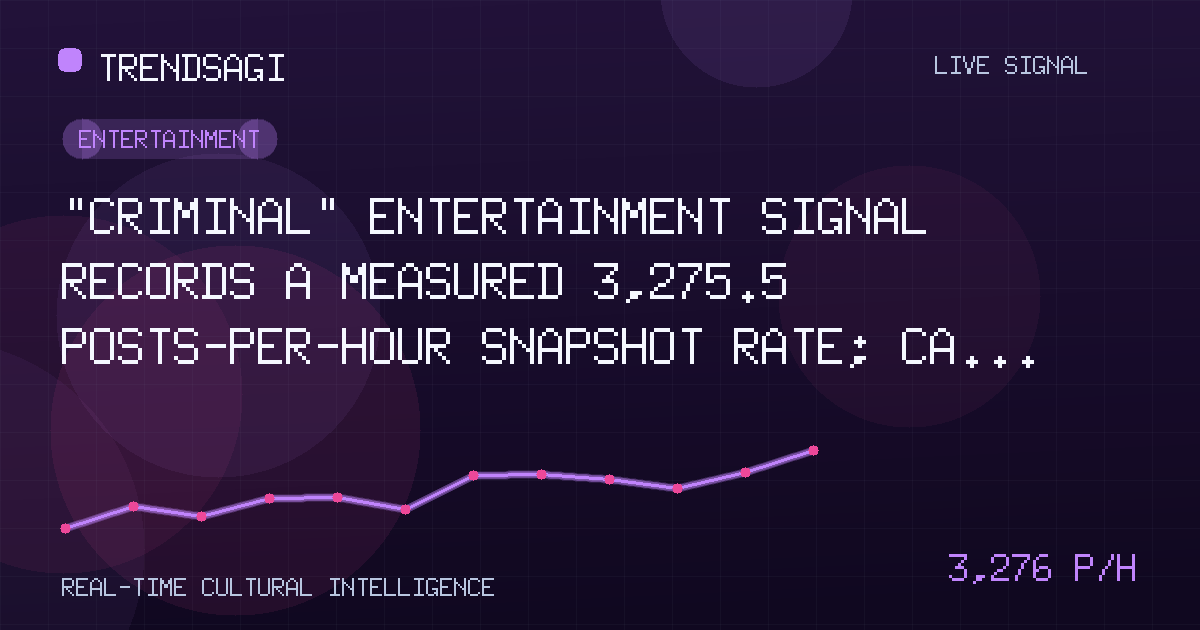
“Criminal” entertainment signal records a measured 3,275.5 posts-per-hour snapshot rate; cause unverified
The “Criminal” entertainment signal has a measured 3,275.5 posts-per-hour snapshot rate; learn what it shows and what remains unverified.
Automated briefing. Generated from stored signal measurements and source-backed research; it is not manually reviewed. Read the methodology and limitations.
Metrics in this briefing are a snapshot associated with its publication date and may not reflect current conditions.
What changed
The stored entertainment signal labeled “Criminal” registered a measured snapshot rate of 3,275.5 posts per hour at 2026-09-25T12:51:37Z, based on 3 stored observations over an exact 900-second window.
The latest snapshot contains 3,000 posts, which is a volume rather than a rate. The cause of the change is unverified: the signal description is empty, and no verified public context connects the activity to a particular release, controversy, legal development, or real-world event.
| Measure | Stored value |
|---|---|
| Observation time | 2026-09-25T12:51:37Z |
| Measured snapshot rate | 3,275.5 posts/hour |
| Exact measurement window | 900 seconds |
| Stored observations | 3 |
| Latest snapshot volume | 3,000 posts |
This is evidence of concentrated posting in the stored sample, not evidence of a particular event, a change in public opinion, or a rise in unique participation.
How to read the signal
The figure establishes a quantity of posting activity per hour across the observations used. It does not establish whether posts were original, how many people contributed, or whether they concerned the same subject. One broad label can collect different stories, reactions, and duplicated material.
For a real reader, the defensible conclusion is that posting activity in this stored entertainment signal changed during the measured window. That does not establish that public concern about crime rose. The first statement describes the observations; the second would require evidence about the content and a meaningful comparison that is not supplied.
The label also needs careful interpretation. “Criminal” might identify a work, a storyline, or commentary about wrongdoing. The available record does not resolve which meaning applies, and the entertainment category does not settle the question.
Why this topic may be moving
Without verified context, the trigger is unknown. The entertainment category makes a release, promotion, storyline development, or controversy involving entertainment figures plausible subjects to investigate, but none is documented here. A new real-world event outside the category is also possible; the label alone cannot rule that in or out.
Posting volume can rise for reasons that do not represent a meaningful new development. Repeated excerpts, automated activity, changes in recommendation or collection rules, and shifts in which labels are included are all possible explanations to test. These are hypotheses, not findings, and they should not be used to fill the missing causal explanation.
Why it matters
Editors, media-intelligence teams, and trend researchers should treat this as a verification task rather than a ready-made story. A topic label paired with a measured rate can prioritize investigation, but it cannot supply a headline’s missing factual premise. In particular, discussion involving criminality is not evidence that a new crime has occurred.
Audience and brand-safety teams may also want to inspect the underlying sample. The measured rate can prompt a check for a factual event, a misleading label, or a content spike. It does not establish sentiment, reach, the credibility of claims, or whether attention is spreading beyond the stored feed.
What to watch next
Use the rate as a starting point for checks that could confirm—or weaken—the apparent trend:
- Event-linked evidence: Look for a time-stamped public record or verified reporting that explicitly concerns the labeled subject and predates the observed activity. A primary announcement that aligns with the timeline would provide a concrete explanation to test, unlike a later article that merely describes the reaction.
- A matched baseline: Compare this window with earlier and later readings collected under identical rules. The available 3 observations establish a windowed rate, not a usual level, a sustained trend, or the statistical significance of the change.
- Stable collection scope: Confirm that the topic definition, category, language settings, geography, deduplication, and sampling method have not changed. Without that consistency, a change in measurement can resemble a social shift.
- Originality and concentration: Inspect whether posts add distinct reporting and commentary or largely repeat the same excerpt. Watch for bursts concentrated in one source pattern, because raw posting volume need not represent independent contributors.
- Cross-platform corroboration: Check whether other services show a time-aligned increase involving the same subject and term. Agreement would strengthen a trend assessment; disagreement would narrow it. Identical words across services do not necessarily mean identical meanings.
Methodology and limitations
The 3,275.5 posts/hour figure is a measured snapshot rate, not current or live activity. It uses 3 stored observations over an exact 900-second window, while the latest snapshot volume is 3,000 posts. Snapshot volume must not be treated as a rate. No live count, forecast, reach, engagement, or unique-person count can be inferred.
No comparison period, source-level sample, audience breakdown, or populated signal description is supplied. Consequently, this briefing cannot establish causation, statistical significance, sentiment, geographic origin, or whether the label concerns fictional material, reporting about real-world events, or both. No external event has been verified as the trigger, so the cause remains unresolved.
Track This Topic for New Signals
Set alerts for future velocity or sentiment changes around this topic.
Explore Tracking PlansAbout TrendsAGI research
TrendsAGI's automated research pipeline publishes dated signal snapshots, methodology notes, and practical workflows for teams evaluating cultural momentum. Read how signals are scoped, scored, and limited in our research methodology.