901-second window · 3 observations · Measured Oct 8, 2026, 5:36 AM UTC · Provider: go_recent_snapshot_v2
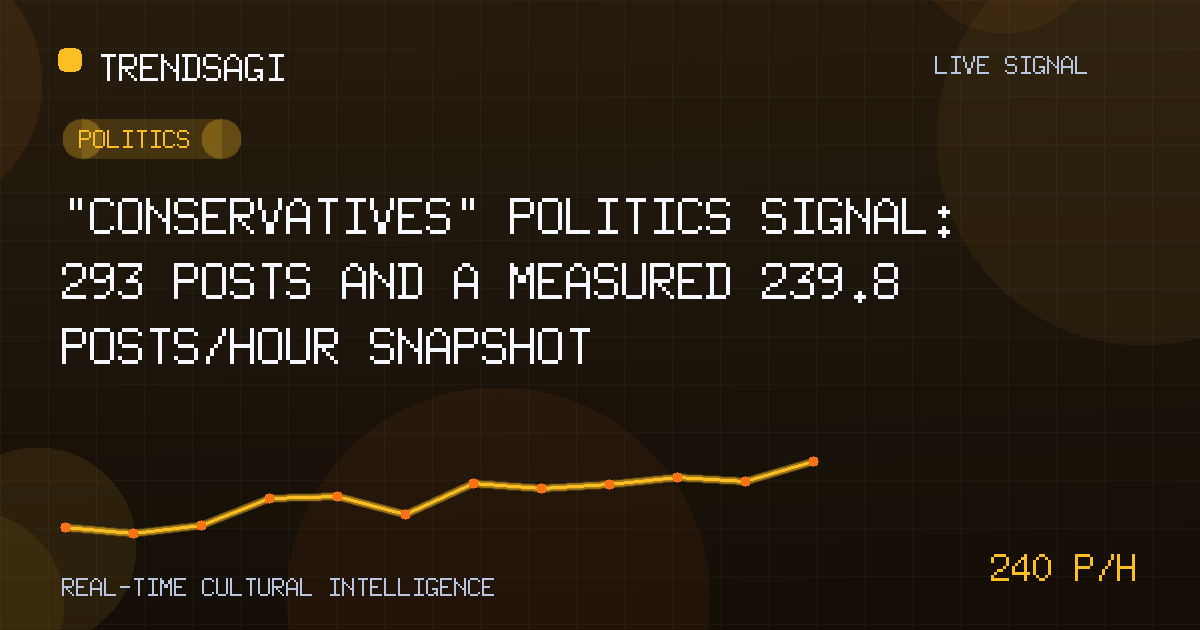
“Conservatives” politics signal: 293 posts and a measured 239.8 posts/hour snapshot
The “Conservatives” signal shows 293 posts and a measured 239.8 posts/hour snapshot; here is what is known and what to verify next.
Automated briefing. Generated from stored signal measurements and source-backed research; it is not manually reviewed. Read the methodology and limitations.
Metrics in this briefing are a snapshot associated with its publication date and may not reflect current conditions.
What changed
Answer: The stored signal labeled “Conservatives” in the Politics category recorded 293 posts at 2026-10-08T05:36:53Z. Over an exact 901-second window based on three stored observations, its measured snapshot rate was 239.8 posts/hour. These figures document posting in the captured sample, but without a prior baseline they do not establish that the topic surged or was rising.
The editorial takeaway is to investigate, not attribute momentum. The 293 posts are the latest snapshot volume, while 239.8 posts/hour is the measured snapshot rate—not a live or current rate, forecast, reach, engagement measure, or unique-person count. No verified public context identifies a triggering event, so the reason for the movement remains unclear.
| Observation time | 2026-10-08T05:36-53Z |
|---|---|
| Snapshot volume | 293 posts |
| Measured snapshot rate | 239.8 posts/hour |
| Measurement window | 901 seconds |
| Stored observations | 3 |
Why this topic may be moving
No defensible event attribution can be made from this record. A breaking political item, a candidate or party statement, a controversy, scheduled activity, or a collection or classification change could all produce a posting cluster. Those are investigation hypotheses, not verified explanations. The stored material supplies no named event, source linkage, or corroborated public context.
The breadth of the label raises another risk: “Conservatives” can collect discussion of different people, parties, places, policies, and issue terms. Without the underlying queries, geography, language settings, or post text, it is impossible to tell whether the sample reflects one development or several unrelated conversations grouped under the same label.
A measured posting rate tells an editor where to look. It does not, by itself, explain the cause, identify the participants, or show how far a conversation traveled.
Why it matters
This signal matters because it can direct scarce verification effort. It should not be used as a proxy for public opinion or political support.
- Newsrooms can use it as a reporting lead, but should identify the underlying event and corroborate it before publishing a causal explanation.
- Campaign and party teams can monitor possible reaction windows, while avoiding the mistake of treating a topic label as a measure of voter sentiment or electoral support.
- Platform trust and safety teams can prioritize content review for coordination, abuse, or misinformation, but high volume alone is not evidence of manipulation.
- Researchers and publishers need the collection method and time series before generalizing from the snapshot to a wider political conversation.
For general readers, the key distinction is between conversation volume and influence. Many posts can be responses to a few repeated items; conversely, a smaller discussion can matter if it contains original reporting or verified official information. Neither condition is established here.
What to watch next
A useful follow-up should move from quantity to provenance:
- Find the earliest substantive items. Inspect their claims, cited sources, and timestamps to identify the first plausible trigger. Separate original posts from replies, quotes, and reposts so repetition is not mistaken for independent confirmation.
- Test a specific event hypothesis. Search reputable publishers and relevant official accounts for the event or claim surfaced in the posts. Attribute a cause only if a publisher’s verified report or an official record connects it to the observed window.
- Compare like-for-like windows. Check adjacent and historical windows of the same length from the same collection process. Ask whether the measured rate persists or falls back toward that source’s normal pattern; do not extrapolate this snapshot forward.
- Measure content diversity. Group posts by the underlying claim and source. Independent discussion, shared reactions, and repeated wording are different signals. Repetition may justify a coordination review, but it does not prove manipulation.
- Assess spread quality. Review whether new posts add information, whether unrelated sources carry the same claim, and whether discussion crosses the uncertain geography or language boundaries. Do not convert post volume into an estimate of participants.
- Check label stability. Determine whether “Conservatives” remains the assigned topic as new posts arrive or whether the classifier is absorbing a broader event. A taxonomy shift can look like audience momentum without any change in political interest.
Concrete watch signals
Watch for a verifiable event preceding the window, independent reporting of the same development, persistence in subsequent equal-length windows, a shift from copied reactions to original reporting, and clusters using identical claims or sources. Those signals would strengthen an explanation, but none is present in the stored snapshot.
Methodology and limitations
The measured snapshot rate is reported exactly as supplied: 239.8 posts/hour across an exact 901-second window using 3 stored observations. It is neither recalculated nor projected. The 293 posts are the volume in the latest snapshot at the stated observation time; they are not a numerator for a broader population.
The record does not provide a sampling frame, query definition, deduplication method, language or geography settings, account composition, weighting, or collection-error information. It also does not distinguish original posts from reactions or repeated content. As a result, the figures cannot establish representativeness, sentiment, authenticity, organic versus coordinated activity, or unique participation.
A single observed point cannot reveal whether the topic was entering a surge, at its peak, declining, or already fading. The three observations underlying the supplied rate do not expose the full shape of the window. Until a triggering event is independently verified and the signal persists in comparable observations, the responsible conclusion is narrow: this is a dated, measured posting snapshot with an unresolved cause.
Track This Topic for New Signals
Set alerts for future velocity or sentiment changes around this topic.
Explore Tracking PlansAbout TrendsAGI research
TrendsAGI's automated research pipeline publishes dated signal snapshots, methodology notes, and practical workflows for teams evaluating cultural momentum. Read how signals are scoped, scored, and limited in our research methodology.