15-minute window · 3 observations · Measured Sep 24, 2026, 4:06 PM UTC · Provider: go_recent_snapshot_v2
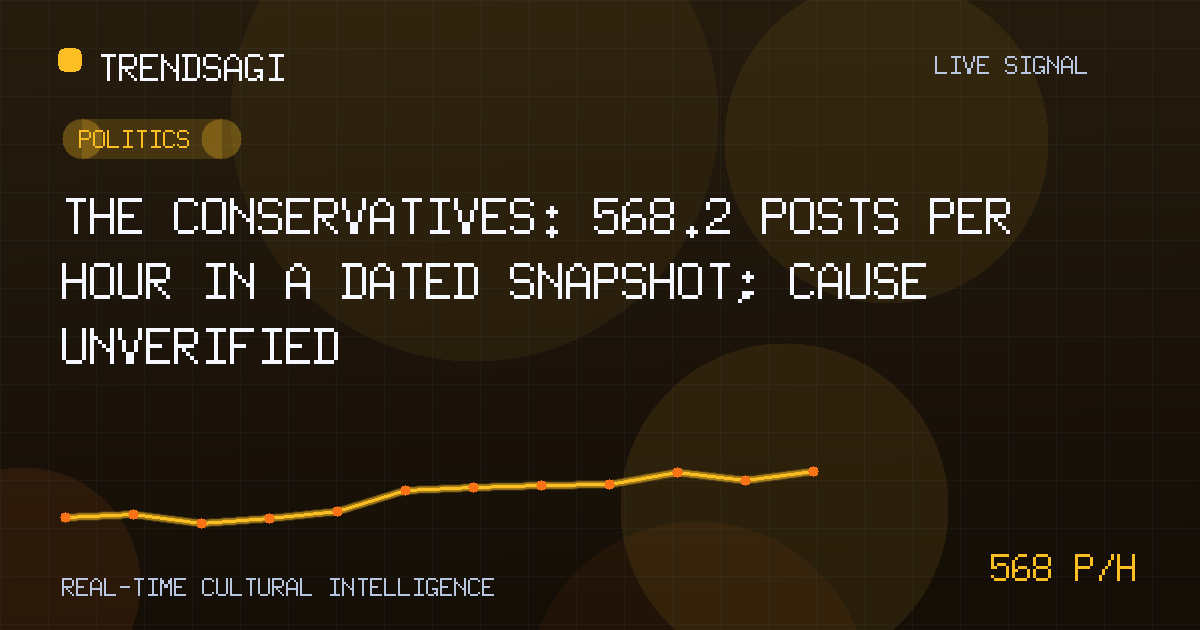
The Conservatives: 568.2 posts per hour in a dated snapshot; cause unverified
A 2026-09-24T16:06:36Z snapshot measured 568.2 posts per hour about The Conservatives. The trigger is unverified; the briefing explains limits and next checks.
Automated briefing. Generated from stored signal measurements and source-backed research; it is not manually reviewed. Read the methodology and limitations.
Metrics in this briefing are a snapshot associated with its publication date and may not reflect current conditions.
What changed
Discussion labeled “The Conservatives” shows a measured burst of attention, but its trigger remains unverified. The defensible reading is a change in the pace of monitored posting—not a demonstrated shift in party support, membership or policy. No dated, verified public event in the available record establishes why the topic is moving.
The measured snapshot rate was 568.2 posts per hour over an exact 900-second window, based on 3 stored observations and measured at 2026-09-24T16:06:36Z. The latest stored snapshot contained 827 posts. The rate is not a live or current estimate, forecast, reach, engagement or count of unique people; the snapshot volume is a count of posts, not another hourly rate.
| Measure | Stored value |
|---|---|
| Observation time | 2026-09-24T16:06:36Z |
| Measured snapshot rate | 568.2 posts per hour |
| Latest snapshot volume | 827 posts |
The word “moving” refers to the recorded attention signal, not a finding about political change. Without a historical average or comparison period, the rate cannot be classified as exceptional, and a short window cannot establish how long the activity will last.
Why this topic may be moving
Several mechanisms could produce this pattern, but they are checks rather than findings. A specific trigger should not be supplied without a verifiable public source tied to the observation time.
- Event reaction: A speech, policy release, internal party development or news story could prompt comments. None is established as a trigger here.
- Label breadth: The label may capture supporters, opponents, replies to other parties or general political commentary. It does not identify a single policy or audience.
- Concentrated amplification: Repeated quotations, a small number of active accounts or automated reposting could raise the rate without a broad change in attitudes. The record does not establish whether any of these occurred.
A credible explanation would require a dated public source, a demonstrable link to the posts and independent corroboration. A report published after the observation cannot explain the earlier activity, and even a contemporaneous report would show context rather than prove that it caused the pattern.
Editorial assessment: This is a signal to investigate a rise in posting activity, not a substitute for evidence about the political event behind it. The number sets the research priority; it does not settle the interpretation.
Why it matters
The immediate value is triage: determine whether attention reflects a specific event, an organized messaging push, a controversy or a measurement artifact. The signal alone cannot separate those explanations, so treating it as a confirmed political development would mislead readers.
- Campaign and party teams: Check for a time-sensitive claim, criticism or request that needs a factual response. Posting volume alone is not a reason to amplify a message.
- Journalists and editors: Find the originating statement or event and verify it independently. Use the snapshot to guide questions, not as a factual source about party affairs.
- Researchers and analysts: Do not substitute this rate for polling, membership data or issue salience. Interpretation needs a defined content sample, duplicate controls and an account-authenticity assessment.
- Decision makers and readers: Distinguish being discussed from being influential or representative. A fast rate can reflect repetition and reaction rather than a broad change in preference.
What to watch next
The next step is to turn an attention alert into a documented chain of evidence.
- Establish contemporaneous context. Check official party channels, relevant public proceedings and reputable reporting available by the observation time. Any proposed cause needs a timestamp, a publisher and evidence that the collected posts refer to it; none is confirmed in the current record.
- Audit the 827-post snapshot. Sample across the window and record timestamps, account types, exact wording, quoted material and link destinations. This shows what the label captured without assuming that every post expresses a substantive party view.
- Test concentration and duplication. Compare the number of contributing accounts with the number of posts, and look for repeated wording or automated behavior. Neither a small source group nor bot activity is established here.
- Check persistence with complete, consistently defined windows. Report raw volumes alongside measured rates, and keep the 2026-09-24T16:06:36Z observation dated. One short window is not a forecast.
- Look for follow-on evidence. Independent reporting, a documented original statement and sustained discussion across distinct issues would strengthen an explanation. More posts alone would not establish what prompted them.
- Measure meaning separately. Code a defined sample for support, opposition, news sharing and off-topic use. Keep sentiment, topic, source diversity and account quality as separate findings.
Methodology and limitations
The rate is calculated from 3 stored observations over the exact 900-second window at the stated observation time. Snapshot volume is a separate count of 827 posts, not an hourly rate. Neither is a live or current estimate, a forecast or evidence of reach; the rate also does not measure engagement or unique authors.
The record does not supply the individual posts, a longer baseline, a verified trigger, sentiment, geography, account counts or duplication and authenticity checks. It therefore cannot establish how unusual the rate is, who generated the posts, why the increase occurred or whether it will persist. The label may also include party-related material from people who are not aligned with the party. Claims about public opinion or electoral significance need separate evidence.
Track This Topic for New Signals
Set alerts for future velocity or sentiment changes around this topic.
Explore Tracking PlansAbout TrendsAGI research
TrendsAGI's automated research pipeline publishes dated signal snapshots, methodology notes, and practical workflows for teams evaluating cultural momentum. Read how signals are scoped, scored, and limited in our research methodology.