1804-second window · 3 observations · Measured Oct 8, 2026, 3:51 PM UTC · Provider: go_recent_snapshot_v2
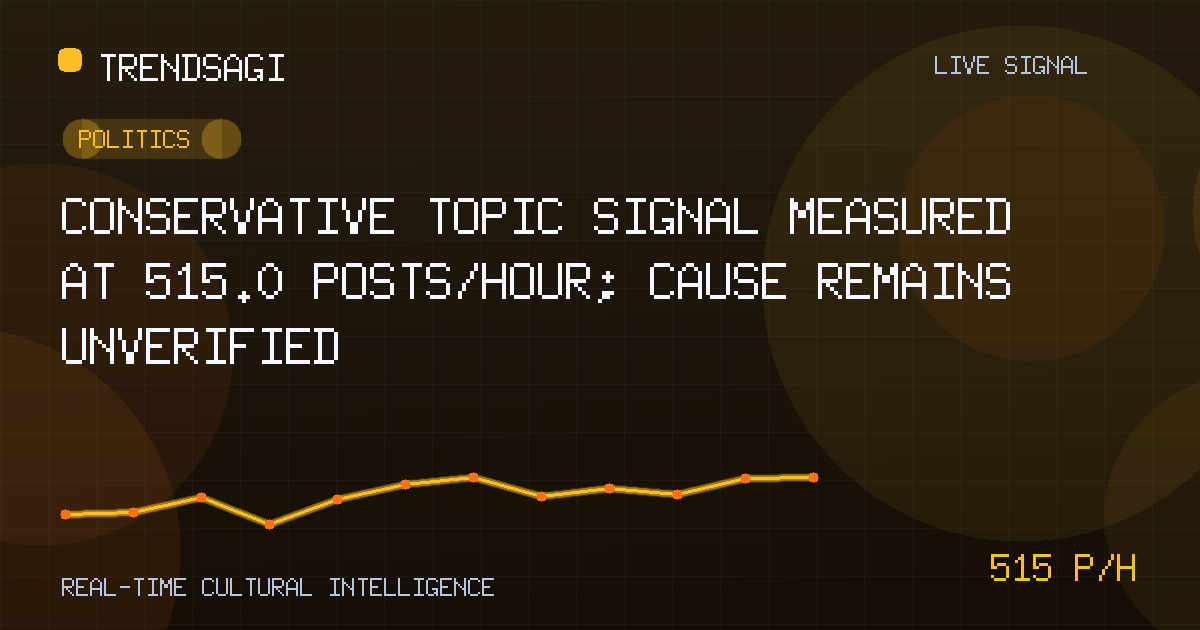
Conservative topic signal measured at 515.0 posts/hour; cause remains unverified
A measured 515.0 posts/hour snapshot captures increased activity around the Conservative label, while its cause and broader significance remain unverified.
Automated briefing. Generated from stored signal measurements and source-backed research; it is not manually reviewed. Read the methodology and limitations.
Metrics in this briefing are a snapshot associated with its publication date and may not reflect current conditions.
What changed
The available signal shows increased posting activity around the topic label “Conservative,” with a measured change rate of 515.0 posts/hour. The defensible conclusion is limited: the monitored stream moved faster during the recorded window. It does not show that a particular person, party, policy, or broader political movement gained support.
The rate was measured over an exact 1804-second window using 3 stored observations. The latest snapshot contained 1058 posts at 2026-10-08T15:51:54Z. Posts per hour is a measured snapshot rate, not a live or current rate, forecast, reach measure, engagement count, or unique-person count.
| Observation time | Measured snapshot rate | Latest snapshot volume |
|---|---|---|
| 2026-10-08T15:51:54Z | 515.0 posts/hour | 1058 posts |
Why this topic may be moving
Why the topic is moving remains unclear. The label is assigned to the Politics category, but no verified public context connects the measured window to a specific political event. The stored signal also has no descriptive text explaining what “Conservative” captures. It may refer to an ideology, a political party or coalition, positions on several issues, or people and groups described with a broad political term.
That ambiguity matters because a fast increase in matching posts does not necessarily represent a coherent political conversation. Search or classification rules may include posts using the word in unrelated contexts. Without the underlying query, classifier, and post sample, the signal cannot establish how narrowly the topic was defined or whether the matches shared a common theme.
A verified news event could also prompt discussion, but no particular event has been established here. Other possible explanations include increased sharing of existing material, duplicate or near-duplicate posts, coordinated posting, automated activity, or a change in the collection process. These are explanations to test, not findings from this signal.
The most defensible reading is not “a conservative political movement is accelerating,” but “the monitored conversation around an underspecified label recorded a measured increase in posting activity.”
Why it matters
The signal is useful as a prompt for investigation, especially for newsrooms monitoring political conversation, researchers tracking issue attention, and public-affairs teams watching changes in their issue environment. It identifies where activity accelerated and provides a timestamp against which public events and the collection process can be checked.
It is not sufficient evidence of a durable trend. The 1058-post snapshot measures volume within the captured set; it does not reveal how many people participated, how much original content was created, or whether the posts expressed support, opposition, news reporting, or unrelated uses of the label. Nor does the posts-per-hour figure measure public reach or engagement.
Political and communications teams should avoid interpreting the rate as a shift in public opinion without examining the actual posts. A broad label can create the appearance of a strong ideological trend even when posts concern different subjects or are simply repeated. Editorial teams should seek a coherent sample and verified context before assigning a political meaning to the increase.
What to watch next
- Persistence: Check whether later snapshots, collected with the same method, remain above the relevant baseline. One measured window can capture a temporary spike and does not establish a continuing trend.
- Original content: Separate original posts from reposts, quotations, reactions, and duplicates. A rise driven by repeated circulation has a different meaning from a rise in new discussion.
- Event alignment: Compare the exact observation time with verified reporting from identifiable publishers. Any claimed catalyst should have a clear timestamp and source rather than being inferred from coincidence.
- Semantic coherence: Review a representative sample and code whether the posts concern ideology, a political organization, policy, elections, or unrelated language. This is essential before describing the activity as conservative in a substantive sense.
- Participation patterns: Examine account concentration, posting coordination, geography, and language. Volume spread across independent participants is different from volume concentrated among a small set of accounts.
- Collection stability: Confirm that the query, category assignment, language filters, deduplication rules, and classification method have not changed. A measurement change can resemble a conversation change.
Concrete signs that would strengthen the signal would include sustained elevated activity in later windows, greater representation of original posts, a shared theme that survives manual review, and alignment with independently verified events. Weak signs would include unstable classification, heavy duplication, narrow account concentration, or no consistent connection among the matching posts.
Methodology and limitations
The reported 515.0 posts/hour figure is a measured change rate derived from 3 stored observations across an exact 1804-second window ending at the recorded snapshot time. The record does not provide a longer baseline, the calculation formula, the collection query, or post-level examples. Those omissions limit conclusions about persistence and cause.
The latest snapshot volume of 1058 posts is a count within that snapshot, not a rate or an audience estimate. Without account-level and content-level information, it cannot establish unique participants, sentiment, organic reach, or influence. The broad topic label also creates a material risk of mixed meanings.
No verified catalyst is available, so the cause of the movement should be treated as unresolved. The appropriate next step is methodological and contextual verification: reproduce the measurement, inspect the matching posts, test whether the activity persists, and compare the timestamp with reliable public reporting. Until those checks are complete, the signal supports heightened attention rather than a firm political conclusion.
Track This Topic for New Signals
Set alerts for future velocity or sentiment changes around this topic.
Explore Tracking PlansAbout TrendsAGI research
TrendsAGI's automated research pipeline publishes dated signal snapshots, methodology notes, and practical workflows for teams evaluating cultural momentum. Read how signals are scoped, scored, and limited in our research methodology.