1024-second window · 3 observations · Measured Sep 4, 2026, 3:07 AM UTC · Provider: go_recent_snapshot_v2
Coco Shows Measured 738.1 Posts per Hour in 1,024-Second Entertainment Snapshot
Coco shows a measured 738.1 posts/hour snapshot rate and 461 posts in an entertainment signal, with cause still unconfirmed.
Automated briefing. Generated from stored signal measurements and source-backed research; it is not manually reviewed. Read the methodology and limitations.
Metrics in this briefing are a snapshot associated with its publication date and may not reflect current conditions.
What changed
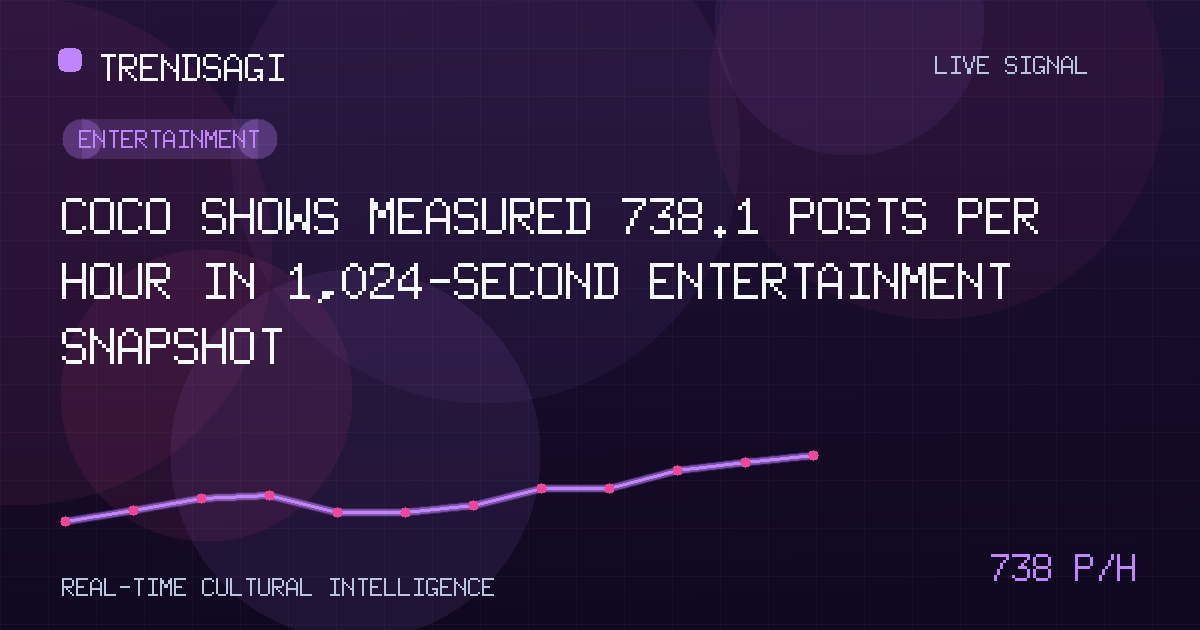
The stored entertainment signal for “Coco” shows a measured snapshot rate of 738.1 posts/hour over an exact 1,024-second window, calculated from three stored observations and measured at 2026-09-04T03:07:36Z. The direct reading is that the label was moving quickly inside the monitored entertainment sample at that moment, not that the topic is currently at that level, will continue at that level, or has a verified public news driver.
The latest snapshot volume is 461 posts. That volume is a stored point-in-time count of posts associated with the label in the sample; it is not a unique-person count, a reach number, or an engagement score. The useful takeaway is a short-window activity marker that needs context before any causal claim can be made.
| Observation time | Measured snapshot rate | Snapshot volume |
|---|---|---|
| 2026-09-04T03:07:36Z | 738.1 posts/hour | 461 posts |
Why this topic may be moving
The stored category is “Entertainment,” and the supplied topic label is only “Coco.” That combination gives enough signal to say the activity is being treated as entertainment-adjacent, but it does not identify the specific object, event, person, title, or meme behind the label.
Because the stored signal description is empty and no verified public context is available in the stored signal, the cause is still unclear. In entertainment trend monitoring, single-word labels can move for many different reasons: a film or song clip, a celebrity reference, a fan edit, a short-form video trend, a platform recommendation burst, a recurring hashtag, a local event nickname, or a misclassified conversation that temporarily appears under an entertainment tag. None of those possibilities should be asserted as fact without matching post content.
What the signal can and cannot establish
The signal can establish three things with the supplied data:
- A short-window measured snapshot rate of 738.1 posts/hour.
- A latest stored snapshot volume of 461 posts at 2026-09-04T03:07:36Z.
- A stored entertainment classification for the label “Coco.”
It cannot, by itself, establish the reason for the movement, the platform mix, the geography of the audience, the sentiment of the posts, whether the posts are from distinct users, whether the label refers to one subject or several unrelated subjects, or whether the activity will persist beyond the observed window.
When a label is only a single word, the strongest trend decision is to separate the measured activity from the identity of the subject. In this case, 738.1 posts/hour tells us that the label was circulating quickly in the stored entertainment sample; it does not tell us what “Coco” means in that conversation.
Why it matters
Short-window entertainment spikes are useful because they can surface early movement before broader coverage appears. A measured snapshot rate is not proof of importance, but it is a trigger for context checks. If “Coco” is tied to a recognizable film, song, artist, or viral clip, the rate may indicate a sudden resurfacing of existing media. If it is a nickname or a platform-specific reference, the signal may be narrower than it appears.
Who should care includes entertainment trend editors, social listening analysts, content marketers, and newsroom staff who need to know whether a label is becoming a story. The editorial value is in avoiding overinterpretation. A high post volume can be generated by a small number of coordinated accounts, a platform feed effect, a repost loop, or a search-driven sampling artifact. It can also be a genuinely interesting entertainment moment. The next step is to match the rate to concrete content, not to treat the number as a final story.
Practical next checks
- Identify the dominant post types: video, image, text, meme, repost, comment, or quote.
- Determine what “Coco” refers to in the highest-visibility posts, including any nearby titles, song names, film references, person names, or event names.
- Check whether the posts cluster around a single media asset or multiple unrelated uses of the same word.
- Review whether the activity is concentrated on one platform or appears across several platforms.
- Compare the 1,024-second window with nearby windows to see if the rate is persistent, spiking, or decaying.
- Look for explicit references, timestamps, locations, hashtags, or creator handles that can narrow the subject.
Concrete watch signals
- The measured snapshot rate remains elevated in the next few stored observations, suggesting sustained movement rather than a brief spike.
- New related labels appear, such as a person’s full name, a song title, a film or series title, or an event name.
- A specific media asset, such as a clip or image, becomes clearly associated with the posts.
- The category moves away from “Entertainment,” which would suggest the label is being used for sports, politics, news, or another subject.
- The rate drops sharply, indicating a short-lived burst, feed-driven spike, or temporary sampling effect.
Methodology and limitations
The rate is a measured snapshot rate: 738.1 posts/hour over an exact 1,024-second window using three stored observations, measured at 2026-09-04T03:07:36Z. It is derived from stored observations, not from live polling, and it should not be described as a current rate, a forecast, a reach metric, an engagement metric, or a count of unique people. The snapshot volume of 461 posts is likewise a stored sample value, not a total across all platforms or a verified count of all posts about “Coco.”
The stored signal does not include a description, and the label alone is ambiguous. Until post-level context is verified, the safest statement is that “Coco” generated a notable measured entertainment signal in the stored sample, while the underlying cause remains unconfirmed.
Track This Topic for New Signals
Set alerts for future velocity or sentiment changes around this topic.
Explore Tracking PlansAbout TrendsAGI research
TrendsAGI's automated research pipeline publishes dated signal snapshots, methodology notes, and practical workflows for teams evaluating cultural momentum. Read how signals are scoped, scored, and limited in our research methodology.