898-second window · 3 observations · Measured Sep 23, 2026, 7:41 PM UTC · Provider: go_recent_snapshot_v2
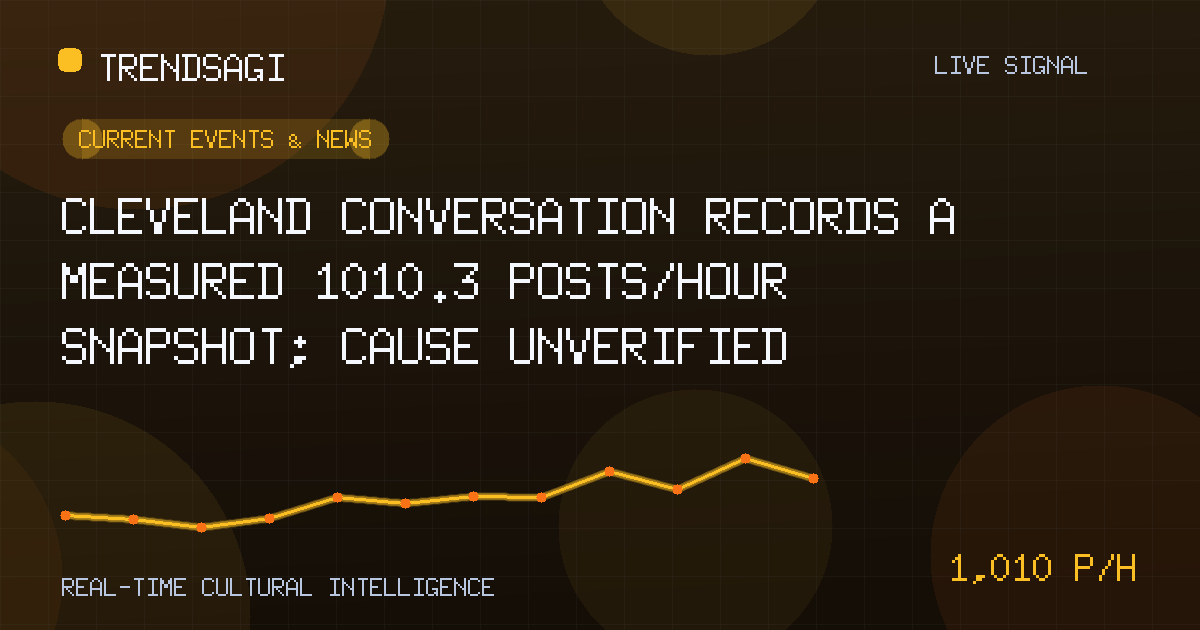
Cleveland conversation records a measured 1010.3 posts/hour snapshot; cause unverified
Cleveland discussion reached 1010.3 posts/hour in the latest measured snapshot; review the evidence, limits, and next checks.
Automated briefing. Generated from stored signal measurements and source-backed research; it is not manually reviewed. Read the methodology and limitations.
Metrics in this briefing are a snapshot associated with its publication date and may not reflect current conditions.
What changed
Cleveland-related posting activity increased in the observed signal, but the event driving the rise has not been verified. The measured snapshot rate was 1010.3 posts/hour over an exact 898-second window, using 3 stored observations ending at 2026-09-23T19:41:02Z. That establishes faster posting in the observed collection, not proof of a citywide reaction.
The latest snapshot contains 525 posts. That figure describes the collection's size at the observation, not a rate or a count of unique participants. Repetition, shared text, or nonhuman posting could affect the totals, so volume alone does not measure how many people took part.
| Observation time | Measured posts/hour | Latest snapshot volume |
|---|---|---|
| 2026-09-23T19:41:02Z | 1010.3 | 525 posts |
Why this topic may be moving
The available material does not establish a verified catalyst. A post-count increase can accompany a news development, a scheduled public event, an entertainment or sports discussion, a controversy, or an increase in repeated or automated content. These are possibilities to investigate, not conclusions supported by this record.
The word Cleveland also does not identify which entity or event the posts concern. Place references, references to a person or organization, and unrelated uses of the same name should be separated before drawing a local conclusion. A location-based topic is not, by itself, evidence of where participants live.
A useful causal account would need a specific development, a reliable publisher documenting it, and evidence that the relevant Cleveland discussion appeared around this observation window. Publisher corroboration could establish context; timing alone would not prove that a development caused the increase.
A measured rise in posts establishes faster activity in the observed stream. It does not, by itself, establish what happened, why people reacted, or whether the response was broadly shared.
Why it matters
High posting velocity is a reason to check for a developing story, not a reason to assume its significance. Volume can be amplified by a small number of active accounts, repeated material, or a shift in collection coverage. None of those mechanisms is demonstrated here; all are reasons to inspect the underlying posts.
Who should care, and what they can responsibly conclude, depends on verification:
- Reporters and local editors: A developing event may justify immediate checking, but a reliable explanation is needed before assigning civic significance or presenting the spike as public consensus.
- Public agencies and community organizations: Separate location-specific consequences from name-level chatter before preparing a response. No specific operational need is established by the rate alone.
- Researchers and analysts: Test whether later observations, broader sources, and independent posts show a durable pattern rather than concentration within one collection.
What to watch next
The most useful follow-up would turn an unexplained rate into a documented, bounded story. Watch for these signals:
- A verified catalyst. Look for reliable reporting that explicitly connects a Cleveland event, announcement, or controversy to the period. A headline using the name alone is insufficient; its timing and subject must match the conversation.
- Whether activity persists. Compare later stored observations under consistent collection coverage. Continuing activity would support sustained conversation, while a reversal would show that the recorded increase was temporary. Neither outcome is established here.
- What the posts contain. Separate original reactions, shared quotations, official statements, and repeated material. This helps distinguish new information from recirculation and identifies which sources are shaping the discussion.
- Who is participating. Check geographic references, source diversity, and account behavior. Do not treat a city label as evidence that participants live there or that multiple posts represent multiple people.
- What changes after verification. Watch for corrections, official responses, event updates, and follow-on reporting. Those developments would help determine whether the conversation concerns an ongoing situation or a fleeting reaction.
Until those checks are completed, the most accurate description is increased Cleveland-related posting activity with an unverified cause.
Methodology and limitations
The measurement uses 3 stored observations across an exact 898-second window ending at 2026-09-23T19:41:02Z. The reported 1010.3 posts/hour is a measured snapshot rate that normalizes observed post counts by elapsed time. It is not a live rate, a forecast, reach, engagement, or a unique-person count.
The latest snapshot volume of 525 posts describes the size of that stored collection. It should not be substituted for the posts/hour measurement. Multiple posts can come from one account, and the record does not establish whether activity is original, copied, or automated.
Coverage details are not provided, including collection boundaries, topic-matching rules, source balance, and geographic filtering. No comparison baseline is available, so the figures cannot show how unusual the rate is relative to typical Cleveland activity or how long it persists. The signal supports a statement about accelerated posting within this observation window; it does not establish all public discussion, causation, or consensus.
No publisher-backed explanation is established in the available material. Any proposed event should remain a hypothesis until reliable reporting connects its timing and subject to the relevant conversation.
Track This Topic for New Signals
Set alerts for future velocity or sentiment changes around this topic.
Explore Tracking PlansAbout TrendsAGI research
TrendsAGI's automated research pipeline publishes dated signal snapshots, methodology notes, and practical workflows for teams evaluating cultural momentum. Read how signals are scoped, scored, and limited in our research methodology.