917-second window · 3 observations · Measured Sep 24, 2026, 2:11 AM UTC · Provider: go_recent_snapshot_v2
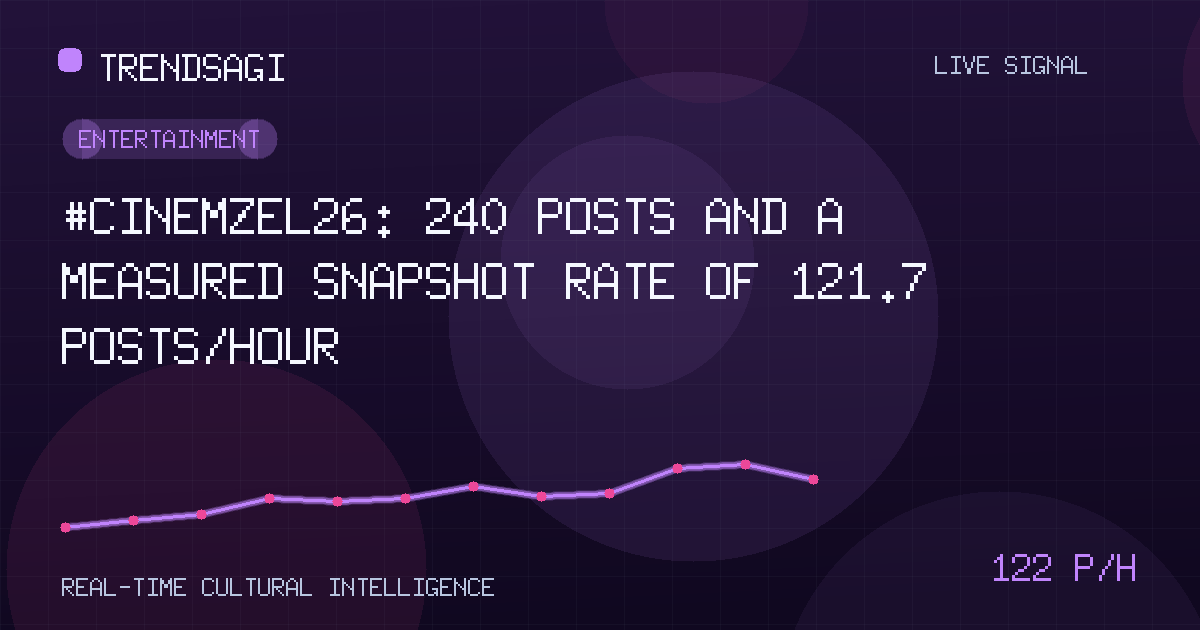
#cinemzel26: 240 posts and a measured snapshot rate of 121.7 posts/hour
The #cinemzel26 snapshot contains 240 posts and a measured rate of 121.7 posts/hour; the cause is unconfirmed, with practical checks for readers.
Automated briefing. Generated from stored signal measurements and source-backed research; it is not manually reviewed. Read the methodology and limitations.
Metrics in this briefing are a snapshot associated with its publication date and may not reflect current conditions.
What changed
#cinemzel26 shows concentrated recorded activity over a short observation window, but its trigger is not established. The latest stored snapshot contains 240 posts. That warrants checking the source posts, not yet attributing the activity to a particular release, announcement, or controversy.
The measured change is a snapshot rate of 121.7 posts/hour over an exact 917-second window from three stored observations, with the snapshot recorded at 2026-09-24T02:11:43Z. This is a stored measurement, not a live or current rate. It does not, on its own, show whether the pace is rising, what preceded it, or how long the activity will last.
| Metric | Recorded value |
|---|---|
| Observation time | 2026-09-24T02:11:43Z |
| Measured snapshot rate | 121.7 posts/hour over a 917-second window; 3 stored observations |
| Latest snapshot volume | 240 posts |
Why this topic may be moving
The stored category is entertainment, but that classification does not identify a particular film, creator, platform, or event. The hashtag itself also does not establish whether it is a campaign label, an event label, or an unrelated phrase.
Possible explanations include a new announcement, a scheduled event, a creator prompt, coordinated amplification, or automated repetition. Volume alone cannot identify which mechanism is operating. An announcement and a repost campaign can both produce a cluster of posts under one label. Distinguishing them requires a triggering statement with an attributable publisher and timestamp, together with evidence about how the posts are being produced.
No external cause has been verified for this briefing. A shared link, a scheduled event, a creator prompt, and automated repetition therefore remain hypotheses, not findings about #cinemzel26.
A short-window posting rate can establish activity, not meaning. The missing causal and audience evidence is what separates a signal worth checking from a publishable explanation of a trend.
Why it matters
A useful trend signal separates activity from explanation: what is changing, and why? This record documents activity within a narrow window but does not establish its cause. That makes the signal an investigation lead, not a finished story.
The distinction protects editorial accuracy and practical decision-making. Reporters should not attach an unconfirmed news event to the hashtag. Community teams should inspect coordination, repetition, and possible automation before interpreting the activity as broad participation. Anyone considering joining the conversation should first establish what the hashtag means and who is already discussing it.
The snapshot cannot rank the tag against competing conversations because no comparative baseline is supplied. Nor can the rate establish prominence. The defensible conclusion is limited to substantial recorded posting activity during the measured window, without a verified explanation.
Who should care
- Editors and reporters: Review the source posts and seek a confirmed trigger before treating the hashtag as evidence of a larger story.
- Social-listening and community teams: Test for originality, coordination, spam, and possible automation, because each changes how posting volume should be interpreted.
- Entertainment audiences and researchers: Treat the tag as an object to investigate, not a self-explanatory reference to a film or event.
What to watch next
- A confirmed event. Seek a timestamped statement from a relevant creator, organization, platform, or established publisher near the start of the cluster. A matching event would strengthen the explanation, although it would not establish that every post resulted from it.
- Continuity after the snapshot. Recheck using the same hashtag-matching rules and collection coverage to see whether the pace persists, cools, or returns to the earlier pattern. The available window cannot distinguish sustained conversation from a brief concentration of posts.
- Original versus copied material. Inspect a representative selection of posts for distinct reactions, repeated wording, quotations, and shared media. Identical or near-identical text may reflect copying or automation rather than a broad exchange of views.
- Independent participation. Check whether accounts are adding distinct information or whether a narrow set is repeatedly amplifying one item. The stored signal supplies no account counts, audience geography, language mix, or platform breakdown.
- A verifiable explanation. Compare the posts with a relevant primary announcement and attributable reporting. If no supporting evidence is found, retain unexplained rather than filling the gap with speculation.
- Metric consistency. Confirm that later volume and rate figures use compatible definitions, windows, and platform coverage. A collection change can resemble a change in public interest when it is actually a change in measurement.
Until those checks produce evidence, the responsible characterization is a concentrated, unexplained signal—not a confirmed cultural, campaign, or industry event.
Methodology and limitations
This briefing uses the stored observation at 2026-09-24T02:11:43Z, containing 240 posts, and the supplied measured rate of 121.7 posts/hour for an exact 917-second window supported by three stored observations. The rate characterizes only that observed interval.
The measured snapshot rate is not a live rate, forecast, engagement measure, reach estimate, unique-person count, or platform-wide total. Snapshot volume and window rate describe different measures; the 240 posts should not be assumed to be the number created during the 917-second window.
Three observations cannot establish a long-term baseline, direction, or persistence. Collection coverage, platform scope, and filtering rules are unspecified, so the result cannot be generalized to all online use of the hashtag. The available evidence does not support conclusions about audience demographics, geography, causation, or the hashtag’s broader cultural significance.
Track This Topic for New Signals
Set alerts for future velocity or sentiment changes around this topic.
Explore Tracking PlansAbout TrendsAGI research
TrendsAGI's automated research pipeline publishes dated signal snapshots, methodology notes, and practical workflows for teams evaluating cultural momentum. Read how signals are scoped, scored, and limited in our research methodology.