15-minute window · 3 observations · Measured Oct 6, 2026, 7:51 PM UTC · Provider: go_recent_snapshot_v2
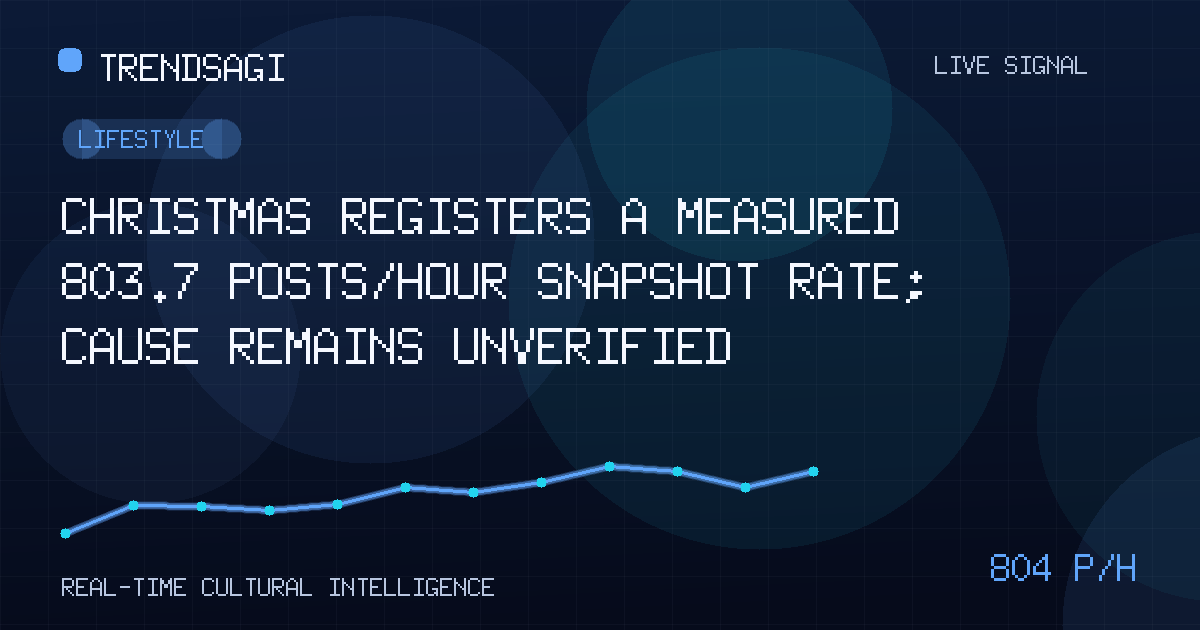
Christmas registers a measured 803.7 posts/hour snapshot rate; cause remains unverified
Christmas posts show a measured 803.7 posts/hour snapshot rate; learn what is established, what is not, and what to verify next.
Automated briefing. Generated from stored signal measurements and source-backed research; it is not manually reviewed. Read the methodology and limitations.
Metrics in this briefing are a snapshot associated with its publication date and may not reflect current conditions.
What changed
Christmas is showing a clear short-window rise in tracked posts, with 900 posts in the latest stored snapshot. The evidence establishes movement in the topic signal, but not what triggered that movement or whether it will continue.
The measured snapshot change rate is 803.7 posts/hour, based on 3 stored observations across an exact 900-second window and recorded at 2026-10-06T19:51:58Z. This is a measured snapshot rate, not a live or current rate, forecast, reach, engagement, or unique-person count. The 900 posts are the separate latest snapshot volume, not the rate.
| Signal measure | Stored value |
|---|---|
| Observation time | 2026-10-06T19:51:58Z |
| Measured snapshot rate | 803.7 posts/hour |
| Latest snapshot volume | 900 posts |
| Measurement basis | Exact 900-second window; 3 stored observations |
Why this topic may be moving
No verified public context establishes why Christmas is moving, so the cause remains unclear. The stored category is Lifestyle, but no explanatory signal description accompanies it. That makes the label useful for triage while leaving too much ambiguity for a confident causal account.
The October observation time makes advance seasonal planning a reasonable hypothesis to test, not a confirmed explanation. Candidate drivers include gift and food planning, holiday travel, decorations, traditions, advertising, news, entertainment, or controversy. The signal alone cannot show which of these is represented in the sample.
- Broad-topic spillover: incidental mentions may be counted alongside substantive holiday discussion.
- A concentrated event: one announcement, episode, campaign, or debate could create a narrow burst.
- Distribution effects: repeated posts, a highly active account, or one source ecosystem could inflate apparent momentum.
- Seasonal interest: more people may be researching or publishing holiday-related material, but the data do not identify their intent.
The measurement is precise for the stored window, but the explanation is not: it documents short-window momentum, not a verified cause, durable trend, or audience effect.
What the signal can—and cannot—establish
The defensible conclusion is narrow: Christmas-related activity changed quickly enough to merit investigation within this stored window.
It can establish:
- The collection recorded 3 observations within the exact 900-second window and produced the supplied measured snapshot rate of 803.7 posts/hour.
- The latest snapshot contained 900 posts.
- The stored topic category is Lifestyle.
It cannot establish:
- Whether activity is sustained beyond the window or unusually high relative to a longer baseline.
- Whether posts represent distinct people, independent reactions, or repeated content.
- Whether attention is positive, negative, informational, commercial, or incidental.
- Which platforms, regions, languages, communities, or subtopics drive the volume.
- Whether attention reflects consumer demand, sales, a news event, or coordinated amplification.
- A verified cause, because no external event has been tied to the sampled posts.
Why it matters
For holiday merchants and campaign teams, the signal may justify checking campaign timing, inventory themes, and customer questions. It should not be treated as evidence of purchasing intent, sales performance, or product demand.
For publishers, creators, and social teams, it provides an early warning to examine audience questions and community needs. The broad Christmas label means the underlying content should be reviewed before teams allocate staff, inventory, or editorial resources.
For analysts and trend teams, the immediate value is prioritization. The snapshot says the topic warrants investigation; it does not yet justify declaring a durable seasonal trend or forecasting continued attention.
What to watch next
Several concrete checks would turn this short-window signal into a more reliable trend assessment:
- Persistence: compare subsequent complete collection windows and adjacent periods under the same source coverage. Keep the movement labeled transient unless it recurs.
- Breadth: determine whether activity spans several platforms, regions, languages, and communities rather than one venue or audience.
- Concentration: examine source and account contribution, duplicate prevalence, and repost patterns. Heavy concentration would suggest amplification rather than broad interest.
- Intent and sentiment: separate holiday planning, commerce, news, entertainment, advocacy, and incidental mentions to reveal what readers are actually discussing.
- External timing: look for verified, timestamped announcements, reporting, campaigns, or cultural events that align with the onset and match the sampled content. Timing alone should not be presented as proof of causation.
- Taxonomy quality: test whether the Christmas label is capturing adjacent terms and false positives. Cleaner classification could materially change the interpretation.
Start with the raw post sample and a measurement audit. A later public-web verification pass should seek publisher or organizer records that predate the observed rise and correspond to themes found in the posts. Without that alignment, the cause should remain explicitly unclear.
Methodology and limitations
This briefing uses the stored Lifestyle classification and the observation recorded at 2026-10-06T19:51:58Z. The measured snapshot rate comes from 3 stored observations across an exact 900-second window; the separate latest snapshot volume is 900 posts. No underlying post text, longer baseline, platform mix, geography, language, account distribution, or engagement data were supplied. No verified public context was available for causal attribution. The figures therefore describe only the stored signal and should not be extrapolated into a current rate, forecast, reach estimate, or measure of unique audience activity.
Track This Topic for New Signals
Set alerts for future velocity or sentiment changes around this topic.
Explore Tracking PlansAbout TrendsAGI research
TrendsAGI's automated research pipeline publishes dated signal snapshots, methodology notes, and practical workflows for teams evaluating cultural momentum. Read how signals are scoped, scored, and limited in our research methodology.


