907-second window · 3 observations · Measured Oct 8, 2026, 9:11 PM UTC · Provider: go_recent_snapshot_v2
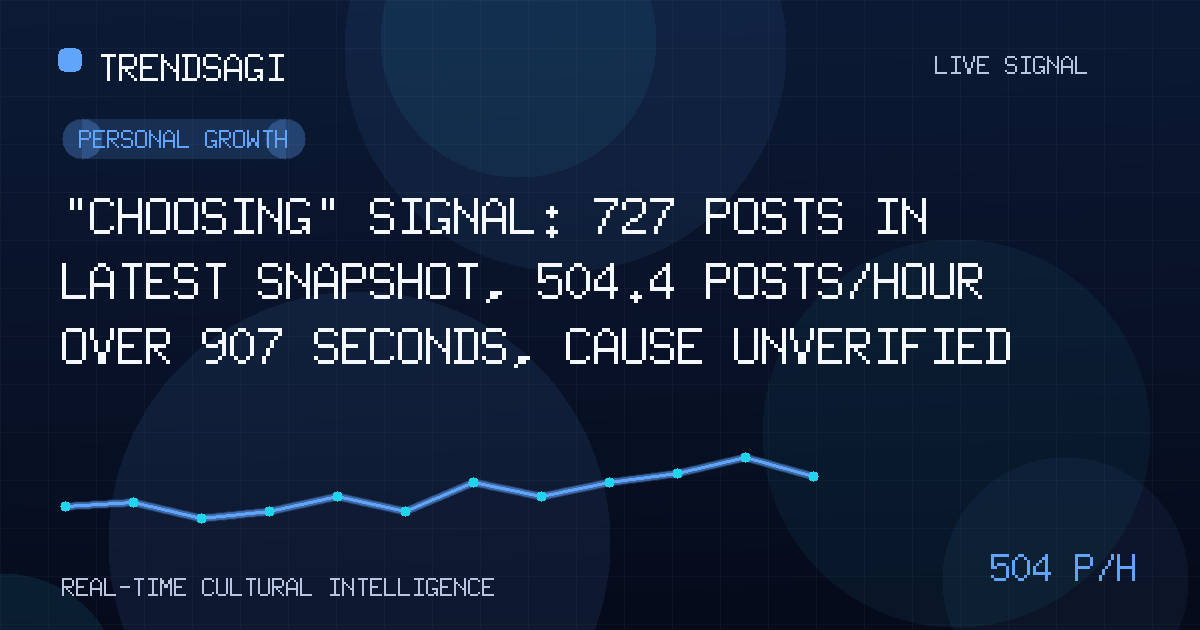
“Choosing” signal: 727 posts in latest snapshot, 504.4 posts/hour over 907 seconds, cause unverified
“Choosing” logged 727 posts in the latest snapshot and a measured 504.4 posts/hour over 907 seconds; the cause and broader trend remain unverified.
Automated briefing. Generated from stored signal measurements and source-backed research; it is not manually reviewed. Read the methodology and limitations.
Metrics in this briefing are a snapshot associated with its publication date and may not reflect current conditions.
What changed
The latest stored snapshot labeled “Choosing” contains 727 posts, but the direct answer is limited: the record does not identify the choice, establish a coherent conversation, or verify why activity occurred. No verified public context links the signal to a catalyst, so the cause remains unclear. The 727 figure is volume at one timestamp, not a count of people.
Across an exact 907-second window based on three stored observations, the measured snapshot rate was 504.4 posts/hour. This is a historical snapshot measurement—not a live rate, forecast, reach figure, engagement measure, or unique-person count. With no earlier baseline or comparison period, it should not be described as a rise, surge, or sustained trend.
The compact record is:
| Observation time | Measured snapshot rate | Latest snapshot volume |
|---|---|---|
| 2026-10-08T21:11:34Z | 504.4 posts/hour | 727 posts |
What the signal establishes
The defensible reading is narrow: the system stored posts under the label “Choosing” and supplied a measured snapshot rate for a defined window. That makes the signal useful for deciding what to inspect next, but not yet for explaining a social phenomenon.
- Established: A timestamped collection exists, with both a latest snapshot volume and a measured snapshot rate supplied.
- Not established: The number of unique authors, original posts, reactions, impressions, locations, platforms, or distinct decisions. Snapshot volume is a post count, while posts/hour is a rate over the stated window.
- Still missing: A baseline showing whether this rate is unusual, the query or collection scope, and evidence that the label captures one underlying issue rather than a common word.
Why this topic may be moving
No verified public context ties this signal to a specific event, announcement, figure, product, or conversation. The cause is therefore unclear. “Choosing” is also an unusually broad label: it may describe a concrete decision, a general reflection, a quotation, a headline, or metadata unrelated to any shared subject.
Several explanations are plausible, but none is verified:
- Label breadth: One word can collect conversations about unrelated choices, making apparent intensity easier to create than genuine agreement.
- Keyword collision: The retrieval process may be matching “choosing” literally while including different intents, such as comparison, uncertainty, advice, or personal narrative.
- Platform concentration: Activity could be concentrated in one community or source whose posting behavior changed, rather than spreading across the wider public.
- Temporary convergence: Separate conversations may have become active around the same observation time without sharing a catalyst.
Promoting any of these possibilities to a factual explanation would require the underlying posts and timestamped public evidence. Until then, the only responsible cause statement is that it is undetermined.
The signal shows collection intensity, not shared intent. A broad label can gather posts from unrelated conversations, so semantic validation must come before any claim that a particular choice is gaining momentum.
Why it matters
The main risk is false coherence. A dashboard can make unrelated posts look like a shared movement, especially when a generic label and a rate are presented without examples or a baseline. People acting on that interpretation could mistake collection volume for cultural momentum.
- Trend researchers and editors should audit semantics before assigning a narrative, audience, or sentiment.
- Community and content teams should check whether one venue, repeated text, or a retrieval rule is driving the label.
- Decision makers should ask what options are actually appearing before changing priorities or publishing a response.
- General readers should treat the signal as an investigation lead, not proof that people are converging on a particular choice.
For those groups, the immediate value is diagnostic: it identifies where a potentially important burst occurred and what validation work is required.
What to watch next
- Inspect the raw posts. Review a representative slice from the observed window and record the recurring nouns, named entities, questions, and choice categories. A concrete watch signal is one recognizable issue occupying most coded examples.
- Test semantic coherence. Separate concrete decisions from generic uses of “choosing.” If examples repeatedly resolve to the same subject, the label becomes more useful; if not, split or retire it.
- Check persistence. Take later snapshots using the same query, scope, and window length. A comparable measured snapshot rate recurring across separate observations would support persistence more strongly than this single window.
- Measure distribution. Identify which platforms, communities, regions, and source types contribute. Concentration in one venue is a warning that the aggregate may reflect local behavior rather than broad interest.
- Track language changes. Look for a shift from abstract posts about choosing to repeated references to specific options, objections, or outcomes. That shift would be a stronger sign of an emerging conversation.
- Find a time-aligned catalyst. Check verified reporting and primary announcements that precede the observations. A relevant event must fit both the timing and the content; timing alone is not enough.
- Add data-quality checks. Deduplicate reposts, distinguish original from copied material, and report unique accounts separately from post volume. These checks can show whether intensity reflects broad participation or repeated content.
Decision rule: Treat the signal as substantive only when semantic coherence, persistence across comparable snapshots, and external evidence align. Without those checks, label it unexplained labeled activity.
Methodology and limitations
This briefing uses only the supplied stored record. It reports the observation at 2026-10-08T21:11:34Z, the latest snapshot volume of 727 posts, and the supplied measured snapshot rate of 504.4 posts/hour over the exact 907-second window using three stored observations.
The record does not say that the 727-post latest snapshot is the sole basis for the rate, and those metrics should remain distinct. It also omits the collection boundary, retrieval logic, baseline observations, source mix, deduplication method, geography, language, and account-level counts. The observations within the stated window document the supplied measurement but do not establish a stable long-term pattern.
No verified public source was available to explain the movement, so no causal claim is made. Use this finding as a monitoring lead until raw examples, comparable follow-up snapshots, and external context are checked.
Track This Topic for New Signals
Set alerts for future velocity or sentiment changes around this topic.
Explore Tracking PlansAbout TrendsAGI research
TrendsAGI's automated research pipeline publishes dated signal snapshots, methodology notes, and practical workflows for teams evaluating cultural momentum. Read how signals are scoped, scored, and limited in our research methodology.