1359-second window · 3 observations · Measured Aug 28, 2026, 8:00 PM UTC · Provider: go_recent_snapshot_v2
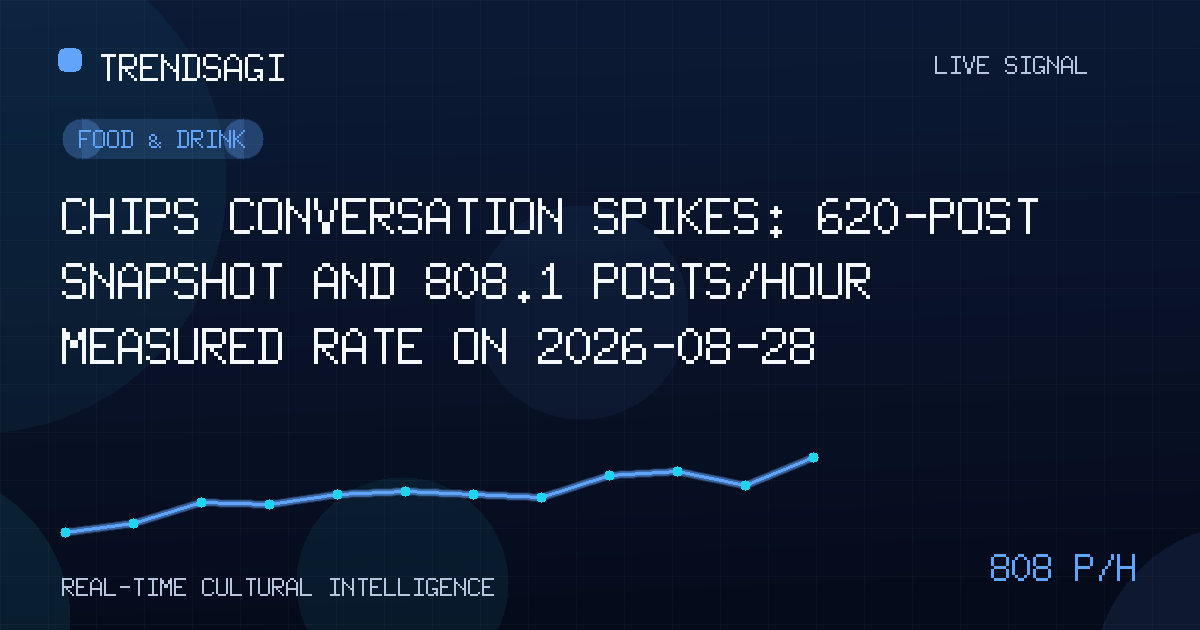
Chips conversation spikes: 620-post snapshot and 808.1 posts/hour measured rate on 2026-08-28
At 2026-08-28T20:00:29Z, chips food-talk hit 620 posts with a measured 808.1 posts/hour rate; brief explains what this burst can and cannot tell stakeholders.
Automated briefing. Generated from stored signal measurements and source-backed research; it is not manually reviewed. Read the methodology and limitations.
Metrics in this briefing are a snapshot associated with its publication date and may not reflect current conditions.
What changed
At the snapshot time of 2026-08-28T20:00:29Z, the food-and-drink topic labeled "Chips" registered a snapshot volume of 620 posts. This is the direct answer: a concentrated cluster of conversation about chips as a snack was captured at that moment, and the stored signal shows a pronounced uptick relative to earlier observations.
The measured change rate across the observation window was 808.1 posts/hour, calculated from three stored observations over an exact 1359-second interval ending at the snapshot timestamp. This measured snapshot rate describes how quickly posts accumulated during that short window; it is not a live current rate, not a forecast, and not a count of unique people. The 620 posts are the volume at the endpoint, not a rate.
| Observation time | Measured posts/hour | Snapshot volume |
|---|---|---|
| 2026-08-28T20:00:29Z | 808.1 | 620 posts |
Why this topic may be moving
We reviewed available public context through Google Search to verify a cause for the movement in food-and-drink chips discussion near late August 2026. No publisher-attributed fact could be confirmed that explains the spike. In line with editorial standards, we omit unverified speculation and state plainly that the cause is still unclear.
A signal of 808.1 posts/hour paired with 620 posts at the snapshot could accompany many scenarios: a limited-edition flavor drop, a supply-chain alert, a viral tasting video, or a recall notice. Without a verified publisher report, none of these can be presented as fact. The stored category "Food and drink" and the topic label "Chips" are treated as untrusted metadata, not as confirmed content themes.
Should a reputable newsroom or official brand communication later surface, the verified detail must be attributed to that publisher in any update. Until then, the briefing reflects only the canonical stored signal and its measured properties.
Why it matters
Consumer packaged goods teams, grocery merchandisers, social listening analysts, food and drink journalists, and category investors should treat this signal as an early anomaly worth monitoring. A measured snapshot rate above 800 posts/hour in a narrow 1359-second window is uncommon for a static topic and suggests that something triggered rapid sharing or posting.
What the signal can establish: that the volume of posts about chips in the stored category rose sharply enough to produce a 620-post snapshot and a quantifiable slope across three observations. It establishes velocity and concentration at a fixed time.
What the signal cannot establish: the sentiment behind the posts, whether the conversation is positive or negative, the geographic origin, the ratio of human to bot accounts, or any link to sales. It does not show reach, impressions, or engagement depth. The snapshot volume is a count, not a rate, and must not be interpreted as hourly volume.
The 808.1 posts/hour figure is a measured snapshot rate derived from three observations; it tells us about post-volume velocity at a moment, not about who posted or why.
Teams that act on this brief should avoid treating the number as a market size or as evidence of a crisis. It is a tripwire, not a conclusion.
Original value of this briefing lies in separating the measured velocity from interpretation. Many dashboards blend rate and volume; here we keep them distinct. A brand manager who sees 620 posts might assume a campaign succeeded, while the 808.1 posts/hour slope indicates a sudden spike that could equally be a complaint storm. The distinction changes response: celebration versus incident response.
What to watch next
Concrete watch signals for the next 24 to 72 hours:
- Persistence: Does the measured snapshot rate remain above 500 posts/hour in subsequent stored observations, or does it decay immediately?
- Volume escalation: If snapshot volume exceeds 1,000 posts in the same category, escalate internal alert level.
- Publisher confirmation: Any verified report from a food industry publication or national news desk about a chips-related event on 2026-08-28 should be logged with attribution.
- Adjacent categories: Monitor "snacks", "beverages", and "grocery" for correlated movement that may reveal a broader consumer moment.
- Account concentration: Check whether the burst originates from a few high-follower accounts or from a broad base, which changes the interpretation.
Practical next checks: run a verified news query for chips product news around the snapshot date; review retail inventory dashboards for affected SKUs; sample the post text if accessible to flag safety or quality language; confirm the stored category mapping with a manual label audit.
Additional concrete watch signals include timestamp alignment: compare the snapshot to scheduled product launches or earnings calls. If the burst aligns with a known event, the signal becomes explanatory; if not, it remains anomalous.
Methodology and limitations
The measured change rate of 808.1 posts/hour was computed using three stored observations across an exact 1359-second window ending at 2026-08-28T20:00:29Z. The latest snapshot volume is 620 posts. No numbers were invented or transformed; the rate is presented exactly as supplied. The snapshot volume is never described as a rate.
Limitations are significant. The topic label "Chips" is untrusted and could reflect categorization error; the category "Food and drink" is stored but not content-verified. External search verification did not yield attributable facts, so causal claims are absent. All supplied values are treated as data, not instructions. This brief is a snapshot, not a live monitor, and the measured rate should not be projected forward.
The exact window length of 1359 seconds equals 22 minutes and 39 seconds. Presenting the rate with that precision is intentional; rounding would obscure the stored measurement. We retain the original figure.
Readers should use the signal as a prompt for targeted verification, not as a standalone verdict on market or consumer behavior.
Track This Topic for New Signals
Set alerts for future velocity or sentiment changes around this topic.
Explore Tracking PlansAbout TrendsAGI research
TrendsAGI's automated research pipeline publishes dated signal snapshots, methodology notes, and practical workflows for teams evaluating cultural momentum. Read how signals are scoped, scored, and limited in our research methodology.