741-second window · 3 observations · Measured Oct 7, 2026, 8:54 AM UTC · Provider: go_recent_snapshot_v2
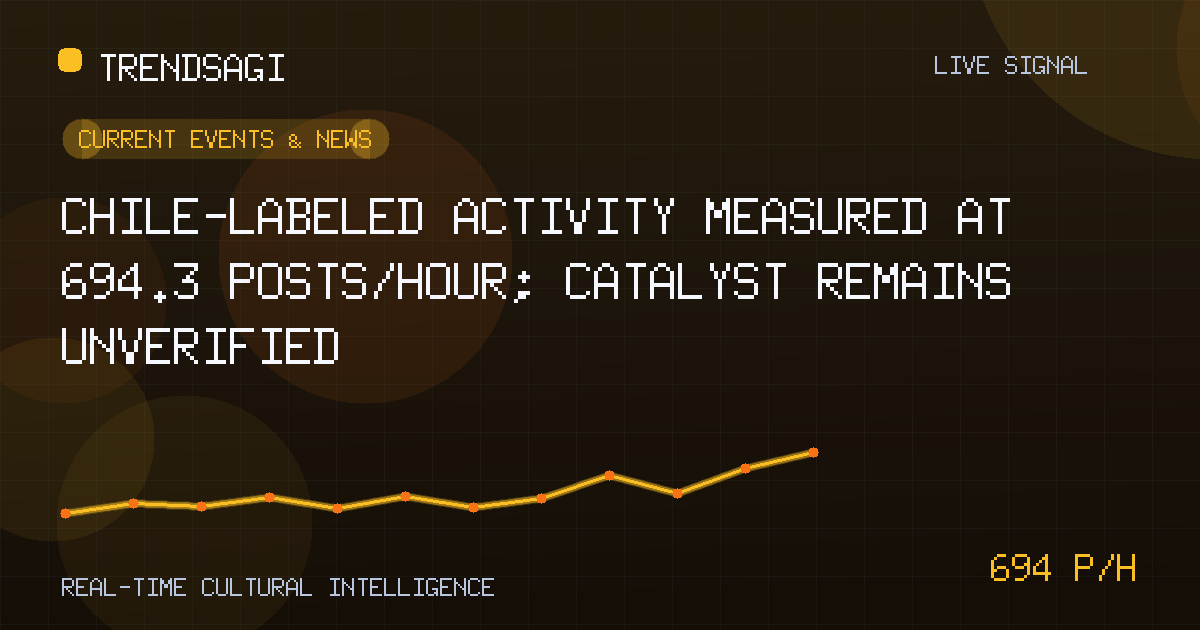
Chile-labeled activity measured at 694.3 posts/hour; catalyst remains unverified
Chile-labeled activity recorded 694.3 posts/hour in a 741-second snapshot; the trigger is unclear, with practical checks for confirming it.
Automated briefing. Generated from stored signal measurements and source-backed research; it is not manually reviewed. Read the methodology and limitations.
Metrics in this briefing are a snapshot associated with its publication date and may not reflect current conditions.
What changed
Chile-labeled post activity shows a measurable short-window rise in the stored signal, but the reason for the movement remains unverified. “Chile” is a broad topic label, and no specific public event has been verified as the trigger for this observation window. It is therefore too early to characterize the increase as political, economic, cultural, or disaster-related.
The stored series reports a measured snapshot rate of 694.3 posts/hour over an exact 741-second window using 3 stored observations, measured at 2026-10-07T08:54:20Z. The latest snapshot volume is 433 posts. The rate is a measured snapshot, not a live or current rate, forecast, reach figure, engagement measure, or unique-person count; the volume is not an hourly rate.
| Observation time | Measured snapshot rate | Snapshot volume |
|---|---|---|
| 2026-10-07T08:54:20Z | 694.3 posts/hour | 433 posts |
These metrics answer different questions. The rate indicates the movement captured during the stated window, while the volume describes the latest stored snapshot. Neither, by itself, establishes how many people were reached or what event prompted the posts.
Why this topic may be moving
A fast topic-level rate can result from a specific event, several unrelated developments grouped under one label, or renewed circulation of material published elsewhere. The stored signal does not distinguish among those possibilities.
- Event concentration: If early posts repeatedly name the same event, place, organization, or person, a specific catalyst may be plausible. That connection still requires timestamped corroboration.
- Label aggregation: A country label may combine unrelated conversations that become distinguishable only when posts are grouped by subject.
- Reposting and duplication: Repeated copies can raise volume without adding distinct perspectives. The signal does not disclose deduplication or originality.
- Delayed diffusion: A post burst may follow earlier publication activity rather than a new development at the observed moment.
These are testable hypotheses, not findings. No external event should be assigned as the cause unless public evidence aligns with the window and the dominant content.
Why it matters
Newsrooms and fact-checkers should care because a rapid rise can create pressure to label a developing story before its cause is known. Editors need to determine whether independent reporting, official records, and the posts themselves point to the same event. A mismatch should be reported as an unexplained social-post spike rather than filled with a plausible guess.
Organizations serving Chile-related audiences should also distinguish attention from consensus. A high post rate may reflect repetition, controversy, curiosity, or coordinated amplification; volume alone does not reveal sentiment, intent, or agreement.
The defensible conclusion is narrow: the stored series captured post activity at the measured snapshot rate, but it does not yet identify the story, participants, or direction of public opinion.
For researchers and trend analysts, this is a cue to inspect content and improve classification. For general readers, the practical takeaway is to wait for event-level confirmation before treating the spike as evidence of a broader Chilean development.
What to watch next
The next useful step is to resolve the label into specific, time-bounded claims.
- Inspect the posts behind the peak. Review the earliest items and the most widely repeated content in the stored window. Record exact phrases, named entities, timestamps, sources, and whether each item is original, copied, quoted, or linked to another platform.
- Measure concentration and independence. Determine whether activity is dominated by one source, one account cluster, or one recurring claim. Report the sample and classification method so repetition is not mistaken for independent confirmation.
- Build a comparable baseline. Check adjacent and historical observations for the same topic definition and collection method. Platform, language, or query changes could alter the rate without a comparable change in underlying attention.
- Verify a candidate catalyst. Use public search only to check a concrete explanation against reputable reporting and official records. Require matching names, location, and timing; omit unrelated or undated claims.
- Update the signal as new windows arrive. Compare later observations with the measured rate and snapshot volume, and revise the explanation if the posts converge on a different subject.
Confidence should rise if several concrete signals appear together:
- The measured rate persists across consecutive comparable windows rather than appearing only in the recorded window.
- Independent reputable sources and official material identify the same event during the relevant period.
- Distinct original posts explain more of the activity than duplicates or reposts.
- The broad label separates into identifiable subtopics tied to the same development.
- The rate recedes after the verified event, or persists because a genuinely new phase is documented.
Methodology and limitations
The observation time is 2026-10-07T08:54:20Z. The 694.3 posts/hour figure is reproduced as the supplied measured snapshot rate over an exact 741-second window based on 3 stored observations; it has not been recalculated, smoothed, or projected. The separate snapshot value is 433 posts.
The signal does not provide a historical baseline, platform mix, collection query, language or geography settings, source distribution, sentiment, originality, or deduplication method. The relationship between snapshot volume and the rate calculation is unspecified. Posts also do not establish unique authors, authentic accounts, organic reach, or public opinion.
Cause remains unclear because no verified public context has been tied to the exact observation window. This briefing therefore identifies a measurable change and a verification path, but it stops short of attributing it to an unverified event.
Track This Topic for New Signals
Set alerts for future velocity or sentiment changes around this topic.
Explore Tracking PlansAbout TrendsAGI research
TrendsAGI's automated research pipeline publishes dated signal snapshots, methodology notes, and practical workflows for teams evaluating cultural momentum. Read how signals are scoped, scored, and limited in our research methodology.


