888-second window · 2 observations · Measured Sep 29, 2026, 12:26 AM UTC · Provider: go_recent_snapshot_v2
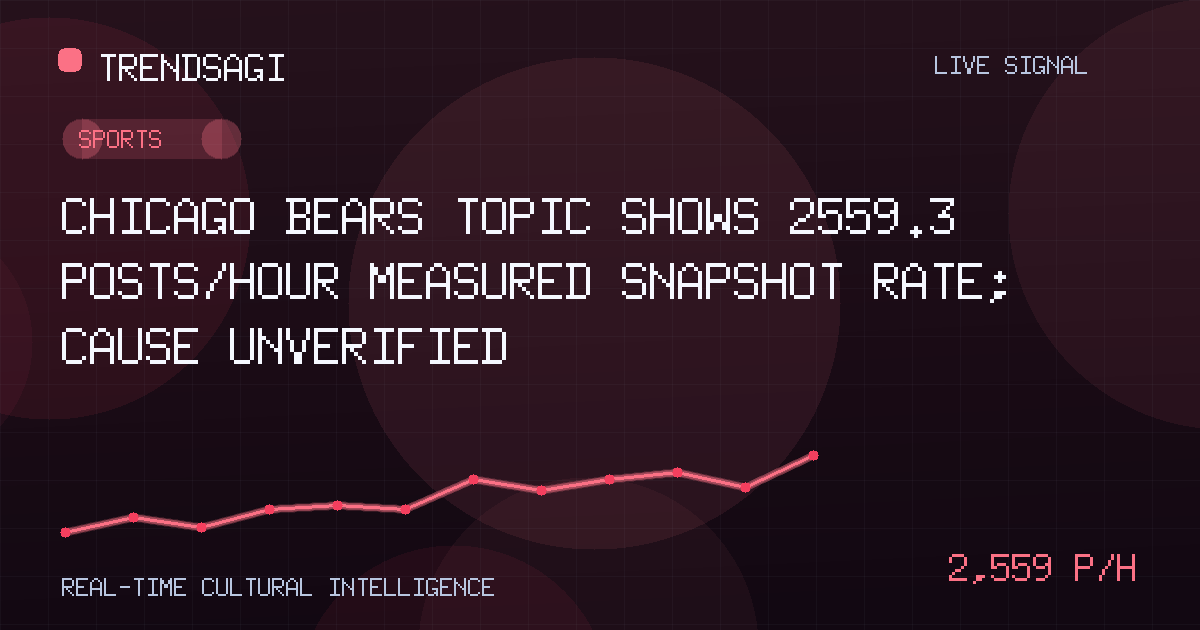
Chicago Bears topic shows 2559.3 posts/hour measured snapshot rate; cause unverified
The Chicago Bears discussion recorded 2559.3 posts/hour in a measured snapshot; the cause is unverified and persistence remains unknown.
Automated briefing. Generated from stored signal measurements and source-backed research; it is not manually reviewed. Read the methodology and limitations.
Metrics in this briefing are a snapshot associated with its publication date and may not reflect current conditions.
What changed
The Chicago Bears topic registered a measured snapshot rate of 2559.3 posts/hour, indicating concentrated change in stored conversation activity around the observation. The available verified record does not establish why it was moving, so no game, roster, injury, coaching, ownership, or controversy should be treated as the cause without confirmation.
The rate was measured over an exact 888-second window using 2 stored observations and recorded at 2026-09-29T00:26:28Z. The latest snapshot volume was 1285 posts. The posts/hour figure is a retrospective measured rate; the 1285 figure is a snapshot count, not a rate, reach estimate, engagement total, or count of unique people.
| Observation time (UTC) | Measured snapshot rate | Snapshot volume |
|---|---|---|
| 2026-09-29T00:26:28Z | 2559.3 posts/hour | 1285 posts |
The key editorial takeaway is that the conversation pattern changed within the measured window, but the evidence supports a change report rather than an event explanation. The short interval and limited observations make persistence beyond the snapshot unknown.
Why this topic may be moving
No publisher-backed or official explanation is present in the available verified context. That matters because high-volume social conversation can be triggered by many different developments, and the same surface pattern can also be amplified by repetition, clipping, reaction posts, or a platform event. None of those mechanisms is confirmed here.
- Sports competition: a game, replay, officiating dispute, or postgame reaction could be a catalyst.
- Team news: an injury designation, roster transaction, contract matter, or coaching update could be driving discussion.
- Organization or community news: leadership, ownership, venue, or broader franchise issues could be involved.
- Social amplification: a widely shared clip, meme, argument, or coordinated repost could create concentration without a new team announcement.
These are hypotheses to test, not facts about this signal. Their value is diagnostic: each would leave a different trail in timestamps, dominant sources, language, and link-sharing patterns. Until a credible item is aligned with the start of the movement, the most accurate description is cause unverified.
What the signal can establish
The signal can show that the stored observation changed at 2559.3 posts/hour across the specified window. It can help editors decide that the Bears conversation warrants closer inspection and establish the precise time around which monitoring should be concentrated.
A measured rate can establish that conversation changed without establishing what changed it, and a snapshot count can show volume at an observation without showing who participated or how far the discussion spread.
It cannot establish the total size of the online audience, sentiment, authenticity, organic versus automated activity, geographic distribution, engagement, or whether the movement persisted. Two observations cannot provide a durable baseline, identify a normal range, or distinguish a one-off burst from a sustained shift. The figures also do not reveal which subtopics account for the activity.
- Use the signal to trigger verification and monitoring.
- Do not use it as proof of a specific event or public reaction.
- Do not present the snapshot count as cumulative attention.
- Do not infer impact from post volume alone.
Why it matters
For Bears readers, the immediate value is knowing that the stored conversation registered a measured change worth checking rather than assuming that a loud online moment represents a settled storyline. A signal is a prompt to inspect sources, not a substitute for reading the underlying event and its evidence.
- Journalists and editors should seek the first credible report, then separate confirmation from reaction.
- Team and league observers should compare the timing of official updates with the first wave of posts.
- Media and sponsorship teams should check whether the activity is broad or concentrated around one format before interpreting audience interest.
- Community managers should monitor for factual correction, breaking updates, and emerging conversation clusters without treating volume as sentiment.
For anyone making decisions, the responsible move is to wait for attribution and persistence. A verified catalyst plus continued activity is stronger evidence than either a large rate or a large snapshot count alone.
What to watch next
The next checks should be concrete and aligned with the recorded observation time:
- Find the earliest verified item immediately preceding 2026-09-29T00:26:28Z. Record its publication time, publisher, and whether discussion began before or after it.
- Inspect subsequent stored observations using the same counting method. Determine whether activity remains elevated, recedes, or shifts to a different topic; do not extend this window retroactively.
- Cluster posts by subject and source type. Separate game reaction, player news, organizational news, criticism, praise, and clip-based sharing rather than labeling all activity as one trend.
- Check whether a small set of highly reposted posts dominates. Concentration would suggest amplification, while varied sourcing would point toward a broader information event, though neither alone proves cause.
- Measure sentiment only after topic clusters are identified. Mixed discussion can produce high volume, so a positive or negative label may conceal substantial disagreement.
- Look for a verified follow-up from an official Bears channel, league source, or established publisher. Its wording and timing can confirm which event deserves attribution.
A particularly useful next signal would be a clean sequence: credible timestamped report, immediate conversation cluster, then persistence in later observations. That sequence would support an event-driven explanation more strongly than the present rate does by itself.
Methodology and limitations
This briefing uses the supplied sports-category observation, its latest snapshot volume, and the change calculation exactly as stored. The 2559.3 posts/hour value is labeled as a measured snapshot rate because it compares two observations across the exact stated window. It is not described as a live rate or forecast.
No external event is asserted because no cause could be confirmed from the available verified public context. The candidate explanations above are monitoring hypotheses, not reported facts. The signal also lacks the fields needed to judge unique authors, engagement, location, sentiment, authenticity, or long-term baseline. Readers should therefore use this briefing to prioritize verification, then rely on confirmed reporting for the event itself and later stored observations for persistence.
Track This Topic for New Signals
Set alerts for future velocity or sentiment changes around this topic.
Explore Tracking PlansAbout TrendsAGI research
TrendsAGI's automated research pipeline publishes dated signal snapshots, methodology notes, and practical workflows for teams evaluating cultural momentum. Read how signals are scoped, scored, and limited in our research methodology.