924-second window · 3 observations · Measured Sep 6, 2026, 1:14 PM UTC · Provider: go_recent_snapshot_v2
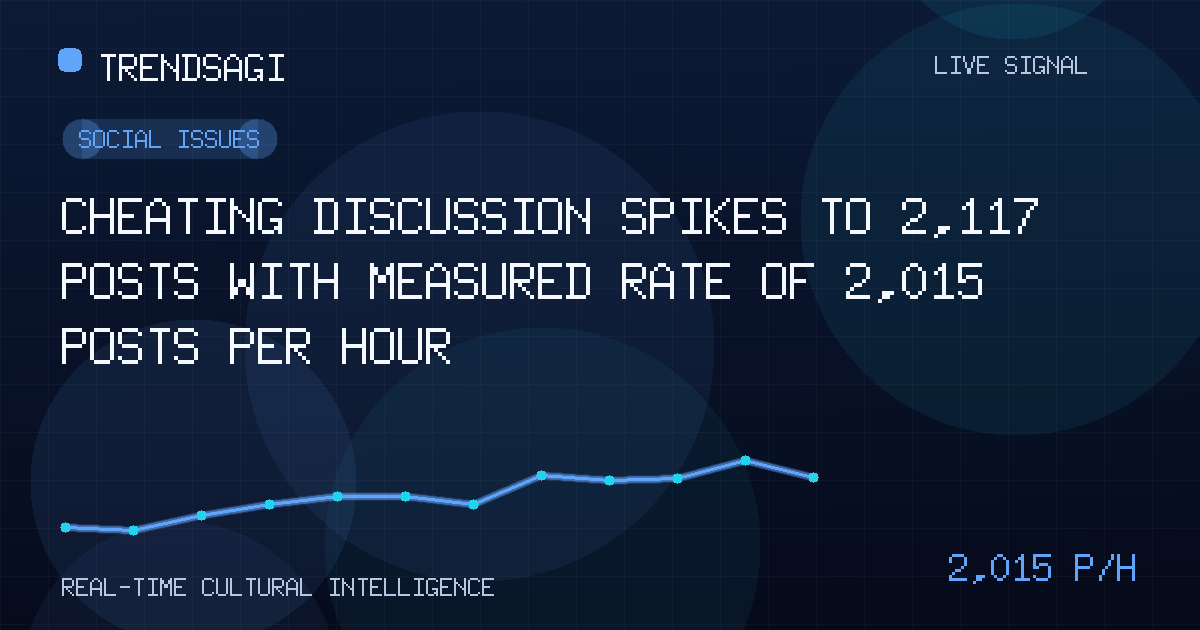
Cheating discussion spikes to 2,117 posts with measured rate of 2,015 posts per hour
Cheating topic surges to 2,117 posts at 2,015 posts/hour measured rate; cause unverified, practical watch signals for researchers and analysts.
Automated briefing. Generated from stored signal measurements and source-backed research; it is not manually reviewed. Read the methodology and limitations.
Metrics in this briefing are a snapshot associated with its publication date and may not reflect current conditions.
What changed
The topic "Cheating" generated 2,117 posts in the latest snapshot at 2026-09-06T13:14:44Z, with a measured change rate of 2,015.2 posts per hour over a 924-second observation window. This rate reflects a snapshot measurement derived from three stored observations, not a live or forecasted value, and indicates a sharp increase in public discussion volume around the concept of cheating.
| Observation time (UTC) | Measured posts/hour | Snapshot volume |
|---|---|---|
| 2026-09-06T13:14:44Z | 2,015.2 | 2,117 |
Why this topic may be moving
As of the observation timestamp, no specific public event or news story has been verified as the primary driver of this spike. The term "cheating" spans multiple domains — academic integrity, romantic relationships, gaming, and AI-assisted work — and surges often coincide with high-profile scandals, policy changes, or viral social media debates. Without a confirmed source, the cause remains unclear. Researchers should treat the volume surge as a signal that warrants further investigation rather than a concluded narrative.
Why it matters
A sudden rise in cheating-related discourse can signal shifting social norms, emerging enforcement actions, or coordinated campaigns. Educators, platform moderators, relationship counselors, and AI ethics researchers may each see different implications. For instance, a spike tied to academic cheating could reflect new detection tools or policy debates; a relationship-focused surge might follow celebrity news or cultural commentary; a gaming-related increase could accompany anti-cheat software updates or esports controversies. The volume alone does not reveal sentiment, demographics, platform distribution, or whether the conversation is driven by a few viral posts or broad grassroots discussion.
What to watch next
- Monitor major news outlets and social platforms for cheating-related headlines across education, relationships, gaming, and AI sectors.
- Track sentiment analysis to see if discussion is condemnatory, supportive, neutral, or polarized.
- Watch for policy announcements from educational institutions, tech platforms, or regulatory bodies.
- Observe if the spike sustains, accelerates, or decays over the next 24–48 hours using the same measurement methodology.
- Cross-reference with adjacent signals such as "plagiarism," "infidelity," "aimbot," or "AI detection" to identify domain-specific drivers.
"A spike in cheating discourse often precedes policy shifts or platform interventions, but without verified triggers it remains a signal, not a story."
Methodology and limitations
The measured rate of 2,015.2 posts per hour is derived from three stored observations across an exact 924-second window, captured at the snapshot time. It represents a point-in-time velocity, not a continuous rate. The snapshot volume of 2,117 posts is a count of retrieved items at that moment and may not capture all relevant posts due to platform API limits, filtering, or definition boundaries. The signal does not establish causation, unique authors, geographic spread, or sentiment. All external context is unverified unless explicitly attributed to a publisher. Readers should treat the figures as indicators of discussion intensity, not as measures of reach, engagement, or unique-person counts.
Track This Topic for New Signals
Set alerts for future velocity or sentiment changes around this topic.
Explore Tracking PlansAbout TrendsAGI research
TrendsAGI's automated research pipeline publishes dated signal snapshots, methodology notes, and practical workflows for teams evaluating cultural momentum. Read how signals are scoped, scored, and limited in our research methodology.


