888-second window · 3 observations · Measured Sep 25, 2026, 10:51 PM UTC · Provider: go_recent_snapshot_v2
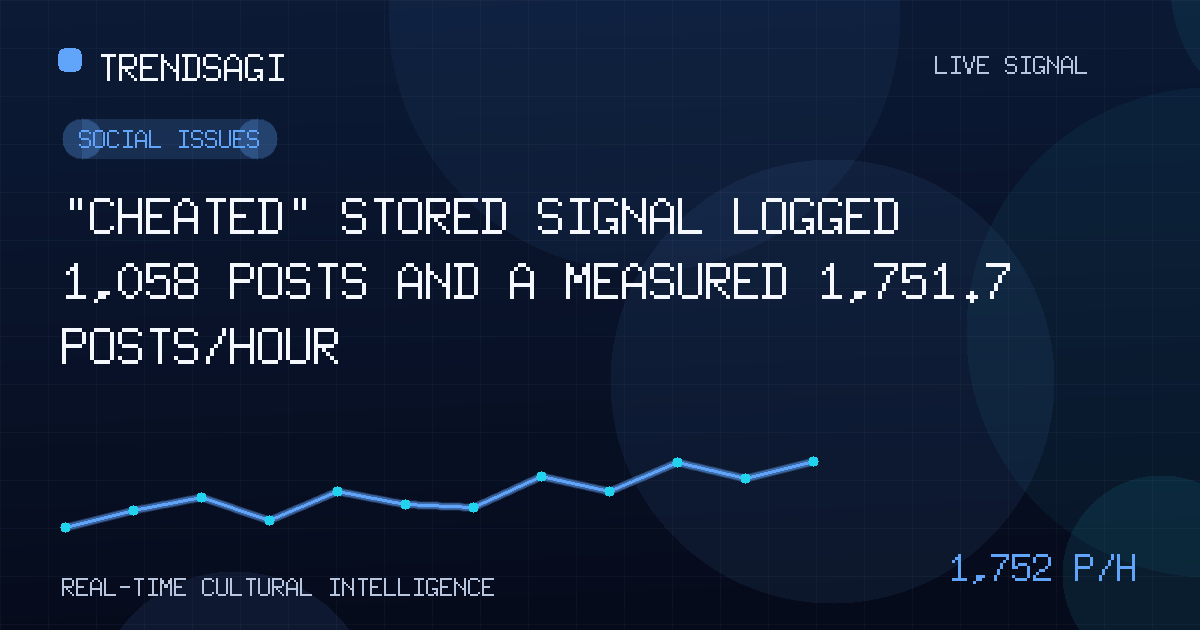
“Cheated” stored signal logged 1,058 posts and a measured 1,751.7 posts/hour
The stored “Cheated” signal logged 1,058 posts and a measured 1,751.7 posts/hour; the burst is clear, but its cause remains unverified.
Automated briefing. Generated from stored signal measurements and source-backed research; it is not manually reviewed. Read the methodology and limitations.
Metrics in this briefing are a snapshot associated with its publication date and may not reflect current conditions.
What changed
The stored “Cheated” signal shows a concentrated posting burst, with 1,058 posts in the latest snapshot. The firm conclusion is limited to the observed change in posting volume: the record does not identify a trigger, and no verified public context establishes why the label is moving. It would be premature to tie the burst to a particular controversy.
Across an exact 888-second window represented by 3 stored observations, the measured snapshot rate was 1,751.7 posts/hour. This describes the recorded interval only. It is not a live or current rate, forecast, reach, engagement figure, or unique-person count; 1,058 is a snapshot volume, not a second rate.
| Metric | Stored value |
|---|---|
| Observation time | 2026-09-25T22:51:51Z |
| Measured snapshot rate | 1,751.7 posts/hour |
| Measurement window | Exact 888-second window using 3 stored observations |
| Latest snapshot volume | 1,058 posts |
Why this topic may be moving
No verified public context accompanies the stored record, so no external trigger can be named responsibly. “Cheated” is also a broad label: it can describe an accusation involving a result, relationship, game, exam, or conduct. That semantic range makes a shared spike possible without a shared underlying story.
- A specific controversy may have supplied the trigger. Test this through repeated names, events, claims, and references rather than the label alone.
- The term may be ordinary slang or part of a joke. Generic posts can accumulate without referring to a common social issue.
- Unrelated conversations may have converged under the same label, producing volume without narrative unity.
- Duplicate, syndicated, or coordinated content may contribute. Repetition can amplify apparent activity, but the stored figures cannot distinguish those patterns.
The stored “Social Issues” category provides a filing label, but it does not prove that the posts share an issue, sentiment, or subject.
What the signal can—and cannot—establish
It can establish:
- The label, observation time, latest snapshot volume, and supplied measured snapshot rate.
- Posting concentration during the measured interval, although no normal baseline is supplied for comparison.
It cannot establish:
- A triggering event, dominant subject, geographic origin, or platform.
- Whether an allegation made in a post is true or disputed.
- Whether posts express agreement, criticism, humor, or neutral discussion.
- Whether participants are independent or whether content is duplicated or coordinated.
- Reach, unique authors, total public interest, persistence, or future activity.
A posting spike can reveal a new burst of conversation without revealing what prompted it. Volume is a reason to investigate, not a conclusion about the event—or about whether any allegation is true.
Why it matters
A broad label can make unrelated posts appear to be one social issue. The main risk is false attribution: readers may infer a scandal, consensus, or verified accusation that the stored signal does not show.
- Editors and fact-checkers should seek a named event and traceable source chain before explaining the movement.
- Trust and safety teams should inspect repetition, account behavior, and possible coordination before treating the volume as organic interest.
- Reputation and communications teams should avoid treating a keyword spike as confirmation that a named person or organization is involved.
- Researchers can use the signal as a detection prompt, but should not use it to estimate prevalence or public opinion without post-level evidence.
What to watch next
The next useful step is to turn the aggregate into an auditable sequence without assuming the cause is known.
- Classify the posts. Review available text from each stored observation and group claims by domain, named entity, stance, and whether “cheated” is literal, metaphorical, or generic.
- Check authenticity. Deduplicate identical text, links, and repeated account patterns, then look for near-duplicates that may have been copied into the sample.
- Trace provenance. Find the earliest substantive posts and follow citations or reposts to distinguish original discussion from downstream repetition.
- Test public context narrowly. Use a dated Google Search check for a contemporaneous event that matches the language and timing in the posts. A search result should not be treated as the trigger unless its publisher, event, and timing can be verified.
- Add a baseline and follow-up. Compare equivalent windows and determine whether later stored observations retain the measured rate, add original context, or quickly fade.
Concrete signals that would sharpen the explanation include:
- Repeated references to the same named event, allegation, or participants.
- Growth in distinct original posts rather than repeated wording or links.
- Verified public reporting that matches both the timing and the way the label is being used.
- A continued measured snapshot rate across later comparable windows.
- Persistent semantic diversity, which would favor a generic-label explanation over a single controversy.
Methodology and limitations
This briefing uses the supplied measurements without recalculating or transforming them. The measured snapshot rate applies to the exact 888-second window using 3 stored observations. The 1,058-post figure is reported separately as latest snapshot volume.
The record does not provide post text, a sampling frame, platform, collection query, geography, account information, duplicate handling, bot assessment, or comparison baseline. It therefore cannot support a population estimate, trend forecast, sentiment claim, or conclusion about organic participation. The increase also cannot be quantified relative to ordinary activity without a baseline.
Most importantly, volume does not validate allegations contained in posts. Until the content and timing converge on a verified event, the responsible conclusion is limited: the “Cheated” label produced a measured burst, and its cause remains unresolved.
Track This Topic for New Signals
Set alerts for future velocity or sentiment changes around this topic.
Explore Tracking PlansAbout TrendsAGI research
TrendsAGI's automated research pipeline publishes dated signal snapshots, methodology notes, and practical workflows for teams evaluating cultural momentum. Read how signals are scoped, scored, and limited in our research methodology.