905-second window · 3 observations · Measured Sep 25, 2026, 4:21 PM UTC · Provider: go_recent_snapshot_v2
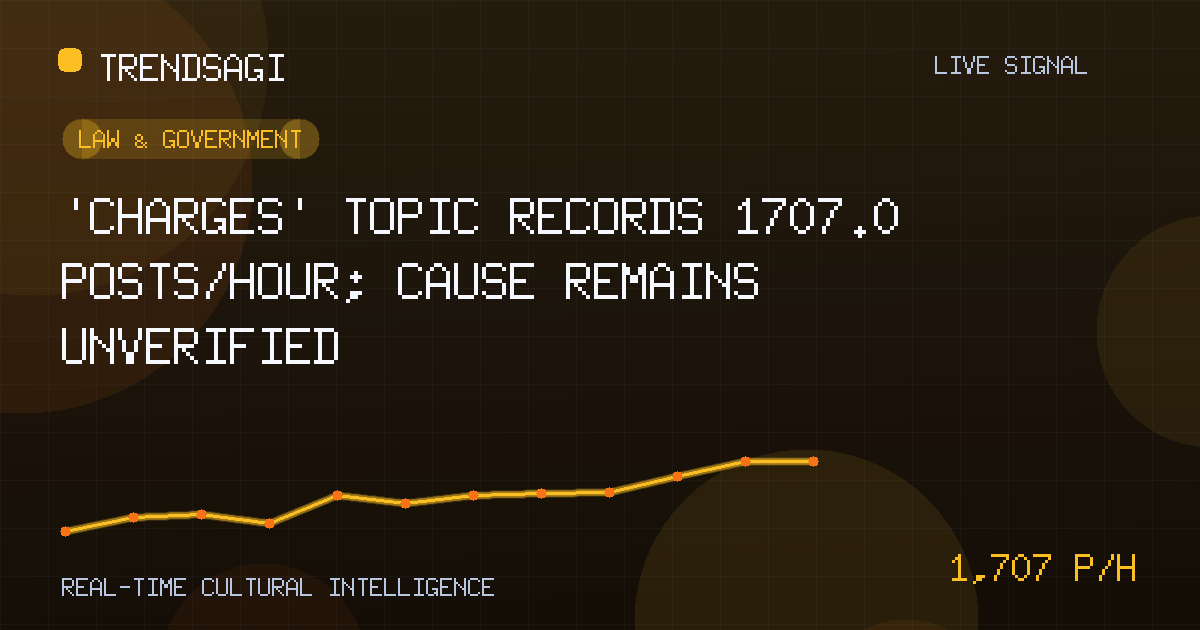
‘Charges’ topic records 1707.0 posts/hour; cause remains unverified
The “Charges” signal measures 1707.0 posts/hour over 905 seconds; this briefing separates the known change from its unverified cause.
Automated briefing. Generated from stored signal measurements and source-backed research; it is not manually reviewed. Read the methodology and limitations.
Metrics in this briefing are a snapshot associated with its publication date and may not reflect current conditions.
What changed
The latest record shows a measured snapshot rate of 1707.0 posts/hour for the broad topic “Charges,” but it does not establish why the topic is moving. The label and Law & Government category suggest a legal or government subject, yet neither identifies an event, jurisdiction, party, charge, or official action. It should not be read as confirmation of a specific case or development.
The measured snapshot rate is 1707.0 posts/hour over an exact 905-second window using 3 stored observations, measured at 2026-09-25T16:21:32Z. The latest snapshot volume is 3000 posts. This is a measured snapshot rate—not a live or current rate, forecast, reach, engagement level, or unique-person count—and the available record does not show what caused the change.
| Observation time | 2026-09-25T16:21:32Z |
|---|---|
| Measured snapshot rate | 1707.0 posts/hour |
| Snapshot volume | 3000 posts |
Why this topic may be moving
No verified public explanation accompanies the stored signal, so the cause remains unclear. “Charges” is also semantically ambiguous. It can refer to criminal or legal allegations, but it can also mean fees, electrical charge, product charge, and other concepts. Even within the stored category, one label may combine unrelated conversations. Without matched post text or named entities, those possibilities cannot be separated or ranked.
A breaking event is one hypothesis, not a finding. An official announcement, filing, court action, or political controversy could prompt discussion, but none is identified in the record. Short-window activity can also be influenced by repeated wording, a narrow group of accounts, or automated posting. The available observations do not show which explanation, if any, applies.
Before assigning a cause, an editor should determine whether “charges” is being used in the criminal or legal sense, whether one event dominates, and whether the rate reflects many distinct conversations or repetition. Until that check is complete, the safest description is broad topical activity with an unverified driver.
A topic label and a rapid posting rate can identify where attention is concentrated, but they cannot identify the event, jurisdiction, people, or allegations that produced it.
Why it matters
This rate is useful as a triage signal: it indicates where a verification queue may need to move quickly. It is not evidence about the merits of any allegation. For newsrooms, legal teams, public agencies, and communications staff, the immediate risk is misattribution—connecting generic posts about “charges” to an unrelated person, place, or proceeding.
Editors should avoid using the rate to imply public scale. The 3000 posts are a snapshot volume, not a count of people or proof of consensus. Legal discussion also carries reputational risk: what is alleged, what has been filed, and what has been adjudicated are different stages, and a topic aggregate cannot distinguish them.
Who should care most? Editors monitoring breaking legal and government news; organizations that may be named in a developing story; and teams responsible for reputation, policy, or public response. Each should first seek a post-level match tying the discussion to a specific event rather than acting on the label alone.
What the signal can—and cannot—establish
The stored record links a set of posts to the “Charges” label, shows that the latest snapshot contains 3000 posts, and reports a measured snapshot rate of 1707.0 posts/hour over 905 seconds. That makes the signal suitable for prioritization and follow-up.
It cannot establish the topic’s baseline, total conversation volume beyond the snapshot, direction after the observation, sentiment, accuracy, geographic scope, source diversity, or unique participation. It also cannot show whether the same post was reposted or whether multiple phrases contributed to the category. A short-window rate can arise from repeated actions rather than broad attention.
Most importantly, the signal cannot establish causation. A temporal coincidence between posts and a public event would still require matched text, credible reporting, or an official record. No public event is tied to the signal in the available record.
What to watch next
- Audit the 3000-post snapshot. Review the matched text, collection timestamp, query or classification rule, and account or post identifiers. Separate criminal and legal uses from fee, product, electrical, sports, and other meanings. Deduplicate reposts and note whether links or quotations point to one underlying event.
- Find the event anchor. Look for repeated names, places, case numbers, agencies, statutes, court dates, or a distinctive source phrase. If no stable entity or event appears, treat the signal as mixed-topic activity rather than a story lead.
- Test the distribution. Examine how early and late posts differ, how many distinct accounts participate, and whether a few accounts supply most of the volume. Then compare earlier and later stored windows. The current 905-second measurement is not a baseline, so a sustained pattern cannot be inferred from it alone.
- Verify externally with Google Search. Search for a clearly named event suggested by the post sample, then compare any official document or reputable report with the observed timing and wording. Search popularity, an unrelated result, or a similarly worded allegation is not verification.
- Watch for concrete confirmation. Relevant signals include an official record matching the terms and date, independent reputable reports describing the same event, continued movement in later snapshots, and clearer classification of the language. Also watch for a clarification that changes the legal meaning or identifies a different jurisdiction.
Methodology and limitations
The reported rate comes from 3 stored observations across an exact 905-second window and was measured at 2026-09-25T16:21:32Z. The latest snapshot contains 3000 posts. The rate is a measured snapshot rate only. It is not a live or current rate, forecast, total conversation size, reach, engagement, or unique-person count.
Because the record does not provide post-level examples, collection logic, a comparison baseline, account distribution, or verified public context, it cannot explain why the topic moved. The appropriate editorial conclusion is narrow: measured short-window activity was recorded under an ambiguous label, and the cause remains unverified.
Track This Topic for New Signals
Set alerts for future velocity or sentiment changes around this topic.
Explore Tracking PlansAbout TrendsAGI research
TrendsAGI's automated research pipeline publishes dated signal snapshots, methodology notes, and practical workflows for teams evaluating cultural momentum. Read how signals are scoped, scored, and limited in our research methodology.